Our Top Picks
A tempered glass desk chair mat is worth buying if you want a mat that never dents, curls or yellows and you are willing to pay roughly three to six times the price of plastic and handle a 25–60 lb panel during setup. It works on both carpet and hard floors, it rolls more easily than any vinyl mat, and it can outlast several chairs. The trade-offs are weight, price, a hard edge that you will notice with bare feet, and the fact that you cannot trim it to fit around a desk leg.
How glass compares with PVC and polycarbonate
Most chair mats fall into three material groups. The table below shows how they behave over years of daily use, not just on day one.

Lorell Tempered Glass Chairmat, 48" Width x 60" Depth x 0.25" Thickness, Clear, 1 Each
Chosen because it specifies 48" Width x 60" Depth x 0.25" Thickness and Clear.
View on Amazon
Lorell Tempered Glass Chairmat with Lip, 45" x 53", Clear, 1 Each
Chosen because it specifies 45" x 53" and Clear.
View on Amazon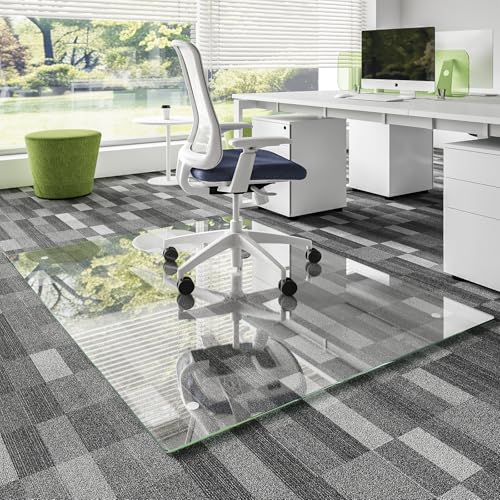
Koonmi Glass Chair Mat for Carpet, 46"x60" Thick Office Chair Mat
Chosen because it specifies 46"x60" Thick Office Chair Mat.
View on Amazon
Azadx Tempered Glass Chair Mat for Carpet 32" x 48" Heavy Duty Chair Mat
Picked as a relevant option in this category.
View on Amazon| Factor | Tempered glass | Polycarbonate | PVC / vinyl |
|---|---|---|---|
| Typical thickness | 1/5 in (5 mm) to 1/4 in (6 mm) | about 1/8 in (2–3 mm) | 1/10 to 1/8 in |
| Weight of a 36 x 48 in mat | about 30–39 lb | about 8–12 lb | about 6–10 lb |
| Caster dimpling | None | Slight over years | Common within months on carpet |
| Curling and cracking | Does not curl | Rarely | Edges curl; cracks in cold rooms |
| Yellowing | None | Low | Moderate |
| Works on medium-pile carpet | Yes, stays flat | Yes with cleats | Flexes and cracks |
| Typical price range | usually $150–$400 | usually $50–$150 | usually $25–$60 |
| Realistic lifespan | 10+ years | 5–10 years | 1–3 years |
The weight column is the one people underestimate. Quarter-inch glass runs about 3.3 lb per square foot, so a 46 x 60 in mat is close to 60 lb. That stability is exactly why glass stays put on carpet without spikes, but it also means one person can struggle to slide it under a desk without help.
Picking the right size
A chair mat should cover the whole area your casters travel, not just the spot under the seat. Measure with the chair at your normal sitting distance, then push back as you would when standing up. Most people roll 24–30 in behind the desk edge.
| Desk setup | Suggested mat size | Approx. weight at 1/4 in |
|---|---|---|
| Compact desk, under 48 in wide | 36 x 46 in or 36 x 48 in | 37–39 lb |
| Standard 48–60 in desk | 40 x 50 in or 44 x 50 in | 45–50 lb |
| 60–72 in desk, frequent side-to-side rolling | 46 x 60 in | about 62 lb |
| L-shaped or corner desk | Large square or two-zone layout, 50 x 50 in and up | 55 lb and up |
Leave about 1–2 in between the mat and the desk legs or modesty panel so you are not trying to wedge a rigid sheet into a gap. Glass cannot be notched at home, so if your desk has a center leg or an L-return, choose a rectangle that sits entirely in front of the obstruction rather than a lipped shape.
Floor type: where glass helps most
Carpet
Glass shines on low and medium-pile carpet up to roughly 1/2 in deep. Because it is rigid, it spreads the chair load over the full panel instead of letting casters sink, so the mat does not form a bowl the way vinyl does. On deep or plush carpet over 3/4 in, the panel can rock slightly at the corners; most glass mats ship with small clear bumpers, and those reduce rocking but do not eliminate it.
Hardwood, laminate, tile and vinyl plank
On hard floors, the main job is protecting the finish from grit trapped under casters. Glass mats use soft rubber or silicone pads on the underside, which keeps the panel from scratching the floor. Lift the mat once or twice a year to wipe underneath, because fine dust between pads and floor can act like sandpaper if the mat shifts.
Heated floors and sunny spots
Tempered glass handles radiant floor heat and direct sun without warping, which is a common failure point for PVC near a window. It does not trap moisture the way a solid rubber backing can, though the bumper pads should be left in place to allow airflow.
What the mat actually feels like day to day
- Rolling: Casters move with very little effort. If your chair already slides too freely, look for rubber or polyurethane “rollerblade” style wheels so the chair does not drift when you lean.
- Sound: Hard nylon casters on glass produce a light rumble. Soft-tread casters make it noticeably quieter, which matters in apartments with downstairs neighbors.
- Look: Clear glass shows the floor through it, so it disappears visually on good hardwood or patterned rugs. Frosted and tinted versions hide dust and fingerprints better.
- Edges: Good mats have polished, slightly rounded or beveled edges. The step from floor to mat is only about 1/4 in, but bare toes do find it.
- Cleaning: Standard glass cleaner and a microfiber cloth. Hair and dust collect around the caster path and are easy to see on clear glass.
Safety and durability realities
Tempered glass is roughly four times stronger than ordinary annealed glass of the same thickness, and if it does break it crumbles into small, blunt pieces rather than long shards. Normal chair use, including a heavier user and a big-and-tall chair, is well within what a 1/4 in panel handles; many makers quote load ratings of several hundred pounds spread across the surface.
The real risks are edge impacts and point loads. Dropping a heavy object such as a cast-iron dumbbell on a corner, or catching an edge against a door frame while carrying it, is how glass mats get damaged. Once installed and lying flat on the floor, they are very resistant. During setup:
- Clear a path and measure doorways; a 46 in wide mat carried flat needs to be tilted on its long edge through a standard 30–32 in door.
- Carry it vertically with two people and gloves for grip. Never carry it flat by one corner.
- Lower it onto the floor along one long edge, then ease it down. Do not let it slap down onto the carpet.
- Attach the bumper pads before laying it flat if they did not come pre-installed.
- Roll the chair on, check for rocking, and move pads slightly if a corner lifts on carpet.
Keep the shipping crate until you are sure the panel is undamaged. Shipping is when most chips happen, and makers typically ask for photos within a short window after delivery.
Who should buy glass, and who should not
| Your situation | Better choice | Why |
|---|---|---|
| You have replaced cracked or dented vinyl mats more than once | Glass | Pays for itself over two or three plastic replacements |
| Medium-pile carpet and a heavier user | Glass | No sinking or bowl shape under the seat |
| Renter who moves every year or two | Polycarbonate | Light, rolls up or stacks easily, still durable |
| Irregular desk shape needing a cutout | Polycarbonate or PVC | Can be trimmed; glass cannot |
| Small children who play under the desk | Either glass or polycarbonate | Glass is safe once flat, but supervise during setup |
| Tight budget, light use | PVC | Fine for a few hours a week on hard floors |
What to look for when comparing glass mats
- Thickness: 1/4 in is the safer choice for carpet and heavier users; 1/5 in saves some weight for hard floors.
- Labeled as tempered: Look for wording that the glass is fully tempered, not just “toughened” or “heavy”.
- Edge finish: Polished and rounded or beveled corners rather than sharp square ones.
- Underside pads: Clear, non-marking pads, ideally with spares in the box.
- Finish options: Clear, frosted, or tinted to match the room. Brands such as Vitrazza focus specifically on glass chair mats and offer several sizes and finishes.
- Return and breakage policy: Because of the shipping weight, check what happens if the panel arrives chipped.
Quick answers
Will a glass chair mat crack under an office chair?
Not under normal sitting and rolling. Tempered panels are designed for that load. Damage comes from dropped objects, edge strikes during moving, or setting it on an uneven surface such as a floor vent.
Does it need to be anchored on carpet?
No. The weight keeps it in place, which is why glass mats do not need the spiked cleats that plastic carpet mats rely on.
Can I use it under a standing desk?
Yes. Many people stand on the glass with an anti-fatigue mat on top when standing and move the anti-fatigue mat aside when sitting. Just check that the desk legs are outside the mat footprint so the frame moves freely.