Our Top Picks
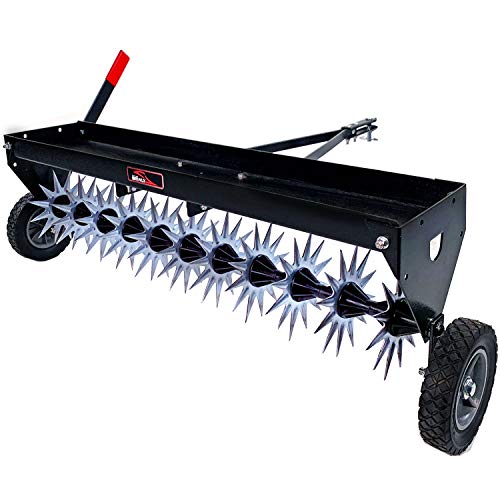 Brinly SAT2-40BH-P Tow Behind Spike Aerator with Transport8" x 1.75"26 x 46.5 x 24.25 inchesCheck on Amazon
The best tow behind lawn aerators for most lawns are plug (core) models with a weight tray, such as the Agri-Fab 48 In, the Brinly PA-482BH-A2 or the Craftsman 40 Inch, because pulling real plugs of soil relieves compaction in a way spikes cannot. A spike aerator such as the Brinly SAT2-40BH-P or the VEVOR 32 in costs less and suits loose, sandy soil or light maintenance. This guide ranks seven tow-behind aerators, explains when core beats spike, and shows how to load the weight tray.
Key takeaways
- Plug (core) aerators remove small cores of soil. Spike aerators punch holes and push soil aside. Core is the usual recommendation for clay and heavily used lawns; spike can help on sandy soil with light compaction.
- Tow-behind aerators need weight. Fill the tray with concrete blocks, sandbags or water-filled containers so the tines can penetrate. Many guides suggest around 150 pounds or more, but check the label for your model.
- Aerate when the grass is actively growing: early fall for cool-season lawns, late spring to early summer for warm-season lawns.
- A tow-behind unit suits half an acre and up. On smaller lawns, a walk-behind or a rental is usually cheaper.
Best tow behind lawn aerators at a glance
| Pick | Type | Width | Tines / knives | Best for |
|---|---|---|---|---|
| Agri-Fab 48 In | Plug | 48 in. | 32 galvanized knives | Large lawns |
| Agri-Fab 40 In | Plug | 40 in. | 24 galvanized coring knives | Mid-size lawns |
| Brinly PA-482BH-A2 | Plug | 48 in. | Check listing | Brand-name alternative |
| Craftsman 40 Inch | Plug | 40 in. | 24 galvanized steel coring points | Includes a 140 lb weight tray |
| Doniks 48-Inch | Plug | 48 in. | 30 galvanised steel tines | Inflatable wheels on rough ground |
| Brinly SAT2-40BH-P | Spike | 40 in. | Check listing | Light maintenance, transport wheels |
| VEVOR 32 in Spike | Spike | 32 in. | Check listing | Narrow paths and small tractors |
We did not personally use these aerators. The picks are drawn from product listings, maker descriptions and general lawn-care guidance. Where a listing does not state a spec, the table says “check listing”.
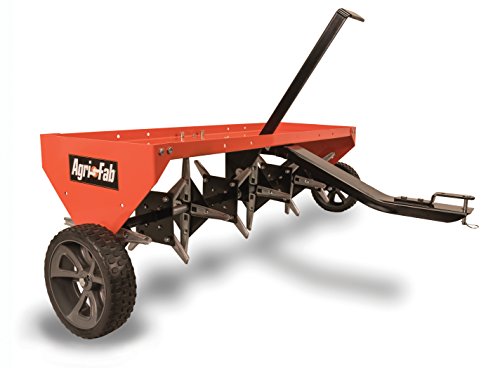
Agri-Fab 48 In Tow Behind Lawn Plug Aerator with 32 Galvanized Knives and Universal Hitch
Picked as a relevant option in this category.
View on AmazonBrinly SAT2-40BH-P Tow Behind Spike Aerator with Transport Wheels, 40" - Hammered Black
Chosen because it specifies 40" and Hammered Black.
View on Amazon
Agri-Fab 40 In Tow Behind Lawn Plug Aerator with 24 Galvanized Coring Knives and Universal Hitch
Picked as a relevant option in this category.
View on Amazon
BlumeTrec 40-Inch Tow Behind Spike Aerator, Pull Behind Lawn Aerator with 10 Galvanized Steel Tines for Aerating Lawns, Soil Penetrator Spikes Tractor with Wheels, Extra-Wide Tow Bar for Garden & Farm
Chosen because it specifies Soil Penetrator Spikes Tractor with Wheels and Extra-Wide Tow Bar for Garden & Farm.
View on AmazonCore vs spike: which tow-behind aerator do you need?
Both types make holes, but they work differently, and that difference matters more than width or brand.
| Question | Plug (core) aerator | Spike aerator |
|---|---|---|
| What it does | Pulls out small soil plugs | Punches holes, removes nothing |
| Best soil | Clay and compacted soil | Sandy or loose soil with mild compaction |
| Compaction relief | Strong | Limited, and repeated spiking can compact the sides of the holes |
| Weight needed | Usually a loaded tray | Tray helps with penetration |
| Cleanup | Plugs left on the lawn to break down | None |
| Typical cost | Higher | Lower |
If you only remember one thing: core for tough soil, spike for light touch-ups. A 40 inch spike model can list a penetration of about two inches, while plug models list plugs of around three inches, though results depend on soil moisture and the weight you load.
1. Agri-Fab 48 In Plug Aerator: Best for large lawns
- Agri-Fab 48 In Tow Behind Lawn Plug Aerator with 32 Galvanized Knives and Universal Hitch
- 48 in. working width · 32 galvanized knives · universal hitch
- Plug (core) design
- Check the listing or maker page for tray details and capacity
Best for: lawns of half an acre or more where you want to finish quickly.
Skip if: your tractor is small or your gates are narrow.
Pros
- 32 knives across 48 inches means a tight hole pattern.
- Galvanized steel resists rust.
- Universal hitch fits most tractors.
- Trusted name in tow-behind tools.
Cons
- Costs more than spike models and imports.
- Wide frame is hard to store.
2. Agri-Fab 40 In Plug Aerator: Best mid-size core aerator
- Agri-Fab 40 In Tow Behind Lawn Plug Aerator with 24 Galvanized Coring Knives and Universal Hitch
- 40 in. working width · 24 galvanized coring knives
- Universal hitch
- Plug (core) design
Best for: lawn tractors with a narrower footprint and lawns of a quarter to half an acre.
Skip if: you want the widest coverage per pass.
Pros
- Fits narrower gates than 48 inch units.
- Similar knife density to the 48 inch model.
- Same maker and hitch system.
Cons
- More passes than a 48 inch aerator.
- Requires adding your own weight to the tray.
3. Brinly PA-482BH-A2: Best name-brand 48 inch alternative
- Brinly PA-482BH-A2 Tow Behind Plug Aerator with Universal Hitch, 48″
- 48 in. width · plug design · universal hitch
- Matte black finish
- Tine count and tray capacity are not stated in the listing text
Best for: shoppers loyal to Brinly or matching other Brinly implements.
Skip if: you want a spec-by-spec comparison from the listing; confirm tine count on the maker page.
Pros
- Same 48 inch width as the Agri-Fab.
- Well-known attachment brand.
- Plug design for core aeration.
Cons
- Sits near the top of this list on cost.
- Listing details are sparse.
4. Craftsman 40 Inch: Best with a 140 lb weight tray stated
- Craftsman 40 Inch Tow Behind Lawn Plug Aerator
- 40 in. width · 24 galvanized steel coring points
- 140 lb weight tray, per the listing
- Plug design
Best for: shoppers who want a stated weight tray capacity and a familiar badge.
Skip if: you need a wider frame than 40 inches.
Pros
- Listing states the tray capacity.
- 24 coring points across 40 inches.
- Galvanized steel points resist rust.
Cons
- 140 lb is near the low end of what many guides recommend for deep penetration.
- Narrower than the 48 inch options.
5. Doniks 48-Inch: Best with inflatable wheels
- Doniks 48-Inch Tow Behind Lawn Plug Aerator with Universal Hitch
- 48 in. width · 30 galvanised steel tines
- Weight tray and inflatable wheels
- For gardens, lawns and farms, per the listing
Best for: bumpy lawns and paddocks where air-filled wheels give a smoother ride.
Skip if: you prefer a flat-free wheel setup.
Pros
- Inflatable wheels absorb bumps.
- 30 tines across 48 inches.
- Tray for ballast.
Cons
- Less established brand; check warranty terms.
- Tires need a pressure check before use.
6. Brinly SAT2-40BH-P: Best spike aerator with transport wheels
- Brinly SAT2-40BH-P Tow Behind Spike Aerator with Transport Wheels, 40″
- 40 in. width · spike design
- Transport wheels, per the listing
- Hammered black finish
Best for: light aeration on loose soil and quick maintenance passes.
Skip if: you have clay or a heavily compacted lawn; core aeration is better there.
Pros
- Transport wheels let you move it without dragging the spikes.
- Lower cost than plug models of similar width.
- No plugs to clean up.
Cons
- Spikes can add compaction around the holes in clay.
- Check the listing for a tray and its capacity.
7. VEVOR 32 in Spike: Best narrow spike aerator for small tractors
- VEVOR Tow Behind Lawn Spike Aerator, 32 in with Universal Hitch
- 32 in. width · universal hitch
- Folded edge tray · rust-resistant, per the listing
- Made for farmland and garden tractors
Best for: narrow paths, compact tractors and anyone who wants a very low-cost spike tool.
Skip if: you need to cover more than a small lawn in one afternoon.
Pros
- Narrow 32 inch frame fits through tight gates.
- Folded edge tray holds weight.
- Among the lowest-priced tools here.
Cons
- Narrow, so more passes.
- Spike design is less effective on hard soil.
Also consider
- Garvee 48 in Tow Behind Core Aerator: 48 in. width · heavy-duty pull-behind plug aerator. A budget plug design.
- YINTATECH 48 Inch Plug Aerator: 32 galvanized steel tines · tray · inflatable wheels · universal hitch. A direct competitor to the Agri-Fab 48.
- VEVOR Tow Behind Plug Aerator 40 in: 150 lb weight capacity · tray · 10.6 in. wheels. A budget 40 inch option.
- BlumeTrec 40-Inch Spike Aerator: 10 galvanized steel tines · wheels · extra-wide tow bar. A spike alternative.
How we chose these tow behind lawn aerators
We did not personally use any of these. Our process:
- Tow-behind (pull-behind) designs only, for tractors, zero-turns, ATVs and UTVs.
- Plug and spike designs, labelled clearly, with plug models ranked first.
- Stated width and a tine or knife count wherever the listing gives one.
- No more than two models per brand.
- No used or parts listings.
- Specs only from the listing text; missing specs are flagged.
Lawn-care guidance comes from university extension pages, Lawn Love and consumer lawn guides.
Buying guide: how to choose a tow-behind lawn aerator
Step 1: decide core or spike
For clay soil, heavy foot traffic, or a lawn that sheds water, choose plug. For sandy soil with light compaction, a spike aerator may be enough for yearly maintenance. If you are unsure, push a screwdriver into the soil after rain. If it goes in easily, compaction is mild. If it will not, you likely need cores.
Step 2: pick a width by tow vehicle and gate
| Lawn size | Tow vehicle | Suggested width |
|---|---|---|
| Quarter acre | Small lawn tractor | 32 to 40 in. |
| Half acre | Lawn tractor or zero-turn with hitch | 40 to 48 in. |
| One acre or more | Large tractor or ATV | 48 in. |
Step 3: plan the weight tray
A tow-behind aerator gets its bite from added weight. Many guides recommend 150 pounds or more in the tray. Fill it with concrete blocks, sandbags or water containers, and spread the weight evenly. Check the maker’s limit; the Craftsman 40 Inch lists a 140 lb tray and some 40 and 48 inch models list capacities above 150 lb. Too little weight and the tines skate across the surface. Too much and you risk overloading the frame or your tractor.
Step 4: check the hardware
- Galvanized steel tines resist rust.
- Inflatable wheels ride smoother, but need air.
- Transport wheels or lock pins allow you to lift tines for travel.
- Universal hitch pairs with most lawn tractors; verify the height.
Step 5: time the job
- Aerate when the grass is growing: early fall for cool-season lawns, late spring to early summer for warm-season lawns.
- Water the lawn lightly a day before, so the soil is moist but not soggy.
- Mark sprinkler heads, shallow lines and buried pipes.
- Make passes in two directions for heavy compaction.
- Leave plugs on the lawn to break down, or rake them if you prefer.
- Overseed and fertilize after aerating, following product labels.
How to load the weight tray
An empty tow-behind aerator mostly slides over the ground. Weight is what drives the tines in. Spread it evenly across the tray and centered over the axle so the frame does not tip. These are common loading materials with rough weights; confirm what your tray allows.
| Material | Approximate weight each | Notes |
|---|---|---|
| Standard hollow concrete block | About 30 lb | Four to five blocks gets near 150 lb; they stack neatly |
| 50 lb bag of sand or gravel | About 50 lb | Easy to size the load; keep bags from splitting |
| One gallon water jug | About 8.3 lb | Need many jugs; good for fine adjustment |
| Paving stone | Varies by size | Check weight on the label |
Start light, make a short pass, then check the holes. If the plugs are shallow, add weight a block at a time. If the frame bounces or the tractor labors, remove some. Always stay within the aerator maker’s limit and your tractor’s towing guidance.
Aeration depth and spacing: what to expect
Core aeration is not about a single number; it is about how many holes you make and how deep they go. Listings often show tine counts and widths but rarely the resulting pattern. A rough comparison helps you set expectations.
| Size | Tines or knives | Width divided by tines | What it means |
|---|---|---|---|
| 40 in. plug | 24 | About 1.7 in. | Dense pattern per pass |
| 48 in. plug | 30 to 32 | About 1.5 to 1.6 in. | Dense pattern, wide coverage |
| 32 in. spike | Check listing | Check listing | Fewer holes per pass |
Real hole spacing also depends on how many tines sit on each row and how fast you drive. Slow, steady passes put more holes in the ground. Two passes at right angles roughly double the density, which is why many guides suggest crossing passes on stubborn soil.
Prepare the lawn before you aerate
- Mow slightly shorter than usual, then leave the clippings off the lawn.
- Water a day or two ahead so the soil is moist. Very dry soil resists tines; soggy soil clogs them.
- Flag hazards. Mark sprinkler heads, shallow irrigation lines, invisible dog fence wires and septic covers.
- Check the weight in the tray and confirm your hitch height.
- Walk the area and pick up sticks, rocks and toys.
Aftercare timeline
The days after aeration matter as much as the pass itself. Here is a simple timeline.
- Day 0: leave the plugs on the lawn. Overseed and spread fertilizer if the label allows it.
- Days 1 to 7: water lightly so holes and seed stay moist. Avoid heavy traffic.
- Weeks 2 to 3: plugs break down. Mow at the usual height once the new seed is established.
- Next season: repeat if soil is still compacted.
Common aerator mistakes
- Towing an empty frame. Without weight, tines skate and make shallow marks.
- Aerating dry, hard soil. Water first.
- Cutting sprinkler lines. Mark them before you start.
- Going too fast. A fast pace skips holes and bounces the frame.
- Aerating a dormant lawn. The grass cannot recover or fill gaps.
- Leaving tines in the ground when reversing. Lift or use the transport wheels.
Lawn aerator guide: where aeration fits in a fall renovation
Aeration is one step in a larger routine. If you plan to dethatch, overseed and feed in the same weekend, the order affects results.
- Dethatch first if your thatch layer is over about half an inch, and rake or sweep the debris away.
- Aerate second, so the tines can reach clean soil and the holes are not clogged by loose thatch.
- Overseed third, because seed falls into the holes and has good contact with soil.
- Fertilize and water following the product labels.
- Roll or leave alone. A light roller pass is optional and only on moist soil.
Each step uses a different tool, so a tractor owner who already has one tow-behind attachment can add the next one next season. Our guides on tow-behind dethatchers and lawn rollers cover those.
Care and storage for a tow-behind aerator
After each use, wash off packed soil and grass from the tines and the tray. Dry the metal, check for bent tines and loose bolts, and touch up bare steel with rust-inhibiting paint if it is chipped. Galvanized parts resist rust but are not immune. If your model has inflatable wheels, check the pressure before you start. Store the unit upright against a wall if possible, or cover the tines so no one steps on them. Remove ballast before you store it, because weight left in the tray stresses the axle over time.
Lawn aeration cost: should you buy or hire?
Lawn aeration cost depends on lawn size, region and method. Professional services usually price by area, with core aeration costing more than spike, and many companies set a minimum charge for small lawns. Renting a core aerator by the day is common, though rental fees and deposits vary. A tow-behind unit that you own eliminates those recurring costs, and many guides say that if you aerate every year, a unit can pay for itself within a couple of seasons.
- Buy if your lawn is half an acre or more and you aerate each year.
- Rent if you only need it once, or you do not own a tractor.
- Hire if your yard is small, you lack storage, or you want a pro to handle it.
Check local quotes and rental prices for current figures, since they change.
Frequently asked questions
What is the best tow behind lawn aerator?
For compacted or clay soil, a plug aerator like the Agri-Fab 48 In or the Brinly PA-482BH-A2. For light maintenance on loose soil, a spike model like the Brinly SAT2-40BH-P.
Is a spike aerator any good?
It can help with light compaction in sandy soil. In clay, repeated spiking can compact the sides of the holes, so core aeration is usually preferred.
How much weight do I need in the tray?
Many guides suggest around 150 pounds or more, but follow the label for your model and your tractor’s limits.
How often should I aerate?
Once a year for heavy-traffic or clay lawns. Every two or three years may be enough for lawns with light use.
Do I need to remove the plugs?
No. They break down on the lawn within a couple of weeks.
Can I aerate and overseed at the same time?
Yes, and it is a good time to do it. Seed has good contact with soil after aerating. Follow the seed label.
Will a tow-behind aerator work with a zero-turn mower?
Often yes, if the mower has a rear hitch and the maker approves towing. Check the manual.
Which one should you buy?
- Large lawns: Agri-Fab 48 In or the Brinly PA-482BH-A2.
- Mid-size lawns: Agri-Fab 40 In or Craftsman 40 Inch.
- Bumpy ground: Doniks 48-Inch, for the inflatable wheels.
- Light maintenance on loose soil: Brinly SAT2-40BH-P or VEVOR 32 in.
Choose core if you can, add weight to the tray and aerate when the grass is growing.
If two models look equal, let storage and ground conditions break the tie. A narrower frame wins when gates are tight. Inflatable wheels win on bumpy ground, while solid wheels win if you dislike checking tire pressure. A tray with a stated capacity is easier to load correctly than one with no number at all. And if you are torn between buying and borrowing, borrow once: a single season of aerating with a neighbor’s unit will tell you whether you will use your own enough to justify the shed space.
Sources
- Product listings and maker pages for each model named
- Lawn Love
- University extension lawn-care publications
- Family Handyman
Last updated: November 2026
More from Amazon
Programs that pair well with the guide above. Offers and eligibility are set by Amazon and may change.
Collect the home and kitchen items you want in one registry that guests can shop from.
Create a wedding registrySet up recurring deliveries of everyday items on eligible products. Terms and savings are set by Amazon.
Explore Subscribe & SaveFree shipping on eligible items, Prime Video and more. Eligible new members can start with a free trial.
Start a Prime free trialAudiobooks and podcasts to listen to on the go. Eligible new members can start with a free trial.
Try Audible freeAs an Amazon Associate we earn from qualifying purchases.