Our Top Picks
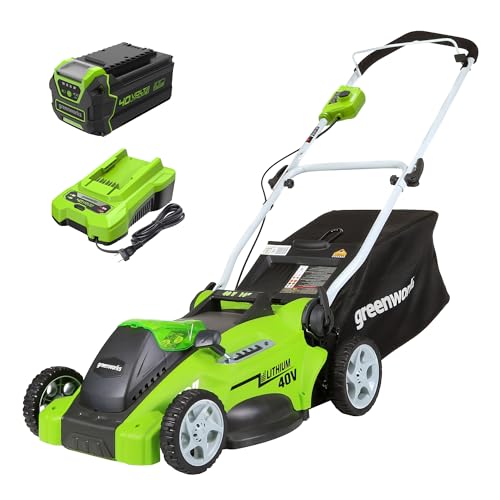 Greenworks 40V 16in Push Lawn Mower16" Cordless (4.0Ah)50.79 x 18.9 x 38.98 inches37.5 PoundsCheck on Amazon
 Greenworks 60V 21in Self-Propelled Lawn Mower21"SP w/2 x 4.0Ah Batteries68.89 x 25.63 x 42.12 Inches65.04 PoundsCheck on Amazon
The best lawn mowers depend mainly on yard size and how you feel about gasoline: a 21 to 22-inch gas self-propelled mower suits large flat lawns, a 16-inch battery push mower suits small ones, and the 60V self-propelled models cover the gap for gas-free large-lawn mowing. Ten listings are sorted below by what their titles state.
Top picks at a glance
Greenworks 40V 16in Push Lawn Mower, 4.0 Ah Battery and Charger | Quiet walk-behind mower with push-button start; gas-free operation eliminates fumes and pull starts
One of the home product options compared in this guide.
View on Amazon
MZK 40V 16-Inch 2-in-1 Lawn Mower, Brushless Cordless Push Mower | Brushless mower with 5 height positions and dual batteries for walk-behind mowing in yards and home lawns.
One of the home product options compared in this guide.
View on AmazonGreenworks 60V 21in Self-Propelled Lawn Mower, (2) 4.0 Ah Battery Kit | Brushless motor with 4-in-1 system; self-propelled drive handles up to 3/4 acre with quiet operation for large yards.
One of the home product options compared in this guide.
View on Amazon
Cordless Lawn Mower, 17-Inch Walk Behind Lawn Mower for Garden | 6-Position Height, 50L Grass Bag, 2×4.0Ah Batteries, Up to 40-Min Runtime, 1200W Max Brushless Power
One of the home product options compared in this guide.
View on Amazon
BILT HARD 201cc Push Lawn Mower, 3-in-1 Gas Lawnmower 21 Inch with 4-Cycle Engine, Bagging, Mulching and Side Discharge, Adjustable 10-Positions Cutting Height, Easy Start
One of the home product options compared in this guide.
View on Amazon
YARDMAX 22 in. 201cc Select PACE 6 Speed CVT High Wheel FWD 3-in-1 Gas Walk Behind Self Propelled Lawn Mower, Black (YG2860)
One of the home product options compared in this guide.
View on Amazon
SENIX 201cc 22" 3-in-1 Variable Speed Self Propelled Gas Lawn Mower | Self Propelled Lawn Mower, 22" Self Propelled Gas Lawn Mower, 6 Height Adjustable
One of the home product options compared in this guide.
View on Amazon
EGO Power+ Electric Lawn Mower, Cordless Push, Includes 56V 4.0Ah Battery and Charger - LM2112
One of the home product options compared in this guide.
View on Amazon
Greenworks 60V 25in Self-Propelled Lawn Mower, (2) 4.0 Ah Battery Kit | Self-propelled mower with 70-min runtime and LED headlight; handles up to 3/4 acre for large property maintenance.
One of the home product options compared in this guide.
View on Amazon
PowerSmart EasyCut 18-Inch Gas Lawn Mower, 144cc 4-Cycle Engine, Walk-Behind Push Lawn Mower, Side Discharge, 5-Position Height Adjustment, Ideal for Small Yards
One of the home product options compared in this guide.
View on Amazon| Model | Key point from title | Price tier | Best for |
|---|---|---|---|
| PowerSmart EasyCut 18-Inch Gas | 144cc 4-cycle, side discharge, 5 heights | Budget | Small yards on a budget |
| Greenworks 40V 16in Push | Push-button start, battery and charger | Mid-range | Small, quiet, gas-free lawns |
| MZK 40V 16-Inch 2-in-1 | Brushless, dual batteries | Budget | Value battery shoppers |
| 17-Inch Cordless Walk-Behind | 2×4.0Ah, 50L bag, up to 40 min claimed | Budget | Mid-sized yards on a budget |
| EGO Power+ LM2112 | 56V 4.0Ah battery and charger | Premium | Higher-voltage preference |
| BILT HARD 21-Inch Gas Push | 201cc, 3-in-1, 10 heights | Mid-range | Medium flat lawns |
| YARDMAX YG2860 | 22in, 201cc, six-speed self-propelled | Mid-range | Large or sloped lawns |
| SENIX 22-Inch Self-Propelled | 201cc, variable speed, 6 heights | Mid-range | Comparable alternative to YARDMAX |
| Greenworks 60V 21in Self-Propelled | Brushless, 4-in-1, two batteries | Premium | Gas-free large lawns |
| Greenworks 60V 25in Self-Propelled | 70 min claimed, LED headlight | Premium | Largest battery deck |
Trends shaping lawn mowers right now
Two worlds sit side by side in this set. Gas mowers remain the default for large lawns because refueling is quick and runtime does not depend on a battery, while battery mowers keep improving as lithium-ion packs and brushless motors mature. Many buyers now choose by hassle: no oil changes and no pull cords on one side, no charging limits on the other.
Self-propelled drive has spread beyond gas machines, with battery models now offering it at higher price tiers. Variable-speed drives, found on the YARDMAX and SENIX listings, let the mower adapt to walking pace. Dual-battery bundles and 3-in-1 or 2-in-1 clipping systems are common selling points.
Marketing language, however, runs ahead of proof. Words like quiet, powerful and up to three-quarters of an acre are seller claims. Also keep in mind that emissions rules and noise ordinances differ by area, so check local requirements before choosing.
Another shift is in how shoppers weigh total effort. A few years ago, price and engine size dominated; today many readers ask about storage, noise at 7 a.m. on a Saturday, and whether they will remember to winterize a gas engine. Battery platforms also tempt owners to buy into one brand for trimmers and blowers, which changes the math on a mower purchase. Hedged as general observations rather than measured data, these patterns explain why the set mixes both power sources: neither wins every yard.
How we picked these
We worked from the product titles, seller descriptions, published specifications, manufacturer documentation and buyer reviews. Nobody on the team used or measured these units. When a title leaves something out, we say so and point you to the listing. Price tiers are relative within the ten and are not prices. Spec claims in titles, such as runtime, wattage and acreage, are the seller’s own, and a few titles are ambiguous or sparse, which we flag where it happens. The picks are grouped by what the listing states rather than ranked by performance, because nothing here was measured by us. Use the list to shortlist two or three models, then read the full product page and manual before buying.
The ten lawn mowers in detail
PowerSmart EasyCut 18-Inch Gas Lawn Mower
The title describes an 18-inch walk-behind push mower with a 144cc 4-cycle gas engine, side discharge and five height positions, pitched at small yards. It is the lowest-displacement gas engine in this set and the only gas model whose title does not mention bagging or mulching.
A 4-cycle engine generally runs on plain gasoline with a separate oil sump, so there is no fuel-oil mixing, but the owner still handles fuel, oil, spark plug and air filter upkeep. Side discharge throws clippings out of the deck, which suits frequent mowing of short grass and not a tidy bagged finish.
Who it suits: Owners of small to moderate lawns who want a low-cost gas machine with no battery to charge and who are comfortable with basic engine maintenance.
Pros
- Gas engine runs as long as there is fuel
- Lowest-cost gas option here
- Five height positions
Cons
- Side discharge only per the title
- Push-only, so effort rises on slopes
Check the listing: starter type, bag or mulch kit availability, weight and warranty. Question before you buy: do I want to store gasoline and change oil, or would a battery model fit better?
Greenworks 40V 16in Push Lawn Mower
A 16-inch, 40V walk-behind mower sold with a 4.0 Ah battery and charger, push-button start, and gas-free operation. The listing text mentions quiet running and no pull starts, but the title does not say whether it bags, mulches or has a brushless motor.
For a small to mid-sized suburban lawn, the appeal is simplicity: press a button, mow, plug in the charger afterward. Because only one battery is named, plan to split larger lawns across charging gaps, and confirm the runtime on the product page rather than assuming.
Who it suits: Homeowners with a modest lawn who want to avoid fuel, oil and pull cords and who mow often enough that clippings stay short.
Pros
- No gasoline or oil to manage
- Push-button start
- Battery and charger included
Cons
- Narrow deck for large lawns
- Single battery named
Check the listing: motor type, clipping modes, height range and stated runtime. Question before you buy: will one pack finish my lawn, or do I need a spare?
MZK 40V 16-Inch 2-in-1 Cordless Push Mower
This listing names a 40V brushless cordless push mower with a 16-inch deck, five height positions and dual batteries, positioned for yards and home lawns. The 2-in-1 label implies two clipping modes, but the title does not name them.
Dual batteries are the main thing separating it from single-pack rivals in the 16-inch class. It sits at a lower price tier than the Greenworks equivalent, which makes it an attractive shortlist entry, though the title says nothing about support, so read the warranty terms.
Who it suits: Value-focused buyers with a small to mid-sized lawn who are happy to swap packs during a long mow.
Pros
- Dual batteries named
- Brushless motor stated
- Lower price tier among battery push models
Cons
- Charger inclusion not stated in title
- Battery amp-hours not stated
Check the listing: pack capacity, charger bundling, bag size and warranty. Question before you buy: what exactly are the two modes in 2-in-1, and is the bag included?
17-Inch Cordless Walk-Behind Mower with 50L Bag
A generically titled 17-inch cordless walk-behind mower: six heights, a 50L grass bag, two 4.0Ah batteries, up to 40 minutes of runtime and 1200W max brushless power. Wattage and runtime are seller claims, and max typically means peak rather than continuous.
The wide deck for its class and a large bag make it practical for a mid-sized yard, provided the bag is emptied often. Because the title carries no clear brand name, it pays to read the full page, the return policy and any manual before ordering.
Who it suits: Cost-conscious owners of mid-sized lawns who like the idea of two packs and a big bag.
Pros
- Two batteries named
- Large bag stated
- Lowest price tier in the set
Cons
- Little brand detail in the title
- 40-minute figure is a best-case claim
Check the listing: which maker is named on the page, the manual and the warranty length. Question before you buy: who services this mower if a battery fails?
EGO Power+ Cordless Push Mower (LM2112)
The title offers few details: EGO Power+ electric mower, cordless push, 56V 4.0Ah battery and charger, model LM2112. It does not give deck width, motor type, height positions or clipping modes.
Higher-voltage systems are designed for stronger cutting, but the title alone cannot prove that. The model code helps in locating the manual and spare parts, and the premium price tier means the full spec page should answer your questions before you commit.
Who it suits: Buyers who want a premium battery push mower and are willing to confirm the details on the product page.
Pros
- Higher-voltage battery named
- Model number aids manual lookup
- Charger included
Cons
- Sparse title
- Premium price tier
Check the listing: deck width, number of heights and whether it mulches or bags. Question before you buy: does the extra spend buy me anything my lawn actually needs?
BILT HARD 201cc 21-Inch Gas Push Mower
A 21-inch push mower with a 201cc 4-cycle engine, offering bagging, mulching and side discharge, ten cutting heights and an easy-start feature. The 21-inch deck is the standard width many shoppers associate with full-size gas mowers.
Ten height positions give fine control across seasons, and the 3-in-1 design covers the common clipping choices. Being push-only, the work falls on the operator, which is fine for flat ground and tiresome on slopes. Gas engines need fuel handling and periodic maintenance, so follow the manufacturer’s instructions and local codes.
Who it suits: Owners of medium to large flat lawns who want a full-size gas deck without paying for self-propelled drive.
Pros
- Full-size 21-inch deck
- 3-in-1 clipping choices
- Ten height positions
Cons
- Push-only effort on slopes
- Fuel and oil upkeep required
Check the listing: what easy start means in practice, bag size, weight and warranty. Question before you buy: am I ready for the upkeep of a gas engine each season?
YARDMAX 22-Inch Self-Propelled Gas Mower (YG2860)
The title is detailed: 22-inch, 201cc, Select PACE six-speed CVT high-wheel front-wheel-drive, 3-in-1 gas walk-behind self-propelled mower in black. Front-wheel drive with big rear wheels is a layout often chosen for uneven or sloped ground.
Self-propelled drive with a variable-speed system lets you match the mower’s pace to your own, which helps on larger lawns. It is heavier and costlier than push gas models, and as with any gas machine you handle fuel, oil and routine servicing.
Who it suits: People with larger or hillier yards who want a gas machine that pulls itself.
Pros
- 22-inch deck
- Six-speed drive per the title
- 3-in-1 clipping handling
Cons
- Heavier than push models
- Gas upkeep and storage of fuel
Check the listing: bag size, height range, weight and what the six speeds do in the manual. Question before you buy: can I store a mower this size where I live?
SENIX 22-Inch Self-Propelled Gas Mower
A 201cc, 22-inch, 3-in-1 variable-speed self-propelled gas mower with six height positions. The title and the extra copy repeat the self-propelled claim several times but do not name the drive type or engine brand.
Its specifications and price tier closely match the YARDMAX listing, so the choice between the two comes down to details the titles do not settle: drive layout, bag size and warranty terms. Compare both manuals side by side before choosing.
Who it suits: Buyers who want a mid-range gas self-propelled mower and are comparing two near-equivalent listings.
Pros
- Variable-speed drive named
- 22-inch deck
- Six heights
Cons
- Drive type and engine maker not in the title
- Near-duplicate class with the YARDMAX
Check the listing: drive layout (front or rear), warranty and parts support. Question before you buy: what does this one offer that the near-identical YARDMAX does not?
Greenworks 60V 21in Self-Propelled Mower
A 60V, 21-inch brushless self-propelled mower with two 4.0 Ah batteries and a 4-in-1 system, rated by the listing for up to 3/4 acre with quiet operation. The 4-in-1 functions are not spelled out in the title.
This is the battery answer to the gas self-propelled models. You trade fuel and oil for charging and a higher up-front price tier. The acreage figure is a claim, so judge by your own lawn size, slope and grass height.
Who it suits: Owners of large lawns who want self-propelled convenience without gasoline.
Pros
- Self-propelled with two batteries
- Brushless motor stated
- No fuel storage
Cons
- Premium price tier
- 4-in-1 functions unstated
Check the listing: drive speeds, bag capacity and battery warranty. Question before you buy: is 3/4 acre realistic on my terrain?
Greenworks 60V 25in Self-Propelled Mower
The widest battery deck in the set: 25 inches, 60V, self-propelled, two 4.0 Ah batteries, with a claimed 70-minute runtime and an LED headlight, aimed at large properties up to 3/4 acre per the listing text.
A 25-inch deck cuts a lot of grass per pass but needs space to turn and store. The headlight is a convenience feature, though mowing in low light adds hazards, so follow the manufacturer’s instructions. If your property is well beyond the 3/4 acre claim, consider whether a rider like those in our riding mowers guide fits better.
Who it suits: Owners of big yards who want the widest battery deck and have the garage space for it.
Pros
- Widest deck in the set
- Long runtime claimed
- LED headlight
Cons
- Highest price tier
- Bulky to store and steer
Check the listing: gate width, weight, deck material and warranty. Question before you buy: will it fit through every gate and passage on my property?
Buying guide: how to choose a lawn mower
Gas or battery
Gas engines give long runtime and fast refueling; they also bring fuel storage, oil, spark plugs, air filters and louder operation. Battery mowers remove most of that but are limited by pack capacity and charging time. For lawns beyond a few thousand square feet, runtime planning matters more than most people expect.
Deck width and lawn size
Pick width by lawn size. Small lawns work with 16 to 18 inches, mid-sized lawns fit 17 to 21 inches, and larger ones benefit from 21 to 25 inches. If your property is much larger than a typical lot, a rider might be more realistic, as covered in our lawn tractor guide.
Push or self-propelled
Self-propelled drive helps with slopes and long mowing sessions but adds weight and cost. Variable speed gives better control than a single fixed speed. On flat lawns under a quarter acre, push is usually enough.
Clipping handling
Bagging suits long grass and tidy results; mulching suits frequent mowing; side discharge is the simplest. A 3-in-1 system covers all three, though you should check what parts are included.
Reading engine and drive terms
Displacement in cubic centimeters (the 144cc and 201cc figures) describes engine size, not guaranteed cutting power, since design and tuning vary. A 4-cycle engine keeps oil and fuel separate. CVT, as named on the YARDMAX, refers to a continuously variable transmission that adjusts drive speed smoothly, while a front-wheel-drive layout puts the driving force through the front wheels. For battery models, voltage and amp-hours together hint at stored energy. None of these terms replace the manual.
Cutting height and lawn health
Height positions matter more than they look. As a general guideline from lawn-care sources, avoid removing more than about a third of the grass blade in one cut, and raise the deck during heat or drought. A mower with only four positions can still do that, but ten positions, as on the BILT HARD listing, give finer steps.
Weight, handling and storage
Self-propelled and wide-deck mowers weigh more, and the weight shows up when you load a mower into a truck or roll it up a ramp. Check whether the handle folds, how tall the mower stands when stored upright (some manuals say whether upright storage is allowed for gas models) and how much floor it needs. A mower you dread hauling out is a mower that gets used less often, which means taller grass and harder cuts.
Noise, fumes and neighbors
Battery mowers are usually quieter and produce no exhaust at the machine, which can matter in tight neighborhoods or for people with sensitivities to fumes. Gas mowers are louder, and hearing protection can be sensible. Local rules on quiet hours differ by area, so check them if you mow early or late.
Safety
Keep hands and feet clear of the deck, clear debris first, and keep children and pets away. For gas models, refuel only with the engine off and cool, store fuel in approved containers away from heat, and never run an engine in an enclosed space because of carbon monoxide. For battery models, remove the pack before clearing a jam. Always follow the manufacturer’s instructions and local codes.
Worked example
Assume a 7,500 square foot lawn, a 22-inch deck, and a walking speed near 2.5 mph (estimate). The theoretical swath rate is about 22 inches times 13,200 feet per hour, or roughly 24,000 square feet per hour; with overlaps and turns, real throughput may be half that, so the lawn takes about 35 to 45 minutes (estimate). A 16-inch deck would need roughly 50 to 60 minutes under the same assumptions. A battery claiming 40 minutes would be borderline for the narrower deck. These figures are illustrative, not product results.
| Spec concept | What to look for | Why |
|---|---|---|
| Power source | Gas engine size or battery voltage and amp-hours | Sets runtime and upkeep |
| Deck width | Match to lawn size | Controls passes |
| Drive | Push, fixed or variable-speed | Affects effort |
| Clipping system | Bag, mulch, side discharge | Fits your habits |
| Heights | 5 to 10 positions | Seasonal flexibility |
| Support | Manual, parts, warranty | Long-term cost |
Mistakes buyers make
Choosing the biggest engine or highest voltage without checking the deck is a frequent error. Another is ignoring storage and gate width for a wide deck. Some buyers assume battery means no maintenance, but blades still need sharpening and decks still need cleaning. Others forget fuel: a gas mower means gas cans, stabilizer for off-season storage and an oil check. Comparing near-identical listings by price alone is also risky, since drive layout, warranty and parts availability can differ. Finally, relying on the words quiet or powerful without reading the manual leaves you guessing. A less obvious mistake is mowing too short: scalping the grass in one cut stresses the lawn, so use the height positions to remove only a modest portion of the blade per mowing. Many buyers also skip blade sharpening; a dull blade tears grass and lowers the quality of the cut no matter which mower you own. Last, some readers buy a mower sized for the whole property when only a portion is lawn; measure the grass area, not the lot.
Verdict by use case
For a small yard on a tight budget, the 18-inch gas push or the 16-inch dual-battery push are the shortlist. For a mid-sized flat lawn, the 21-inch gas push offers a full-size deck. For large or sloped ground, compare the YARDMAX and SENIX gas self-propelled listings, or step into the 60V Greenworks if you want to skip gasoline. If you like a high-voltage ecosystem, check the EGO page in detail. Between the two near-identical gas self-propelled listings, pick whichever offers clearer manuals, bag details and warranty terms, since the titles do not separate them. If a listing leaves out the core specs, such as the 17-inch cordless model’s brand or the EGO’s deck width, treat that gap as a reason to read further before purchasing, and avoid buying purely on the lowest price tier.
Related guides
- Dehumidifier For Condensation On Windows
- Aprilaire Vs Santa Fe Dehumidifier
- Perfect Aire Dehumidifier
Frequently asked questions
Is a gas or battery mower better for a large lawn?
Gas mowers keep going as long as you add fuel, so they suit large lawns without runtime planning. Battery mowers remove fuel, oil and most noise but depend on pack capacity. The 60V self-propelled listings here claim up to 3/4 acre, which is a seller claim. Choose gas for simplicity on big lawns and battery if you prefer low maintenance, less noise and no fuel storage.
What does 3-in-1 mean on a lawn mower?
It usually means the mower can bag clippings, mulch them or discharge them to the side. Some parts, such as a mulch plug or a bag, may be sold separately or included depending on the model, so confirm the contents on the listing. Mulching works best when you cut often, and bagging suits longer grass. Side discharge is the simplest and best for quick jobs on short turf.
Is self-propelled worth it?
It is worth considering for slopes, long mowing sessions or if pushing a heavy deck tires you. Variable-speed drive lets you match your walking pace, as named on the YARDMAX and SENIX listings. On a small flat lawn, push models cost less and weigh less. Check the manual for how the drive behaves with a full bag, and whether the drive can be switched off for tight spots.
How wide should my mower deck be?
A rough guide is 16 to 18 inches for small lawns, 17 to 21 inches for mid-sized lawns and 21 to 25 inches for large ones. A wider deck cuts fewer passes but is harder to store and steer through gates. Measure gate widths and storage space before choosing, and remember that the grass area, not the lot size, is what the deck has to cover. If the lawn is very large, a rider may be more realistic than any walk-behind.
Do gas mowers need oil changes?
Four-cycle gas engines, as named in several titles, generally have a separate oil sump that needs checking and periodic changing. Follow the manufacturer’s instructions for oil type, intervals and fuel handling. Battery mowers avoid these tasks but still need blade care and cleaning. Check the oil level before use if the manual says to, and do not overfill, since too much oil can cause problems in some engines.
How should I store a mower for winter?
Follow the manufacturer’s instructions and local codes. For gas models, that often means draining or stabilizing fuel and storing it away from heat sources. For battery models, store packs indoors in a cool, dry place and charge them as the manual suggests. Clean the deck and sharpen or replace the blade before the next season. Disconnect the battery or spark plug lead before handling the blade, as the manual describes.