Key takeaways
- Hand clearance: Look for a rear fence tall enough to brace a workpiece with your palm flat and both hands well outside the kerf line. Zero-clearance support at the blade slot also keeps small offcuts captive rather than letting them lift and kick.
- Runner material and fit: UHMW polyethylene glides smoothly and shrugs off humidity swings; aluminum bars offer rigidity and adjustable set screws for dialing out slop. Either beats hardwood runners, which swell and bind in July and rattle in January.
- Base stability: MDF and plywood bases are affordable and easy to replace, but they need sealing on both faces to stay flat. Aluminum or phenolic bases hold their reference surface far longer if you cut daily.
- Mass versus push effort: Heavier sleds track better but tire you out on long production runs and are awkward to lift on and off the saw. For small-parts work, a compact sled you can position with one hand reduces far more fatigue than a full-width monster.
- Serviceability: Favor designs with T-track, threaded inserts, and bolt-on fences you can re-square, plus replaceable sacrificial faces. A sled you can tune in five minutes stays accurate for years; one that’s glued shut becomes scrap.
What's inside
Repetitive crosscutting is where most shop injuries and most wasted stock come from, and the miter gauge is usually the culprit. Pinching a 2-inch tenon shoulder against a stubby fence forces your fingers within a hand’s width of the blade, twists your wrist into an unnatural angle, and leaves the offcut free to rotate into the teeth. The strain compounds: after thirty identical cuts, your shoulder is doing the aligning instead of the jig, and squareness quietly drifts. A well-built sled solves the geometry and the body mechanics at the same time, moving your hands to the outside of the panel and letting you push in a straight line from the hips rather than the arms.
This guide evaluates 2026’s most practical table saw sleds the way a fixtures engineer would: how the runners wear, whether the base stays flat through a humid summer, how much push effort the design demands, and which parts you can replace when they eventually loosen. Whether you need a compact small-parts sled for furniture joinery, a full kit to build a sled sized to your own saw, or a router sled for flattening slab tabletops, the picks below cover the range.
As an Amazon Associate we earn from qualifying purchases.


🛒 Best Price Today on Amazon
Prime members get fast, free shipping on everything above, plus member-only deals. New members get a 30-day free trial — cancel anytime.
How to Choose a Table Saw Sled (2026)
- Hand clearance: Look for a rear fence tall enough to brace a workpiece with your palm flat and both hands well outside the kerf line. Zero-clearance support at the blade slot also keeps small offcuts captive rather than letting them lift and kick.
- Runner material and fit: UHMW polyethylene glides smoothly and shrugs off humidity swings; aluminum bars offer rigidity and adjustable set screws for dialing out slop. Either beats hardwood runners, which swell and bind in July and rattle in January.
- Base stability: MDF and plywood bases are affordable and easy to replace, but they need sealing on both faces to stay flat. Aluminum or phenolic bases hold their reference surface far longer if you cut daily.
- Mass versus push effort: Heavier sleds track better but tire you out on long production runs and are awkward to lift on and off the saw. For small-parts work, a compact sled you can position with one hand reduces far more fatigue than a full-width monster.
- Serviceability: Favor designs with T-track, threaded inserts, and bolt-on fences you can re-square, plus replaceable sacrificial faces. A sled you can tune in five minutes stays accurate for years; one that’s glued shut becomes scrap.
The Best Table Saw Sleds of 2026, Reviewed
Small Crosscut Sled with Zero-Gap Support
Purpose-built for 90-degree cuts on thin dowels, tenons, and delicate moldings, this compact sled keeps your hands a comfortable distance from the blade while the zero-gap support prevents the fiber blowout that ruins small parts. The aluminum slide rails are the standout durability feature here, holding their fit without the seasonal movement you get from wood runners.
POWERTEC 71403 Crosscut Sled Kit
A complete jig-and-hardware package for builders who want a sled scaled to their own saw and their own reach, which is the real ergonomic advantage. The included hardware is solid enough to re-tension and re-square down the road, so the sled ages with you rather than against you.
Rockler Small Parts Crosscut Sled
Rockler’s version is the one I’d hand to someone doing repetitive furniture joinery: the zero-clearance support and controlled hold-down geometry mean you’re bracing parts rather than pinching them. Fit and finish are consistent, and replacement parts are easy to source, which matters more than initial precision over a decade of use.
O’SKOOL Slab Flattening Router Sled (RTA012)
A different animal entirely, this 3-axis gantry jig with a 3.5-inch router lift flattens live-edge slabs, river tables, and workbench tops that will never fit through a planer. The rigid gantry resists deflection mid-pass, and the lift lets you take shallow bites so you’re not fighting the tool across a wide slab.
21P Table Saw Sled Kit
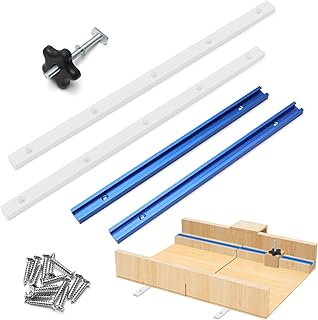
The best value for a DIY build: predrilled T-track, two UHMW miter bars, and the knobs and screws to assemble a genuinely tunable sled. UHMW bars are the right call for stability in an unheated garage, and the T-track lets you add stop blocks so your hands never approach the blade during repeat cuts.
Frequently Asked Questions
Do I still need a sled if my saw has a good miter gauge?
Yes, for anything short or narrow. A miter gauge supports the workpiece behind the blade only; a sled carries the piece, the offcut, and a zero-clearance surface through the cut together, which is both safer and cleaner.
Will these sleds fit my table saw?
Most are built for standard 3/4-inch by 3/8-inch miter slots found on common contractor and cabinet saws. Measure your slot depth and width before ordering, and check whether your slots are T-shaped, since some runners require it and others won’t accept it.
How do I keep a sled square over time?
Use the five-cut method to set the fence at assembly, then recheck it seasonally or after any drop. Store the sled hanging vertically rather than flat on a bench, where the base can take a set.
Is a prebuilt sled better than a kit?
A prebuilt small-parts sled is faster and ideal for joinery work. A kit wins when you want a base sized to your saw and your body, or when you plan to add stops and clamps for production runs.
Final Thoughts
For most furniture makers, the Rockler Small Parts Crosscut Sled is the safest, most repeatable everyday choice, with the zero-gap aluminum-rail small crosscut sled a close second for fine moldings and tenon work. If you’d rather build to your own dimensions, the POWERTEC 71403 kit gives you serviceable hardware and a sled you can keep tuning for years, and slab-tabletop builders should look at the O’SKOOL RTA012 router sled instead.