Key takeaways
- Runner material and fit: Steel or aluminum bars resist dents and stay dimensionally stable; UHMW glides with almost no drag and shrugs off moisture. Whichever you pick, the runner should fill a standard 3/4″ × 3/8″ miter slot with no detectable side play, because slop translates directly into extra grip force from your hands.
- Base flatness and weight: MDF and phenolic bases stay flatter than plywood, but mass is a tradeoff. Heavier sleds track beautifully and dampen vibration; lighter ones are kinder to your back when the sled lives on a shelf between projects.
- Fence height and squaring hardware: A tall rear fence gives your palm somewhere to press without curling your fingers, and it supports upright stock for shoulder cuts. Look for adjustment screws or a micro-square feature so you can re-true the fence rather than rebuild the sled.
- Guarding and hand placement: Blade guards, hold-downs, and a clearly defined safe zone matter most on small parts, where the temptation is to reach. Transparent covers let you watch the cut without leaning over the blade path.
- Capacity versus footprint: Match maximum cut width to the parts you actually make. A 13″ capacity handles face frames and drawer sides comfortably; anything wider adds mass and overhang that will fight you on a compact jobsite saw.
What's inside
Ask any cabinetmaker where their shoulders ache at the end of a build day, and the answer is rarely the sanding. It’s the hundred small crosscuts made with a stock miter gauge: one hand pinning the stock, the other pushing, the body twisting to follow the cut, and the wrist rolling inward at exactly the angle tendons hate. A loose gauge lets the workpiece creep, so you compensate with grip pressure, and grip pressure is what turns a five-minute task into a sore forearm. Accuracy suffers alongside comfort, since a piece that pivots even a degree leaves a joint line you’ll be chasing with a block plane later.
A crosscut sled fixes the mechanical problem and the human one at the same time. The workpiece rides on the sled instead of sliding across steel, the rear fence holds the angle for you, and both hands move to sensible positions well behind the blade. This guide looks at the sleds worth owning from a durability and body-mechanics standpoint: how the runners wear, whether the base stays flat through a humid summer, how tall the fence sits relative to your natural push height, and which designs still feel good on cut number two hundred.
As an Amazon Associate we earn from qualifying purchases.



🛒 Best Price Today on Amazon
Prime members get fast, free shipping on everything above, plus member-only deals. New members get a 30-day free trial — cancel anytime.
How to Choose a Cross Cut Sled For Table Saw (2026)
- Runner material and fit: Steel or aluminum bars resist dents and stay dimensionally stable; UHMW glides with almost no drag and shrugs off moisture. Whichever you pick, the runner should fill a standard 3/4″ × 3/8″ miter slot with no detectable side play, because slop translates directly into extra grip force from your hands.
- Base flatness and weight: MDF and phenolic bases stay flatter than plywood, but mass is a tradeoff. Heavier sleds track beautifully and dampen vibration; lighter ones are kinder to your back when the sled lives on a shelf between projects.
- Fence height and squaring hardware: A tall rear fence gives your palm somewhere to press without curling your fingers, and it supports upright stock for shoulder cuts. Look for adjustment screws or a micro-square feature so you can re-true the fence rather than rebuild the sled.
- Guarding and hand placement: Blade guards, hold-downs, and a clearly defined safe zone matter most on small parts, where the temptation is to reach. Transparent covers let you watch the cut without leaning over the blade path.
- Capacity versus footprint: Match maximum cut width to the parts you actually make. A 13″ capacity handles face frames and drawer sides comfortably; anything wider adds mass and overhang that will fight you on a compact jobsite saw.
The Best Cross Cut Sled For Table Saw (2026)s Reviewed
Rockler Small Parts Crosscut Sled
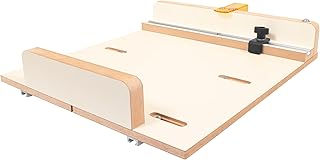
Purpose-built for the cuts that cause the most injuries, this sled keeps hands anchored far from the blade while zero-clearance support prevents small offcuts from diving into the throat plate. If you make boxes, jigs, or trim parts, it earns its keep on ergonomics alone.
Fulton MDF Crosscut Sled
The dense MDF platform gives you a genuinely flat reference surface and enough mass to glide smoothly without wandering. Keep it off a damp concrete floor and seal the edges, and it will hold calibration for years.
16″ × 18″ Precision Right-Angle Crosscut Sled
Aluminum miter runners and an adjustable stop make this the pick for repeat-length parts, and the transparent guard means you can track the cut without dropping your head toward the blade. The compact footprint suits smaller contractor saws.
POWERTEC 71403 Crosscut Sled Kit
You get the hardware and jig components to assemble a sled tuned to your own saw and reach, which is the most direct route to a fence height that matches your posture. Assembly takes an afternoon, and every part is replaceable.
Standard 3/4″ × 3/8″ Runner Crosscut Sled
Sized for common DeWalt, Ridgid, and Skil slots with a 13.2″ capacity, this one handles 90° and miter work without the bulk of a full-sheet sled. A sensible first sled for a garage shop where storage space is tight.
Frequently Asked Questions
Should I build a sled instead of buying one?
Building teaches you the geometry and lets you dial in fence height precisely. Buying gets you a flat, square platform immediately, which matters if your shop lacks a reliable reference surface to build from.
Will a sled fit my table saw?
Measure your miter slot first. Most modern saws use the 3/4″ × 3/8″ standard, but T-slot profiles and older imports vary, so confirm before ordering.
How do I keep the fence square over time?
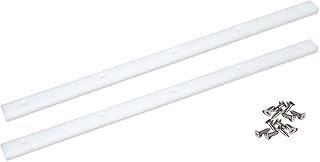
Check it monthly with the five-cut method and re-adjust rather than accepting drift. Replaceable UHMW runner bars, sold separately with predrilled holes, are the cheapest way to restore a sled that has developed side play.
Does a sled reduce cutting capacity?
Yes, the base thickness costs you roughly 1/2″ to 3/4″ of blade height. Plan around it, or keep a second throat plate for full-depth ripping.
Final Thoughts
For small-part safety and the least strain on your hands, the Rockler Small Parts Sled is the clear choice. Shops wanting a stable, low-maintenance workhorse should look at the Fulton MDF Sled, while anyone who wants a sled fitted to their own body mechanics will get more from the POWERTEC 71403 kit.