Key takeaways
- Tooth count: Lower counts generally remove material quickly for ripping, while higher counts favor smoother crosscuts and finish work. A 40-tooth combination blade is often the most practical single-blade choice.
- Tooth geometry: Alternate-top-bevel teeth are useful for crosscutting and reducing tear-out. Flat-top or more aggressive designs tend to clear waste efficiently during rip cuts.
- Blade diameter and arbor: Match the blade diameter to your saw’s guard and maximum specification, then confirm the arbor hole. A 10-inch blade with a 5/8-inch arbor will not automatically fit every machine.
- Kerf and stability: Thin-kerf blades reduce strain on compact saws, but a stiff full-kerf blade may track more confidently in demanding cuts. Avoid any blade that visibly wobbles or vibrates during a test cut.
- Material and maintenance: Carbide teeth hold an edge longer than basic steel, especially when cutting hardwoods or sheet goods. Keep blades clean of resin and inspect for damaged teeth before each project.
What's inside
Choosing a table-saw blade is less straightforward than picking the highest tooth count. A blade that produces a polished crosscut may struggle when ripping thick stock, while an aggressive framing blade can leave fragile veneer and painted panels with chipped edges. Arbor size, kerf, tooth geometry, material quality, and the saw’s available power all affect the result.
This guide focuses on practical furniture-making performance: clean edges, predictable feed pressure, vibration control, and useful service life. The recommendations cover fine finishing, general shop work, ripping, and compact 8-1/4-inch saws, with attention to when each blade makes sense rather than treating tooth count as the whole story.
As an Amazon Associate we earn from qualifying purchases.




🛒 Best Price Today on Amazon
Prime members get fast, free shipping on everything above, plus member-only deals. New members get a 30-day free trial — cancel anytime.
How to Choose a/an Saw Blades For Table Saw (2026)
- Tooth count: Lower counts generally remove material quickly for ripping, while higher counts favor smoother crosscuts and finish work. A 40-tooth combination blade is often the most practical single-blade choice.
- Tooth geometry: Alternate-top-bevel teeth are useful for crosscutting and reducing tear-out. Flat-top or more aggressive designs tend to clear waste efficiently during rip cuts.
- Blade diameter and arbor: Match the blade diameter to your saw’s guard and maximum specification, then confirm the arbor hole. A 10-inch blade with a 5/8-inch arbor will not automatically fit every machine.
- Kerf and stability: Thin-kerf blades reduce strain on compact saws, but a stiff full-kerf blade may track more confidently in demanding cuts. Avoid any blade that visibly wobbles or vibrates during a test cut.
- Material and maintenance: Carbide teeth hold an edge longer than basic steel, especially when cutting hardwoods or sheet goods. Keep blades clean of resin and inspect for damaged teeth before each project.
The Best Saw Blades For Table Saw (2026)s Reviewed
FOXBC 10-Inch 80-Tooth Ultra-Finish Blade
The FOXBC 10-Inch Table Saw Blade, 80-Tooth, Ultra Finish Wood Cutting, 5/8-Inch Arbor is aimed at appearance-critical work such as cabinet parts, trim, and veneered panels. Its dense tooth pattern should leave a refined edge when the stock is supported properly, although the high count is better suited to controlled cuts than fast ripping.
Luckyway 10-Inch 60T and 32T Two-Pack
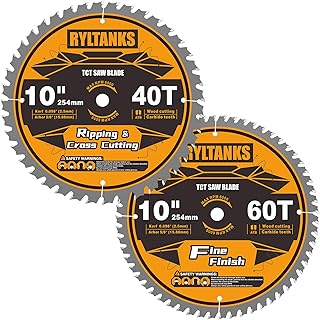
Luckyway’s 10 Inch Table Saw Blade/Miter Saw Blade two-pack pairs a 60-tooth finishing blade with a 32-tooth blade for more aggressive construction cuts. That division of labor is valuable for furniture shops: use the coarser blade to size boards and the finer one when edge quality matters, reducing the temptation to force one blade through every task.
DEWALT 10-Inch 40-Tooth Fine Finish Blade
The DEWALT DWA11040 is a sensible general-purpose option for users who want one dependable blade rather than a collection of specialized models. Its 40-tooth layout balances ripping speed and crosscut cleanliness, while the carbide construction and familiar 5/8-inch arbor format make it a practical everyday choice for many 10-inch saws.
FOXBC 8-1/4-Inch 60-Tooth Blade
Designed for compact table saws, the FOXBC 8-1/4 Inch Table Saw Blade 60 Tooth Fine Finish Wood Cutting with 5/8-Inch Arbor is a useful match for portable machines that cannot accept a full 10-inch blade. Its 60 teeth favor clean furniture cuts, but users should verify both diameter clearance and the saw’s recommended blade specifications before installation.
10-Inch 32T, 60T, and 80T Three-Pack
This 10 Inch Table Saw Blade/Miter Saw Blade three-pack covers framing, fine finishing, and ultra-fine finishing with 32-, 60-, and 80-tooth blades. It offers the broadest task coverage in this group and can be economical for a developing workshop, provided the blades remain properly aligned and are not pushed beyond the materials and cut quality they are designed to handle.
Frequently Asked Questions
Is a higher tooth count always better?
No. More teeth can improve crosscut smoothness, but they also create narrower gullets and remove waste more slowly. A high-tooth-count blade may heat up or bind if used aggressively for long rip cuts.
What is the best all-purpose table-saw blade?
A quality 40-tooth combination or general-purpose blade is usually the best starting point. It offers a workable compromise between ripping efficiency and crosscut finish, especially for home furniture projects.
When should I use a 32-tooth blade?
Use a 32-tooth blade when speed and chip clearance matter more than a finished edge, such as rough sizing, framing lumber, or initial breakdown cuts. Follow with a finer blade or a jointer-ready operation when the edge will be visible.
How can I reduce tear-out?
Use a sharp blade suited to the material, support the workpiece fully, and maintain a steady feed. For plywood and veneer, a finer crosscut-oriented blade, zero-clearance insert, and scoring or masking techniques can further improve the cut.
Final Thoughts
The DEWALT DWA11040 is the strongest all-round starting point, while the FOXBC 80-tooth blade is better for demanding finish work. For maximum flexibility, the Luckyway two-pack or the three-pack with 32-, 60-, and 80-tooth options gives a home workshop the right cutting behavior for more situations.