Key takeaways
- Fence rigidity over fence features: Press down hard on the far end of the fence and watch for lift. A fence that flexes under hand pressure will drift under a 6-foot walnut panel, and no amount of measuring compensates for that. Rack-and-pinion systems generally hold better than single-lock designs.
- Working height and reach: Aim for a table surface between 34 and 38 inches. Too low forces you to hinge at the waist through every cut; too high and you lose the downward pressure needed to keep stock against the fence. Also check that the on/off paddle sits where your knee or left hand can find it blind.
- Stand mechanics and transport weight: A folding stand you can deploy one-handed matters more than the spec sheet suggests. Pneumatic-style wheels roll over gravel and door sills; small hard casters stall on both. Anything above 60 pounds without wheels becomes a two-person lift.
- Trunnion mounting and vibration: Cabinet-mounted trunnions stay aligned longer than table-mounted ones because the mass carries the load, not thin sheet metal. Run the saw at idle and rest a hand on the tabletop; buzz you feel now becomes bearing wear and blade chatter later.
- Dust extraction and guard quality: A shroud that captures below the blade keeps fine dust out of your breathing zone and off the trunnion gears. Confirm the riving knife installs and removes without tools, or you’ll leave it off, which is where most kickback injuries begin.
What's inside
A table saw is the one tool in a furniture shop that you stand at for hours, and the price tag rarely tells you how that hour will feel. Buyers get pushed toward whatever number looks lowest, then discover the fence walks out of parallel mid-rip, the stand sits three inches too low for comfortable feeding, or the whole thing has to be wrestled off a truck bed by two people. Cheap becomes expensive the moment you’re shimming a fence instead of building a dresser.
This guide looks at value the way a durability tester would: what holds tolerance after a few hundred board feet, which stands actually roll over a threshold, and where the posture penalties hide. Below you’ll find the current picks worth their asking price in 2026, a checklist for judging one before you buy, and honest notes on where each saw earns its keep in a home furniture shop.
As an Amazon Associate we earn from qualifying purchases.



🛒 Best Price Today on Amazon
Prime members get fast, free shipping on everything above, plus member-only deals. New members get a 30-day free trial — cancel anytime.
How to Choose a Table Saw at the Best Price (2026)
- Fence rigidity over fence features: Press down hard on the far end of the fence and watch for lift. A fence that flexes under hand pressure will drift under a 6-foot walnut panel, and no amount of measuring compensates for that. Rack-and-pinion systems generally hold better than single-lock designs.
- Working height and reach: Aim for a table surface between 34 and 38 inches. Too low forces you to hinge at the waist through every cut; too high and you lose the downward pressure needed to keep stock against the fence. Also check that the on/off paddle sits where your knee or left hand can find it blind.
- Stand mechanics and transport weight: A folding stand you can deploy one-handed matters more than the spec sheet suggests. Pneumatic-style wheels roll over gravel and door sills; small hard casters stall on both. Anything above 60 pounds without wheels becomes a two-person lift.
- Trunnion mounting and vibration: Cabinet-mounted trunnions stay aligned longer than table-mounted ones because the mass carries the load, not thin sheet metal. Run the saw at idle and rest a hand on the tabletop; buzz you feel now becomes bearing wear and blade chatter later.
- Dust extraction and guard quality: A shroud that captures below the blade keeps fine dust out of your breathing zone and off the trunnion gears. Confirm the riving knife installs and removes without tools, or you’ll leave it off, which is where most kickback injuries begin.
The Best Price For Table Saw (2026) Picks, Reviewed
DEWALT DWE7491RS 10-Inch with Rolling Stand
The rack-and-pinion fence on this one is the reason it stays in shops for a decade: it tracks square across the full 32-1/2-inch rip capacity without needing a bump-and-check ritual. The rolling stand deploys in one motion and rolls loaded, which spares your back the awkward pivot lift that shortens the life of both operator and casters.
SKIL TS6307-00 15 Amp Portable Jobsite Saw
SKIL’s standout is the rack-and-pinion fence at a notably lower entry point, paired with a folding stand that lands at a comfortable feeding height for most adults. The cast tabletop resists the flex you feel on stamped-steel competitors, and the integrated dust port pulls better than its class average.
DEWALT DWE7485 8-1/4-Inch Compact
The smaller blade trades depth of cut for a lighter, more manageable package that a single person can carry up basement stairs without recruiting help. It’s the right call if you break down sheet goods with a track saw and want the table saw for joinery and narrow rips.
10-Inch Table Saw with Stand, Angle Stop and Push Stick
A solid budget entry with a 0–45° bevel and cutting depths up to 3-11/32 inches, which covers thick stock most compact saws can’t reach. Expect to spend an evening tuning the fence and miter gauge; once dialed in, it holds well enough for casework.
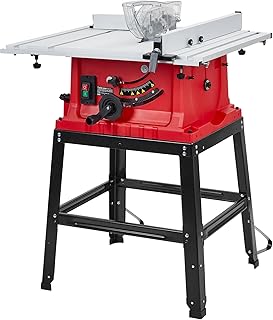
10-Inch Table Saw with Stand and Protective Cover
The generous 36 x 25-inch tabletop gives your workpiece real support, which reduces the tipping and hand-crowding that cause most bad cuts on small saws. The included cover is a genuine durability feature in a garage shop where humidity and dust attack the tabletop between projects.
Frequently Asked Questions
Is a 10-inch saw always better than an 8-1/4-inch?
Only if you need the depth. A 10-inch blade cuts roughly 3-1/8 inches at 90°, versus about 2-1/2 inches on an 8-1/4. If your stock is under two inches thick, the compact saw gives you lighter transport and easier handling with no practical loss.
How much rip capacity do I actually need for furniture work?
Around 24 inches lets you rip a full sheet of plywood down the middle, which covers most cabinet and case work. The 32-inch class saws add convenience for wide panels but require more floor space and clear runoff behind the blade.
Will a portable jobsite saw stay accurate over years of use?
The better ones will, provided you check blade-to-fence parallelism seasonally and keep the elevation and bevel gears clean of packed sawdust. Aluminum tabletops and stamped trunnions are the components that wear first, so inspect them if you’re buying used.
What upgrade improves results most for the money?
A quality 40-tooth combination blade, then a zero-clearance insert. Both reduce tearout and vibration more than any price bracket jump, and they lower the feed pressure your shoulders have to supply.
Final Thoughts
If you want a saw you’ll never have to apologize for, the DEWALT DWE7491RS remains the durability benchmark, with a fence and rolling stand that repay the premium every session. The SKIL TS6307-00 is the smarter buy for most home furniture builders, delivering the same fence architecture for meaningfully less, while the DEWALT DWE7485 is the pick if portability and single-person handling top your list.