Key takeaways
- Working height, not total height: Your ladder needs to reach roughly three feet above the roof edge so you have something to hold while transitioning. A single-story eave at 10 feet wants 13–14 feet of usable ladder; a two-story gutter usually needs 20 feet or more.
- Rung geometry: Look for flat, ribbed rungs at least 1 inch deep front to back with consistent 12-inch spacing. Deep rungs distribute load across the arch instead of concentrating it under the ball of your foot, which is what causes that burning ache halfway through a job.
- Lock mechanism and hand clearance: Auto-lock rungs with wide paddle releases are kinder to thumbs than narrow spring pins, and they let you retract sections one at a time with your fingers well clear of the pinch zone. Test the release force before you trust it overhead.
- Base stability hardware: Anti-slip rubber feet are the minimum. A stabilizer bar widens the footprint and resists the sideways twist that happens when you lean toward a downspout, and detachable roof hooks keep the top from walking along the gutter lip.
- Load rating and material finish: A 330 lb capacity rating covers your body plus tools with margin. Anodized or powder-coated aluminum resists the oxidation and galling that make telescoping sections bind after a couple of seasons stored in a damp garage.
What's inside
Roof access is the one household climb where the equipment failure modes actually matter. A ladder that feels merely “wobbly” on a driveway becomes something else entirely at the eave, where you’re shifting your center of gravity sideways, reaching past the stiles, and asking a single pair of feet to hold on wet concrete or soft turf. Most buyers end up choosing on height and price alone, then discover the real problems later: rungs too shallow to stand on comfortably, thumb latches that pinch, hinges that develop play after one summer of gutter work.
This guide looks at roof-access ladders through two lenses that rarely show up in spec sheets: ergonomics, meaning how the ladder treats your hands, wrists, arches, and shoulders over a 40-minute job, and durability, meaning how the locking hardware, rung swages, and pivot points behave after a few hundred extension cycles. Below are six models worth considering in 2026, followed by the selection criteria I’d apply before spending anything.
As an Amazon Associate we earn from qualifying purchases.




🛒 Best Price Today on Amazon
Prime members get fast, free shipping on everything above, plus member-only deals. New members get a 30-day free trial — cancel anytime.
How to Choose a/an Ladder For Getting On Roof (2026)
- Working height, not total height: Your ladder needs to reach roughly three feet above the roof edge so you have something to hold while transitioning. A single-story eave at 10 feet wants 13–14 feet of usable ladder; a two-story gutter usually needs 20 feet or more.
- Rung geometry: Look for flat, ribbed rungs at least 1 inch deep front to back with consistent 12-inch spacing. Deep rungs distribute load across the arch instead of concentrating it under the ball of your foot, which is what causes that burning ache halfway through a job.
- Lock mechanism and hand clearance: Auto-lock rungs with wide paddle releases are kinder to thumbs than narrow spring pins, and they let you retract sections one at a time with your fingers well clear of the pinch zone. Test the release force before you trust it overhead.
- Base stability hardware: Anti-slip rubber feet are the minimum. A stabilizer bar widens the footprint and resists the sideways twist that happens when you lean toward a downspout, and detachable roof hooks keep the top from walking along the gutter lip.
- Load rating and material finish: A 330 lb capacity rating covers your body plus tools with margin. Anodized or powder-coated aluminum resists the oxidation and galling that make telescoping sections bind after a couple of seasons stored in a damp garage.
The Best Ladder For Getting On Roof (2026)s Reviewed
LANBITOU 14 FT Multi-Position Folding Ladder
The A-frame plus extension design makes this the most versatile pick here, and the four-step configuration gives you genuinely usable standing platforms rather than the thin rungs typical of straight telescopers. At 330 lbs and 14 feet it comfortably handles single-story eaves, and the stair-capable stance is a real advantage for interior work.
12.5 FT Heavy-Duty Telescoping Extension Ladder
A straightforward, well-priced choice for attic hatches and low roofs, with textured anti-slip treads that hold up better in wet conditions than smooth extruded rungs. Best suited to shorter jobs where compact storage matters more than a wide stabilizer footprint.
SINMEIRUN 12.5 FT Pro Telescoping Ladder
ANSI certification and detachable roof hooks are the standouts, and the hooks meaningfully reduce lateral creep at the gutter line. The high-visibility orange finish is a practical safety feature around driveways and RV sites where a silver ladder disappears against the background.
20.3 FT Telescoping Ladder with Hooks, Stabilizer & Wheels
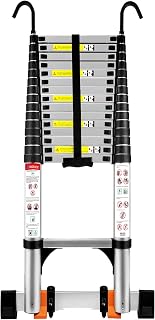
This is the one to buy if you have a two-story roofline. The stabilizer bar plus wheeled base solves the hardest part of tall-ladder work, which is positioning and raising the thing solo without scarring the siding, and the auto-lock rungs keep extension quick and predictable.
SocTone 12.5 FT Telescoping Ladder with Stabilizers
Stabilizers at this length and price point are unusual and worth having, since a 12.5-foot ladder gets used at steeper angles where a narrow base is least forgiving. A sensible all-rounder for gutters, RV roofs, and general exterior maintenance.
Frequently Asked Questions
How tall a ladder do I need to get on my roof?
Measure to the eave, then add three feet. Set the ladder at roughly a 75-degree angle, which means the base sits about one foot out from the wall for every four feet of height.
Are telescoping ladders safe enough for roof work?
Yes, provided the model is ANSI-rated and you confirm every section has audibly locked before climbing. Extend and inspect on the ground first, every time.
Do I really need roof hooks or a stabilizer?
For anything above single-story, they’re the difference between a stable climb and a ladder that shifts when you reach. Stabilizers help most on uneven ground; hooks help most at the transition point.
How do I keep a telescoping ladder working smoothly?
Wipe the sections clean and dry before collapsing, store it indoors or under cover, and keep grit out of the rung channels. Contamination, not wear, is what jams most locking mechanisms.
Final Thoughts
For most single-story homes, the LANBITOU 14 FT multi-position ladder offers the best combination of usable step depth and configuration flexibility. If your roofline is two stories up, the 20.3 FT model with stabilizer and wheels is the safer investment, while the SINMEIRUN 12.5 FT Pro is the pick for anyone who wants ANSI certification and roof hooks in a compact, easy-to-store package.