Key takeaways
- Seat height: Measure from the floor to the underside of your counter or island. A gap of roughly 9 to 12 inches between the seat and work surface usually allows comfortable leg movement, but thick countertops and personal proportions can change the ideal.
- Support: A shaped backrest helps during longer meals, while a backless saddle stool slides neatly beneath an overhang. Arms can improve lateral support, but they require enough clearance to fit beneath the counter.
- Foot positioning: A properly placed footrest reduces pressure behind the thighs and prevents dangling legs. Check that it is firmly attached, does not rotate unexpectedly, and sits at a useful height for everyone in the household.
- Frame durability: Look for evenly joined metal or solid wood components, broad contact points, and a base that remains stable when you shift your weight. Published weight ratings are useful, but they do not replace careful assembly and periodic tightening.
- Maintenance: Faux and bonded leather wipe clean more readily than woven fabric, while upholstered linen can feel cooler and softer. In every case, inspect seams, stitching, and finish quality because these areas receive the most wear.
What's inside
Kitchen counter stools look simple until daily use exposes their weak points: the wrong seat height, a footrest that flexes, upholstery that traps crumbs, or a frame that begins to wobble after repeated loading. Because stools concentrate body weight on a small footprint, comfort and structural stability matter more here than they do with many conventional dining chairs.
This guide evaluates the listed stools through an ergonomics-and-durability lens. We consider seat height, back and arm support, pressure distribution, foot positioning, materials, balance, cleaning demands, and the practical realities of assembling and using stools around a busy kitchen island.
As an Amazon Associate we earn from qualifying purchases.




🛒 Best Price Today on Amazon
Prime members get fast, free shipping on everything above, plus member-only deals. New members get a 30-day free trial — cancel anytime.
How to Choose a/an Kitchen Counter Stools (2026)
- Seat height: Measure from the floor to the underside of your counter or island. A gap of roughly 9 to 12 inches between the seat and work surface usually allows comfortable leg movement, but thick countertops and personal proportions can change the ideal.
- Support: A shaped backrest helps during longer meals, while a backless saddle stool slides neatly beneath an overhang. Arms can improve lateral support, but they require enough clearance to fit beneath the counter.
- Foot positioning: A properly placed footrest reduces pressure behind the thighs and prevents dangling legs. Check that it is firmly attached, does not rotate unexpectedly, and sits at a useful height for everyone in the household.
- Frame durability: Look for evenly joined metal or solid wood components, broad contact points, and a base that remains stable when you shift your weight. Published weight ratings are useful, but they do not replace careful assembly and periodic tightening.
- Maintenance: Faux and bonded leather wipe clean more readily than woven fabric, while upholstered linen can feel cooler and softer. In every case, inspect seams, stitching, and finish quality because these areas receive the most wear.
The Best Kitchen Counter Stools (2026)s Reviewed
Full-Back Linen Swivel Stools
These grey 24-inch counter stools pair a supportive padded back with a swivel function, making them practical for an island where users frequently turn toward the kitchen or dining area. The metal footrest should help distribute lower-leg pressure, while the full back is a better choice than a backless design for extended breakfasts or homework sessions; keep the swivel mechanism and fasteners checked periodically.
Barrel Counter Stools with Arms
The 26-inch barrel design adds both a backrest and arms, creating a more enveloping sitting position than a simple open-frame stool. Its linen upholstery may feel comfortable for longer sitting, and the stated 450-pound capacity is reassuring for robust everyday use, although the broader silhouette needs adequate space between neighboring stools and beneath the counter.
Raynesys Curved Bonded-Leather Stools
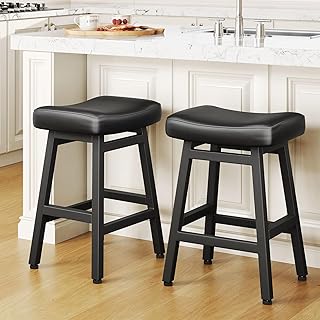
Raynesys’ 24-inch stools use a curved bonded-leather seat and heavy-duty metal legs to balance a compact profile with easy-clean practicality. The curved form can help keep the pelvis centered without forcing a rigid posture, while the black finish conceals minor marks; users should still avoid dragging the metal legs across hard flooring.
PrimeZone Solid-Wood Saddle Stools
PrimeZone’s 26-inch backless saddle stools are a strong fit for kitchens that prioritize clearance and a tidy visual line. The solid-wood construction, integrated footrest, and nailhead-trimmed upholstered seat offer a farmhouse-friendly combination, but the lack of back support makes these better for shorter periods than for lingering meals.
FSC-Certified Upholstered Faux-Leather Stools
This set of three uses a 27-inch seat height, a metal base, and upholstered faux leather for a coordinated island arrangement. The FSC-certified element may appeal to buyers seeking responsibly sourced materials, while the back support improves comfort; verify your counter height carefully because 27 inches can be too tall for many standard kitchen islands.
Frequently Asked Questions
What is the best stool height for a kitchen counter?
Most kitchen counters work well with stools having seats approximately 24 to 26 inches high. Measure the actual counter, including its thickness, and leave enough knee room for an upright posture rather than choosing by label alone.
Are swivel stools comfortable for everyday use?
They can be, particularly when entering and leaving the seat repeatedly. A swivel is most useful when it turns smoothly without excessive play; a stable base and supportive back remain more important than rotation by itself.
Are backless counter stools practical?
Yes, when stools must slide fully under an overhang or be used for quick meals. They are less suitable for prolonged sitting because they provide no lumbar or upper-body support, so a saddle-shaped seat and a reliable footrest become especially valuable.
How can I prevent counter stools from becoming wobbly?
Assemble them on a level surface, tighten hardware evenly, and retighten fasteners after the first few weeks of use. Add suitable floor pads if the legs contact uneven flooring, and do not ignore a loose joint or shifting footrest.
Final Thoughts
For longer, more supported sitting, the barrel stools with arms are a compelling choice, while the Raynesys curved bonded-leather stools offer a practical balance of cleanability and compact comfort. Choose the PrimeZone saddle stools when under-counter clearance and easy movement matter most, provided your household does not need extended back support.