Our Top Picks
If you want one impact sprinkler for a typical backyard, the Orbit Tripod Brass Impact Sprinkler (58308) is the pick we would start with: a metal head on an adjustable-height tripod that lifts the spray over tall grass and garden beds. The runner-up is the Biswing Large Impact Sprinkler Head on Tripod Base, which is the better fit if you want a larger three-quarter-inch hose connection and a heavier-duty stance. If you would rather skip the “tick-tick-tick” sound altogether, the Orbit H2O-Six Gear-Drive on a T-spike is the quiet alternative. This guide covers the best impact sprinklers and the gear-driven models that compete with them, so you can match range, base style and durability to your own yard.
A note on how this guide works: it is research-based. We compared manufacturer listings, product descriptions and general irrigation guidance, and we did not personally use these sprinklers. Where a listing does not state a number (throw distance, flow rate, pressure range), we write “not listed” instead of guessing. Prices are shown as tiers only because they change often.

Biswing 2 Pack Impact Sprinklers, Heavy Duty Zinc Alloy Lawn Sprinkler Head with 1/2" NPT Thread, Adjustable 360 Degree Watering Sprinkler for Large Area Grass Yards Patio Garden Irrigation
Picked as a relevant option in this category.
View on Amazon
ACDRIME 4 Pack Impact Lawn Sprinkler, Heavy Duty Zinc Alloy Lawn Sprinkler Head with Zinc Alloy Spike Base, 360° Adjustable Pulsating Water Sprinkler for Large Area Yard Lawn Patio Garden Irrigation
Picked as a relevant option in this category.
View on Amazon
Rain Bird AG-5 Impact Sprinkler, Full Circle, 24-45 Feet | Irrigation Supplies, Sprinklers, Impulse Sprinklers, Adjustable Sprinklers, Rain Bird AG-5 Lawn Sprinkler, 1/2 in
Chosen because it specifies Full Circle and 24-45 Feet.
View on Amazon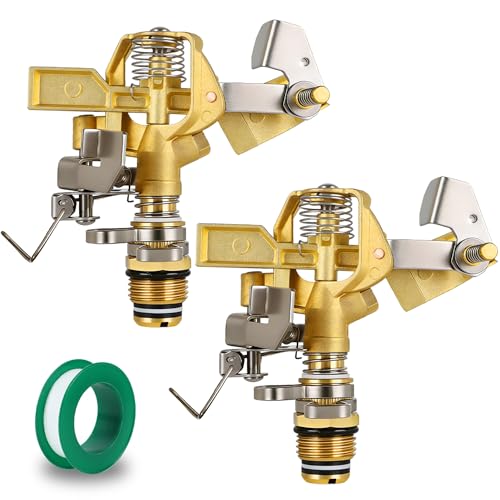
Triumpeek 2-Piece 1/2" Brass Impact Sprinkler Heads
Picked as a relevant option in this category.
View on AmazonTop Picks at a Glance
- Best Overall: Orbit Tripod Brass Impact Sprinkler (58308)
- Best for Large Lawns: Biswing Large Impact Sprinkler Head on Tripod Base
- Best Budget: Chapin 4980 Platform Impact Sprinkler
- Best Multi-Pack Value: ACDRIME 4 Pack Impact Lawn Sprinkler with Zinc Spike Base
- Best Quiet Gear-Driven: Orbit H2O-Six Gear-Drive Sprinkler on Metal T-Spike (58573)
- Best Gear-Driven for Sturdy Base: Dramm ColorStorm Gear Drive Sprinkler on Metal Base
- Best Pop-Up Style Rotor: Rain Bird 42SASPG Gear Drive Rotor
Comparison Table
| Product | Best for | Key specs (from the listing) | Watch for | Price tier |
|---|---|---|---|---|
| Orbit Tripod Brass Impact (58308) | All-round lawn watering | Brass head, adjustable-height tripod, 360-degree rotation | Tripod needs flat ground | Mid-range |
| Biswing Large Impact on Tripod | Wide open lawns | Zinc alloy head, 3/4-inch connection, adjustable tripod | Heavier, more to store | Premium |
| Chapin 4980 Platform Impact | Tight budgets, small yards | Platform base, 360-degree, up to 85 ft coverage as listed | Plastic-leaning build per category norms; check listing | Budget |
| ACDRIME 4 Pack Impact | Covering several zones | Zinc alloy head, zinc spike base, 360-degree adjustable | Spike base can tip on soft soil | Mid-range |
| Orbit H2O-Six Gear-Drive (58573) | Quiet watering, multi-pattern | Gear-drive, metal T-spike, multiple coverage patterns | Shorter throw than a big impact head | Budget |
| Dramm ColorStorm Gear Drive | Small to large areas, steadier base | Gear drive, heavy-duty metal base, 4 patterns | Pattern dial adds complexity | Mid-range |
| Rain Bird 42SASPG Gear Drive Rotor | Fixed or semi-permanent setups | Full circle, 26 to 38 ft range as listed, gear-drive rotor | Made for plumbed installs, not a hose-end stake | Mid-range |
Impact vs Gear-Driven: What Actually Differs
Before the individual picks, it helps to separate the two mechanisms, because the search phrases “impact sprinkler”, “impulse sprinkler” and “gear-driven sprinkler” are often used loosely.
An impact (also called impulse or pulsating) sprinkler uses a spring-loaded arm that is knocked by the water stream, which makes the head turn in small steps with the familiar ticking sound. The stream breaks up into larger droplets and usually reaches further for a given hose pressure, which is why impact heads are associated with big lawns and gardens. A gear-driven sprinkler routes water through a small turbine and gear train that turns the nozzle smoothly and almost silently. The stream is steadier, and many gear-driven models let you choose a spray pattern or arc.
In practice: pick impact when you need reach, adjustable arc and a design you can repair by cleaning the arm and spring; pick gear-driven when noise, wind drift and consistent coverage matter more. The trade-off is that gear-drive internals can clog with sand or mineral deposits, and a clogged gear train is harder to service than a stuck impact arm.
1. Orbit Tripod Brass Impact Sprinkler (58308): Best Overall
- Brass impact head with 360-degree rotation
- Adjustable-height tripod base, as the listing title states
- Marketed for long-range lawn watering and heavy-duty use
- Throw distance and flow rate: not listed in the title, check the maker page for your pressure
Best for: a standard backyard with some taller plants where you want the spray lifted above the canopy. Skip if: your lawn is sloped or very soft, where a tripod can shift.
Brass is a sensible material for the head, because it resists the corrosion that can freeze up cheaper arms over a few seasons. The tripod matters more than it looks: raising the head means the stream clears grass blades and low shrubs, so the water lands where you aim it instead of being blocked. That is the key difference between a tripod impact sprinkler and the same head on a short spike.
The practical downside of any tripod is footprint. The three legs need level ground to stay put, and in windy weather a lightweight tripod can tip when the head swings to the end of its arc. Weighting a leg with a paver or a sandbag is a cheap fix. Also remember that adjustable-arc impact heads let you stop the stream hitting a driveway or fence, which saves water.
Pros: metal head; adjustable height; good for tall beds; arc adjustment typical of the category. Cons: needs level ground; bulkier to store than a spike model.
2. Biswing Large Impact Sprinkler Head on Tripod Base: Best for Large Lawns
- Zinc alloy construction, per the listing
- Tripod base with adjustable height
- 3/4-inch connection for higher flow than a standard half-inch fitting
- Marketed for large-area irrigation
- Maximum radius: not listed in the title
Best for: open lawns, pasture-style yards and larger garden plots where you need a bigger footprint per setup. Skip if: your hose or spigot runs low pressure, because a large head needs adequate flow to rotate properly.
The larger connection is the main reason to consider this model. A three-quarter-inch fitting passes more water than a half-inch one, and more flow generally means more reach and a stronger arm stroke. If your spigot and hose are standard garden size, you will usually need the right adapter, which is a small detail that trips people up. Check your hose thread before ordering.
Zinc alloy is a sturdy, cost-effective choice, though it can corrode if left wet in hard-water areas, so drain and wipe the head at the end of the season. Because this is a bigger, heavier unit, storing it is slightly more awkward, but it is also less likely to be knocked over by a gust.
Pros: larger connection; metal construction; tripod lifts spray; suited to big areas. Cons: costs more; heavier; needs good pressure.
3. Chapin 4980 Platform Impact Sprinkler: Best Budget
- 360-degree automatic impact head on a platform base
- Up to 85 ft coverage area, as stated in the listing
- Made for gardens and lawns
- Head material: check the listing before buying
Best for: a first impact sprinkler, small to medium yards, and renters who want something inexpensive to try. Skip if: you need an all-metal head for years of heavy use.
The “up to 85 ft” figure should be read as a best-case coverage area, not a promise for your hose. Real reach depends on water pressure, nozzle setting and wind. In our research, budget impact sprinklers tend to perform well for the first season, and the typical failure is a worn pivot or a weak spring rather than a cracked body, so rinse it and keep the arm clear of debris.
The platform base is a wide, flat footing that sits on the lawn rather than on a spike. That helps on hard or dry ground where a spike will not penetrate, and it is gentler on soil, but it can slide on wet grass if the hose tugs. Keep the hose slack behind it.
Pros: low cost; platform base stable on hard ground; stated wide coverage. Cons: likely less durable than all-metal rivals; hose can drag it.
4. ACDRIME 4 Pack Impact Lawn Sprinkler: Best Multi-Pack Value
- Pack of four heavy-duty zinc alloy impact heads
- Zinc alloy spike base, per the title
- 360-degree, adjustable coverage
- Flow rate and radius: not listed in the title
Best for: long, narrow yards and people who want to chain several sprinklers on a single hose line. Skip if: your spigot pressure is modest; running four heads from one hose can drop the performance of each.
Buying a four-pack makes sense when you plan to cover a long strip, such as a side yard or a row of garden beds, and move the set as a unit. Water pressure is the limit: each additional head splits the flow, so many people run two at a time and keep the other two as spares or for a second zone. The metal spike base pushes into moist soil easily, but in dry compacted ground you may need to water the spot first.
Pros: four heads for the money; metal heads and spikes; adjustable coverage. Cons: spikes can tip in loose soil; pressure shared across heads.
5. Orbit H2O-Six Gear-Drive Sprinkler (58573): Best Quiet Gear-Driven
- Gear-drive mechanism, as named in the title
- Metal T-spike base
- Customizable coverage with multiple rotating patterns
- Throw distance: not listed in the title
Best for: homes with patios close to the lawn, early-morning watering where noise matters, and uneven beds that need different patterns. Skip if: you want the longest possible reach from a single head.
Gear-driven sprinklers rotate smoothly, so the water does not slap against patio furniture or windows in the same way as an impact stream. The multi-pattern feature is helpful: you can set the sprinkler for a full circle in the middle of a lawn or a narrower arc along a fence. The metal T-spike is also easier to push into the ground than a single-point spike and resists flopping sideways.
Keep your expectations realistic on range. Gear-drive heads in this class usually throw a shorter distance than the largest impact heads, so use them for small to medium lawns. If you have well water with sand or sediment, an inline filter at the hose end is worth adding because gear trains do not like grit.
Pros: quiet; multiple patterns; metal stake; low cost. Cons: shorter reach; can clog with sediment.
6. Dramm ColorStorm Gear Drive Sprinkler: Best Gear-Driven With a Sturdy Base
- Gear-drive sprinkler on a heavy-duty, durable metal base
- Four spray patterns, per the listing
- Aimed at small, medium and large areas
- Exact range: not listed in the title
Best for: people who like a heavy sled-style base that stays put on a lawn and a pattern dial they can switch quickly. Skip if: you prefer a simple one-setting sprinkler.
Dramm is a long-standing garden watering brand, and this model targets the gap between flimsy plastic sprinklers and larger rotors. A heavier base is the feature that matters on a gear-driven unit: because the stream is steady and the head is light, the body can walk or tilt on wet ground. A weighted metal base keeps the spray level, which keeps coverage even. The four patterns let you reshape the watering area as your garden changes, from a wide circle to a narrow rectangle-style pass.
Pros: sturdy base; patterns; works for various yard sizes. Cons: more settings to learn; gear internals do not like grit.
7. Rain Bird 42SASPG Gear Drive Rotor: Best Pop-Up Style Rotor
- Gear-drive rotor, full-circle, per the listing
- Stated throw of 26 to 38 feet
- Pop-up rotor design intended for in-ground sprinkler systems
- Required fittings and riser: check before buying
Best for: anyone building or repairing a plumbed irrigation system who wants reliable, replaceable heads. Skip if: you only need a hose-end sprinkler that you move around.
This one is on the list because many readers searching for a “long range pop up sprinkler” or a “gear driven sprinkler 25 40” are really shopping for an in-ground rotor. The listing gives a 26 to 38 foot range, which falls in that “25 to 40 foot” window. A pop-up rotor sits flush with the soil, rises when water runs, and retracts afterward, so you can mow over it. It needs proper pipe, a riser and correct spacing, so it is a project rather than an impulse buy.
Spacing matters more than head choice. For even coverage, heads are normally spaced so the water from one reaches the next; a maker’s spacing chart and your pressure reading tell you far more than a general guide can.
Pros: flush with the lawn; stated 26-38 ft range; replaceable head. Cons: not hose-end ready; installation skill needed.
Also Consider
Orbit Saturn III Gear-Drive Rotor (2-Pack)
A budget gear-drive rotor pair for small lawns; the listing describes an adjustable spray range. A good second sprinkler if you already own a big impact head.
Eden Multi Pattern Turbo Gear Drive Sprinkler
Gear-driven with a one-direction misting system and quick-connect set per the listing. Handy when you also want a gentle mist for seedlings, though the details of range are not listed.
Triumpeek 2-Piece Brass Impact Sprinkler Heads
Half-inch brass impact heads sold as bare heads. Use them if you already have your own stakes or want to replace worn heads on existing risers.
WEMADE Heavy Duty Metal Pulsating Sprinklers
A low-cost metal pulsating (impact) option for yards where you only need the basics. Check the base style before buying.
How We Chose
This guide is research-based. We compared manufacturer product pages, listing details and the way each sprinkler type is described by irrigation guidance from lawn-care extension services and brand documentation. We did not personally use these products. We favored metal heads over all-plastic ones when the listing made that clear, looked for stated coverage rather than marketing claims, and included both impact and gear-driven designs because many shoppers use the terms interchangeably. Models that list no maker, no stated construction or only vague claims were left out. When a number such as throw distance was not in the listing title, we marked it “not listed” rather than inventing one.
Buying Guide
Range and Water Pressure
Maker range figures are normally measured under ideal pressure, so treat them as the upper limit. A standard home spigot often supplies somewhere in the 40 to 60 psi range, and anything lower will shrink the throw. If your pressure is weak, run one sprinkler at a time and avoid long, thin hoses. A larger hose diameter and a three-quarter-inch fitting both reduce friction loss.
Base Type: Spike, Platform, Tripod or Sled
A spike is the easiest to store and sits stable in moist soil, but it tips in sand or when the ground is dry and hard. A platform or sled sits on the grass and works on hard ground; it can creep along the lawn when the hose tugs. A tripod lifts the head so the spray clears plants, which is why it is the common pick for gardens and tall grass. If you only water a flat, short lawn, a spike or platform is enough.
Material and Durability
Brass resists corrosion and is a common material for impact heads. Zinc alloy is strong but can pit in hard water. Plastic is light and cheap but more prone to cracking in sun and frost. Whatever material you choose, drain the sprinkler and bring it inside before the first freeze, since trapped water splits parts.
Arc Control and Pattern
Adjustable-arc impact heads let you stop the spray hitting a path or house. Gear-driven models may offer preset patterns instead. If your lawn is rectangular, patterns are convenient; if you need to work around objects, an adjustable arc is more flexible.
Maintenance
Impact sprinklers usually stop turning when grit lodges in the arm or the spring is weak; flushing the line and cleaning the pivot normally fixes it. Gear drives need a clean water supply, so a simple inline filter is worth fitting. Check washers in the hose connection each spring and replace them if they leak. Avoid overwatering: most lawns do well with deep watering a few times a week rather than daily light watering, and local guidelines vary by climate.
A Quick Worked Example: Sizing for a 40 by 60 Foot Lawn
Suppose your lawn is a rectangle of 40 by 60 feet, which is 2,400 square feet. A single impact sprinkler set to a full circle with a 30-foot radius covers a circle of roughly 2,800 square feet on paper, but a circle wastes water on the corners and any spray past the edge lands on pavement or a neighbor’s fence. A more practical plan uses two placements: set the sprinkler near the middle of each 30-foot half, reduce the arc so it covers only the lawn, and overlap the two zones by a few feet. The overlap matters because sprinkler output is heaviest near the head and lightest at the edge of the throw, so edges need coverage from two directions to even out.
Run each zone long enough to deliver the amount your local extension service recommends, which is often described as about an inch of water per week in total from rain and irrigation, adjusted for your climate and soil. A simple way to measure what your sprinkler delivers is to place a few shallow cans around the zone, run the sprinkler for thirty minutes, and measure the depth collected. Impact heads usually apply water more slowly on the fringe than near the center, so averaging the cans gives you a realistic run time. Heavy clay soils absorb slowly and may need shorter, repeated cycles, while sandy soils drink quickly and can handle a longer single run.
Common Mistakes to Avoid
- Choosing by the largest range number and ignoring your actual pressure.
- Putting a spike-based sprinkler on dry, hard soil and expecting it to stay upright.
- Running several sprinklers off one hose and wondering why none of them reaches far.
- Letting spray hit sidewalks and the house, which wastes water and can stain siding.
- Leaving the sprinkler outside in freezing weather with water inside.
Frequently Asked Questions
What is the best impact sprinkler for a small yard?
A budget platform or spike model such as the Chapin 4980 is usually enough for a small yard. Adjust the arc so water stays on the lawn, and move it between zones rather than buying a large tripod unit.
What is the difference between an impact sprinkler and an impulse sprinkler?
They are generally the same thing. Both names describe a head that rotates in small steps when a spring-loaded arm is hit by the water stream. “Impulse” and “pulsating” are alternative labels you will see on listings.
Are impact sprinklers good for tight spaces?
Yes, if the arc is adjustable. Set the stop pegs so the spray covers only the area you want, and use a spike or compact base. For very narrow strips, a gear-driven model with a rectangle or narrow pattern can be easier to control.
Are gear-driven sprinklers better than impact sprinklers?
Neither is better for everyone. Gear-driven heads are quieter and smoother, while impact heads tend to throw further and are simpler to clean. Choose by noise tolerance and lawn size.
Which stake or base is best for a heavy-duty lawn sprinkler?
A metal spike works well in moist soil, a platform or sled suits hard ground, and a tripod suits tall plants. Heavier bases resist tipping in wind, so weight the legs if conditions are breezy.
How far will a long-range sprinkler actually throw?
Often less than the maximum on the box. Wind, nozzle angle and pressure all cut into the figure, so plan for overlap rather than assuming the full number.
Can I use a gear-driven rotor with a garden hose?
Some models are designed for hose-end use, while pop-up rotors like the Rain Bird 42SASPG are made for plumbed systems. Check whether the product includes a hose-ready base or needs a riser and pipe fittings.
Which One Should You Buy?
For most backyards, buy the Orbit 58308 tripod impact sprinkler. If you have a large lawn and good pressure, step up to the Biswing large tripod model. On a tight budget the Chapin 4980 gets you started, and a four-pack from ACDRIME suits long, narrow zones. If noise matters, pick the Orbit H2O-Six or the Dramm ColorStorm. If you are building a permanent system, look at the Rain Bird 42SASPG. Check the listing for your hose fitting and confirm your water pressure before buying, and always follow the manufacturer’s instructions for installation and winter storage.
Sources
- Orbit Irrigation Products sprinkler product pages
- Rain Bird rotor product documentation
- Dramm gear drive sprinkler product page
- Chapin impact sprinkler product page
- University extension lawn-watering guidance
Last updated: October 2026