
Key takeaways
- Warranty Description: 1 year
- Tension Supported: 150LBS
- Item Dimensions D x W x H: 74.8"D x 38.5"W x 79.9"H
If you have never trained seriously before, the hardest part of a home gym is not the lifting — it is knowing whether you are doing it right with nobody watching. That single fact should shape the purchase. Guided cable stations put your joints on a fixed path, cap how badly a rep can go wrong, and let you change resistance by moving a pin instead of wrestling plates. For a first machine, that combination is worth more than any spec on the carton.
The six options below run from 150 lb selectorized stations to a 200 lb configurable frame, plus a pulley-driven trainer and a folding bench. I have judged them on how quickly a newcomer can go from unboxing to a productive session: how obvious the setup is, how forgiving the movement paths are, and how much the machine punishes you for not yet knowing what you are doing. Stack weight matters, but a beginner’s real constraint is confidence.
Our top picks
 JELENS Home Gym
- Warranty Description: 1 year
- Tension Supported: 150LBS
- Item Dimensions D x W x H: 74.8"D x 38.5"W x 79.9"H
Three pulley heights support a wide range of exercises
Adjustable seat and leg pad fit different body sizes
Five shock-absorbing foot pads add quiet stability
74.8-inch depth needs a dedicated room footprint
Ships in four boxes requiring full assembly
 Mikolo Home Gym
- Tension Supported: Weight Stack 154lbs (12 Levels)
- Item Dimensions D x W x H: 75"D x 36.3"W x 80"H
- Maximum Weight Recommendation: 300 Pounds
 SincMill Home Gym Multifunctional Full Body Workout
- Warranty Description: 10 Years
- Tension Supported: 148 pounds
- Handle Type: Pulldown, Strap
Thick steel frame and weight guards add durability
Leg exercise pedal targets more leg muscle groups
Backed by a 10-year warranty on the frame
148-pound tension ceiling limits heavier strength training
Assembly takes about 30 minutes per the included video
| Product | Key specs | |
|---|---|---|
| JELENS Home Gym | Warranty Description: 1 year Tension Supported: 150LBS Item Dimensions D x W x H: 74.8"D x 38.5"W x 79.9"H | Check price |
| Mikolo Home Gym | Tension Supported: Weight Stack 154lbs (12 Levels) Item Dimensions D x W x H: 75"D x 36.3"W x 80"H Maximum Weight Recommendation: 300 Pounds | Check price |
| SincMill Home Gym Multifunctional Full Body Workout | Warranty Description: 10 Years Tension Supported: 148 pounds Handle Type: Pulldown, Strap | Check price |
 Marcy Multifunctional Workout Station 100lbs to 200lbs Marcy Multifunctional Workout Station 100lbs to 200lbs | This home gym system is made with heavy-duty… This gear comes with a 150-pound selectorized weight… Designed with dual action press arms, this versatile… | Check price |
 XGSW Multi-Function Home Gym Workout Station XGSW Multi-Function Home Gym Workout Station | Material: steels Tension Level: Heavy Duty (> 300 lbs) | Check price |
 YOLEO Adjustable Weight Bench for Home Gym YOLEO Adjustable Weight Bench for Home Gym | Check price | |
 SunHome Multifunction Home Gym Equipment Workout Station SunHome Multifunction Home Gym Equipment Workout Station | Warranty Description: 2 Year Tension Supported: 138 pounds Handle Type: Fixed Handle | Check price |
 MQRW Push Up Board MQRW Push Up Board | Maximum Weight Recommendation: 600 Pounds Warranty Type: Push up board Assembly Instructions Description: No assembly required | Check price |
As an Amazon Associate we earn from qualifying purchases at no extra cost to you.
Quick Comparison
| Product | Best For | Standout Feature | Watch Out For |
|---|---|---|---|
| JELENS H11 Home Gym | First machine buyers | Pin-select 150 lb stack | Fiddly cable assembly |
| Mikolo Home Gym Station | Learning a full routine | 152 lb stack, four core stations | Takes real floor space |
| SincMill Home Gym | Absolute beginners | Minimal setup decisions | Narrow adjustment range |
| Marcy Workout Station | Fast early progress | Stack scales to 200 lb | Overkill for month one |
| XGSW Multi-Function Gym | Learning curls and extensions | Fixed-path arm and leg trainers | Manual is light on detail |
| YOLEO Adjustable Bench | Testing the habit first | 98% pre-assembled, 827 lb rated | Free weights need more skill |
How to Choose
- Start where the load starts: Check the lightest pin position, not the heaviest. A stack whose bottom setting is already challenging leaves a beginner nowhere to build technique before adding weight.
- Fixed paths reduce risk: Cable and lever stations keep your shoulders and knees tracking correctly even when you are tired. That is the main reason a machine beats a barbell for someone training alone without coaching.
- Count the setup steps: Every adjustment is a chance to get it wrong. A machine with three settings you can learn in a week beats one with twelve you will guess at forever.
- Look for a printed exercise chart: Many stations include a placard or poster showing each movement. It sounds trivial; in practice it is the difference between using four stations and using two.
- Leave room to grow, cheaply: Pick a frame you will not outgrow within a year, but do not pay for a 200 lb stack if you are starting from zero — put the difference into a bench and dumbbells instead.
Top Picks Reviewed
Best First Machine: JELENS H11 Home Gym
The H11 gets the beginner essentials right: a pin-selected 150 lb stack you can change in two seconds, guided movement paths that are hard to perform badly, and a compact frame that fits a spare room without renovation. Nothing can fall on you, which removes the main anxiety of training alone.
Assembly is the one place it asks a lot. Cable routing is genuinely fiddly for someone doing it for the first time, and the diagram-led instructions assume more familiarity than a first-time buyer has. Recruit a second person.
Best for Building a Routine: Mikolo Home Gym Station
Four core stations off a 152 lb stack — pulldown, row, chest press, leg extension — map neatly onto a beginner full-body template. You can learn one movement per week and have a complete programme inside a month without buying anything else.
The footprint is the price of that variety. It wants clearance behind and in front, so a small bedroom will feel cramped and you may find yourself skipping the station that is hardest to reach.
Easiest to Learn: SincMill Home Gym
Fewer stations, fewer adjustments, fewer opportunities to set something up incorrectly. For someone genuinely nervous about equipment, the SincMill lets you sit down and train on day one with no tutorial.
The narrow adjustment range is the catch. Users at the taller or shorter ends of the spectrum may never find a properly comfortable seat position, and that discomfort is precisely what stops beginners coming back.
Best If You Progress Fast: Marcy Workout Station
Beginners gain strength quickly, especially on pulling movements, and Marcy’s 100 to 200 lb configurations mean you will not hit the top of the stack within your first year. The frame feels planted, which builds confidence when you start pulling hard.
For the first few months it is more machine than you need, and it is the largest and heaviest option here. If your space or budget is tight, this is not where to start.
Best for Learning Arm Work: XGSW Multi-Function Gym
The dedicated arm and leg trainers put curls and extensions on a fixed arc, which teaches the feel of the movement far faster than free weights do. For anyone who has watched videos and still cannot tell whether they are cheating a curl, that guidance is valuable.
The documentation is thin. Working out how to route the pulley for each variation takes trial and error, and a beginner will spend the first session experimenting rather than training.
Best Trial Run: YOLEO Adjustable Bench
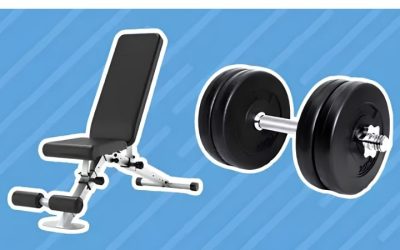
If you are not yet sure you will stick with it, spend little and start here. Rated to 827 lb under ASTM testing and 98% pre-assembled, it is training-ready in about fifteen minutes, and with one pair of dumbbells it supports presses, rows, and step-ups.
Free weights demand more technique than a guided stack, and there is no safety mechanism if a press goes wrong. Start conservatively light and learn the movement before adding load.
Frequently Asked Questions
Are machines better than free weights for beginners?
For training alone, generally yes at the start. Fixed paths let you build strength and confidence without a spotter, and you can transition to free weights later once the movements feel natural.
How many days a week should I use it?
Three full-body sessions with a rest day between each is the standard starting point and fits neatly around four stations. More frequency does not accelerate early progress and does increase the odds of quitting.
What weight should I start with?
Whatever lets you complete ten to twelve controlled reps with two or three left in reserve. On most stacks that is the second or third pin. Add one increment only when the last rep still feels smooth.
Do I need a trainer if I buy a machine?
Not necessarily, but one or two sessions to check setup and form pays for itself. Failing that, film yourself from the side once a month — the discrepancy between how a rep feels and how it looks is usually instructive.
Final Thoughts
For a first serious purchase, the JELENS H11 Home Gym offers the gentlest learning curve in a footprint most homes can absorb, while the Mikolo Home Gym Station is the better pick if you have the room and want a complete routine from day one. If your commitment is still unproven, the YOLEO Adjustable Bench and a dumbbell pair is the low-risk way to find out before spending more.
Write Your Review
No reviews yet. Be the first to share your experience!