Key takeaways
- Measure circulation: Aim for roughly 36 inches between the table edge and walls or fixed furniture where people need to walk. About 30 inches can work in a low-traffic spot, but chair movement becomes tighter.
- Check usable seating: A stated capacity does not guarantee comfortable elbow room. For regular dining, allow approximately 24 inches of table edge per person, with less space reserved for occasional guests.
- Study the base: Central or pedestal-style supports usually improve knee clearance, while corner legs can obstruct chairs. Confirm that the legs will not interfere with the positions you intend to use.
- Prioritize the mechanism: Drop leaves and extension leaves are valuable only when they are simple to operate and supported securely. Look for hinges, locks, or rails that keep the expanded surface level.
- Match materials to maintenance: Solid wood can often be repaired or refinished, while MDF and veneer offer consistent surfaces at a lower weight or cost. Either can perform well when protected from standing water, heat, and harsh cleaners.
What's inside
Choosing a dining table for a small home is rarely just a matter of finding the narrowest top. The table must leave enough clearance to walk, pull out chairs, open nearby doors, and still support everyday meals without feeling flimsy. Many compact tables save floor space but compromise on seating comfort, stability, or useful surface area.
This guide evaluates small-space dining tables through an ergonomics-and-durability lens. The focus is on footprint, seating access, conversion mechanisms, leg placement, material practicality, and how each design is likely to function in an apartment, breakfast nook, or compact dining room. Measurements and current availability should be verified on the product page before ordering.
As an Amazon Associate we earn from qualifying purchases.



🛒 Best Price Today on Amazon
Prime members get fast, free shipping on everything above, plus member-only deals. New members get a 30-day free trial — cancel anytime.
How to Choose a Dining Room Table For Small Space (2026)
- Measure circulation: Aim for roughly 36 inches between the table edge and walls or fixed furniture where people need to walk. About 30 inches can work in a low-traffic spot, but chair movement becomes tighter.
- Check usable seating: A stated capacity does not guarantee comfortable elbow room. For regular dining, allow approximately 24 inches of table edge per person, with less space reserved for occasional guests.
- Study the base: Central or pedestal-style supports usually improve knee clearance, while corner legs can obstruct chairs. Confirm that the legs will not interfere with the positions you intend to use.
- Prioritize the mechanism: Drop leaves and extension leaves are valuable only when they are simple to operate and supported securely. Look for hinges, locks, or rails that keep the expanded surface level.
- Match materials to maintenance: Solid wood can often be repaired or refinished, while MDF and veneer offer consistent surfaces at a lower weight or cost. Either can perform well when protected from standing water, heat, and harsh cleaners.
The Best Dining Room Table For Small Space (2026)s Reviewed
HIPIHOM 70.9-Inch Dining Table Set
This walnut-finish set pairs a long rectangular table with two benches, making it a practical choice when chairs would otherwise crowd the room. The benches can slide beneath the top to reduce visual and walking obstruction, although the generous length is better suited to a narrow dining zone than a truly tiny nook.
Hinged Drop Leaf Dining Table
With a round top that adjusts from approximately 22 to 36 inches, this dark-brown table is designed for rooms where every inch matters. Its compact folded footprint is useful for one or two diners, while the raised leaf adds occasional dining capacity; inspect the hinge alignment and base stability carefully after assembly.
Gizoon Dining Table Set for 4
The Gizoon five-piece set combines a compact table with upholstered chairs, providing a coordinated solution for an apartment or breakfast area. Its built-in seating count simplifies planning, but buyers should measure chair depth and clearance behind each seat rather than relying on the table dimensions alone.
47.2–63-Inch Extendable Walnut Table
This rectangular table offers a useful middle ground: a relatively restrained everyday length that expands when visitors arrive. The removable extension leaf and durable MDF top favor predictable sizing and straightforward upkeep, while the four-to-eight-person range makes it more adaptable than a permanently large table.
Solid Wood Expandable Table for 2–6
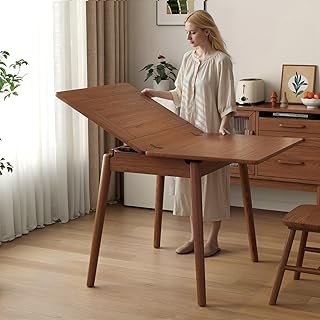
Designed to extend from about 23.6 to 47.2 inches, this walnut solid-wood table is a strong fit for buyers who want a small daily footprint without giving up flexibility. Solid wood brings repairability and a more substantial feel, though the expansion hardware should be operated evenly to prevent premature wear.
Frequently Asked Questions
How much space should I leave around a small dining table?
Leave about 36 inches wherever people need to pass or pull out chairs. In a lightly used corner, approximately 30 inches may be workable, but it will feel noticeably less accessible, especially with armchairs or thick upholstery.
Are benches better than chairs in a small dining room?
Often, yes. A bench can tuck fully beneath the tabletop and accommodates changing group sizes efficiently. However, it provides less individual back support, so a chair-based set may be more comfortable for long meals or for people who need easier sit-to-stand movement.
Is a drop-leaf table durable enough for daily use?
It can be, provided the hinges, supports, and locking points are robust and kept properly aligned. Avoid placing heavy objects on an unsupported leaf, and open or close the mechanism with both hands to reduce twisting stress.
Which tabletop material is easiest to maintain?
Sealed engineered wood is generally easy to wipe clean and offers consistent resistance to everyday wear. Solid wood is also practical, but it benefits from prompt spill cleanup and periodic attention to its finish. Use trivets and avoid abrasive pads on either surface.
Final Thoughts
The Hinged Drop Leaf Dining Table is the most space-conscious option for a very compact room, while the 47.2–63-Inch Extendable Table offers the best balance of everyday footprint and guest capacity. For buyers who value natural material and flexible sizing, the Solid Wood Expandable Table is another compelling choice; measure the complete chair and walking zone before making the final decision.