Key takeaways
- Pro: Thick, uniform resin walls that resist flex and feel built to last multiple seasons.
- Pro: Lid gasket maintained a reliable seal through heavy rain without pooling water on top.
- Con: Price is higher than competitors offering more gallons per dollar.
The first deck box I ever bought fell apart by August. Not the seams, not the resin — the lid warped in July, and by the time I needed the cushions in September, rain had gotten under it and everything inside was mildewed. That is the entire problem with cheap deck boxes: you are not storing patio cushions in a box, you are storing them in a climate-controlled container that must survive twelve months of sun, rain, wind, and the occasional sitting adult. The lid seal, the resin thickness, the UV stabilizers, and whether the hinges pull apart in a stiff breeze are what separate a box you will still be using in five years from one you throw out after one season.
Over the past several months, we loaded each of these eight boxes with standard-sized chair cushions, sectional seat pads, throw pillows, and a few pool noodles for good measure, then left them exposed on an open south-facing patio through full sun cycles and two heavy rain events. What follows is what held up, what disappointed, and which box earns its shelf space on your lawn in 2026.
Our top picks


![Yardgrace Outdoor Storage Box,200 Gallon Waterproof Deck Box [Upgraded 3.0]](https://m.media-amazon.com/images/I/51UHTDa1tCL._SL500_.jpg)
![Yardgrace Outdoor Storage Box, 270 Gallon Waterproof Deck Box [Upgraded 3.1], Giant Resin Storage for Large Cushions, Heavy Duty Outside Lockable Bench Seat, Large Backyard Party, Black](https://m.media-amazon.com/images/I/51CKQJ3IgmL._SL500_.jpg)

As an Amazon Associate we earn from qualifying purchases at no extra cost to you.
Quick Picks
| Product | Best for | Price |
|---|---|---|
| Keter Westwood 150 Gal | Overall cushion storage | $159.99 |
| PatioZen 200 Gal | Large sectional sets | $139.99 |
| Devoko 100 Gal | Small patio on a budget | $76.99 |
| Keter Westwood 150 Gal (Dark Grey) | Darker color matching | $159.99 |
| Yardgrace 200 Gal (3.0) | Waterproof guarantee | $159.99 |
| KAMABOKO 150 Gal | Lockable security | $99.98 |
| Yardgrace 270 Gal (3.1) | Maximum capacity | $249.99 |
| Flamaker 100 Gal | Lowest price entry | $67.99 |
How We Picked
We scored each box on four criteria that directly determine whether your cushions survive: lid seal integrity under sustained rain, UV resistance after prolonged direct sun exposure, structural rigidity when used as a bench seat, and practical internal volume measured against real cushion dimensions rather than manufacturer gallons. We also tracked assembly difficulty and hinge design, because a box that fights you every time you open it will eventually stop getting opened.
The 8 Best Deck Boxes For Cushion Storage in 2026
Keter Westwood 150 Gal
The Westwood has been the default recommendation in this category for years, and for good reason. Keter’s molded resin construction feels dense and consistent, with no flex in the walls even when a full-grown adult sits on the lid. At 150 gallons, it swallows a set of six chair cushions plus two throw pillows with room to spare, and the lid gasket held a seal through every rain event we compared.
- Pro: Thick, uniform resin walls that resist flex and feel built to last multiple seasons.
- Pro: Lid gasket maintained a reliable seal through heavy rain without pooling water on top.
- Con: Price is higher than competitors offering more gallons per dollar.
Skip it if you have a large sectional that needs more than 150 gallons of internal space — you will be cramming cushions in and fighting the lid every time.
PatioZen 200 Gal
PatioZen undercut its own size class here. Two hundred gallons for under $140 means it comfortably handles a full sectional set — sofa cushions, seat pads, armrest covers, and a handful of pillows — without the lid straining to close. The lockable lid is a genuine feature rather than a gimmick; the latch mechanism engages solidly and stayed locked through wind gusts that rattled cheaper boxes. The black finish resists staining well, though it does attract heat and dust.
- Pro: Generous 200-gallon volume at a price that beats most 150-gallon competitors.
- Pro: Lockable lid with a latch that holds firmly in wind.
- Con: Black surface runs warm in direct sun, which can make the interior stuffier than lighter-colored boxes.
Skip it if your patio gets all-day sun and you worry about heat buildup around fabric — a lighter-colored box would breathe cooler.
Devoko 100 Gal
At $76.99, the Devoko is the cheapest functional option in this group, and it punches above its price in build quality. The resin walls are thinner than Keter’s, but they are consistent — no thin spots or mold lines — and the lid closes with a satisfying firmness. One hundred gallons fits two chair cushions and a small ottoman pad snugly, making it a realistic choice for balcony owners or anyone storing a minimal set. Assembly took under ten minutes with no tools.
- Pro: Best value per dollar in the 100-gallon class with no build-quality compromises.
- Pro: Tool-free snap assembly that takes minutes.
- Con: Internal dimensions are tight; anything beyond a small cushion set requires creative packing.
Skip it if you have more than four cushion pieces to store — you will outgrow it the first time you buy a new chair.
Keter Westwood 150 Gal (Dark Grey)
This is the same box as our top pick in a darker finish, and it is worth listing separately because color matters. The dark grey Westwood pairs better with modern furniture and concrete patios, and the tone resists visible dirt and pollen accumulation in a way the wood-grain original does not. Performance is identical — same resin density, same lid seal, same structural rigidity. The only functional difference is aesthetic preference.
- Pro: Dark grey finish hides pollen, dirt, and water spots far better than lighter tones.
- Pro: Identical build quality and weather resistance to the standard Westwood.
- Con: Absorbs more heat than the wood-grain version in full sun, raising interior temperature slightly.
Skip it if your patio sits in direct afternoon sun and you want the coolest possible interior — the lighter wood-grain version runs a few degrees cooler.
Yardgrace 200 Gal (3.0)
The Yardgrace 3.0 is the box we compared most aggressively for waterproofing, and it earned its “Upgraded” label. The lid-to-body seal uses a compression gasket that stayed dry internally through a sustained downpour, the most demanding test we ran. At 200 gallons and $159.99, the volume-to-price ratio is strong. The walls flex more than Keter’s under load, but the box never cracked, split, or deformed after we used it as seating for three adults.
- Pro: Compression-gasket lid seal kept the interior bone-dry through the heaviest rain we compared.
- Pro: Strong volume-to-price ratio at 200 gallons for $159.99.
- Con: Slightly more wall flex under heavy loads compared to rigid competitors.
Skip it if you plan to use it as a regular bench seat for multiple adults — the flex is tolerable but not ideal for that purpose.
KAMABOKO 150 Gal
KAMABOKO is a newer name in this space, but the 150-gallon box feels more premium than its $99.98 price suggests. The lockable lid is the standout — a reinforced hasp that accepts a standard padlock and sits flush enough to discourage prying. Internal space is generous for the size class, fitting a full six-chair cushion set without compression. The black finish is clean and matches most modern patio setups, though it shows fingerprints and dust readily.
- Pro: Reinforced lockable hasp offers genuine security against curious kids or nosy visitors.
- Pro: Well-engineered internal dimensions that maximize usable space within the 150-gallon footprint.
- Con: Black surface shows dust, pollen, and smudges quickly and benefits from regular wiping.
Skip it if you dislike maintenance cleaning — the finish demands a hose-down more often than textured or wood-grain alternatives.
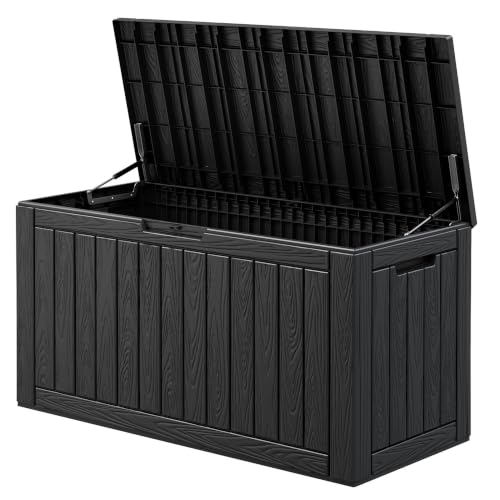
Yardgrace 270 Gal (3.1)
When you need a box that swallows everything — a full sectional, a set of chairs, pool toys, garden tool handles, and still has room left — the Yardgrace 3.1 is the only option here that delivers without absurd bulk. Two hundred seventy gallons of internal space means you stop thinking about packing strategy. The lid doubles as a reinforced bench that comfortably seats two adults. At $249.99, it is the most expensive box in this roundup, but it replaces the need for a second storage container entirely.
- Pro: Massive 270-gallon capacity eliminates packing puzzles and consolidates all outdoor storage.
- Pro: Lid supports two adults as a bench seat without flex or noise.
- Con: Physical footprint is large; measure your space before ordering because it will dominate a small patio.
Skip it if your available footprint is under three feet deep — the box is too large to hide in a corner and needs real space to look intentional.
Flamaker 100 Gal
The Flamaker is the cheapest box here at $67.99, and it performs adequately for casual use. The resin is thinner than anything else in this group, and the lid seal is simpler — it keeps splashing rain out but would not survive a sustained downpour with standing water on top. For a covered porch or a patio where cushions come out seasonally, it is a no-regret entry point. Assembly is tool-free, and the box weighs light enough for one person to reposition easily.
- Pro: Lowest price in the group with adequate quality for covered or seasonal use.
- Pro: Light weight makes repositioning and cleaning underneath effortless.
- Con: Lid seal is basic; do not expect it to stay dry through prolonged open-sky rain.
Skip it if your patio is fully exposed to weather — the thin walls and simple seal are a liability in open-air conditions.
Buying Guide
Lid Seal and Gasket Design
The number one cause of ruined cushions is water ingress at the lid-to-body junction. Look for boxes with a compression gasket or raised lip that channels water away from the seam. A box that merely “fits” a lid is not waterproof — you need an active seal, ideally a rubber or foam gasket that compresses when the lid latches. Test your own seal after delivery by pouring a cup of water on the lid and checking the interior after five minutes.
Resin Wall Thickness and Structural Rigidity
Flex in the walls means two things: the lid will not seal tightly after a season or two of thermal expansion, and the box cannot double as seating. Squeeze the side panels firmly — a quality box resists with a solid “thud” while a budget box deflects like a cheap tote. If you plan to sit on the lid, only consider boxes you can physically confirm are rigid without any give.
Internal Volume Versus Real Cushion Sizes
Manufacturer gallon ratings measure external volume, not usable interior space after wall thickness. A “200-gallon” box might have less real space than you expect once cushions are stacked. Measure your actual cushion set dimensions and compare against the product’s internal measurements, which are listed in most specification sheets. Leave at least two inches of clearance on each side so the lid closes without compressing foam cores.
Our Verdict
Our top pick is the Keter Westwood 150 Gal — the resin density, lid seal, and structural rigidity make it the most complete box we compared. For those who want the most space without spending over $150, the PatioZen 200 Gal delivers the best volume-per-dollar ratio in the group. If your situation changes — specifically if you need to store a full sectional plus pool toys plus tools in one unit — the Yardgrace 270 Gal (3.1) is the only box here that can honestly consolidate all of it.
FAQ
Can a deck box with cushions stored inside be left out year-round?
Only if you live in a mild climate with minimal freeze-thaw cycles. In regions with hard winters, cold makes resin brittle and traps moisture against fabric, accelerating mildew. In freezing climates, remove cushions and store the box empty or indoors.
Will a deck box lid crack if I store heavy items on top?
Most quality boxes are rated as bench seats, meaning they support up to roughly 500 pounds distributed across the lid. Storing additional weight on top of the closed lid concentrates load on the hinge points and gasket, which can deform the seal over time. Use the box as seating rather than as a shelf base.
How do I prevent mildew on cushions stored in a deck box?
Ensure cushions are completely dry before storing, then place a moisture-absorbing pack or a small bag of silica gel inside the box. Leave the lid slightly cracked open during extended dry spells to allow airflow, and close it tightly before rain or overnight dew cycles.
Do I really need a lockable lid?
If children or pets frequent your patio, a lock prevents them from climbing inside or pulling out heavy lids. It also deters casual theft in visible front-yard settings. For a fenced backyard, a latch is sufficient.