
Most people shopping for a mat are thinking about their own comfort. If you train in an upstairs flat or above a room where someone is working, you should also be thinking about the floor. A dumbbell set down carelessly, a kettlebell placed on tile, or a burpee landing all transmit energy straight into the structure, and the person below hears it as a thump rather than as exercise. A mat is the cheapest intervention available, but only if you buy for impact absorption rather than for softness.
Those are not the same property. Soft foam compresses instantly and bottoms out, passing most of the shock through to the floor beneath. Dense foam absorbs energy progressively across its whole depth, which is why gym flooring is firm rather than plush. The same distinction protects your floor finish — a dense mat spreads the load of a dumbbell edge, while a soft one lets it press through to the laminate underneath. The options below are compared on exactly that.
Our top picks


As an Amazon Associate we earn from qualifying purchases at no extra cost to you.
Quick Comparison
| Product | Best For | Standout Feature | Watch Out For |
|---|---|---|---|
| CAP Barbell 1/2-Inch High Density Mat | Absorbing impact from weights | Dense half-inch foam that spreads load | Not a substitute for proper gym flooring |
| Fitvids 1/2-Inch Extra Thick Mat | Protecting floor finishes | Anti-tear surface under equipment edges | Point loads still mark soft flooring |
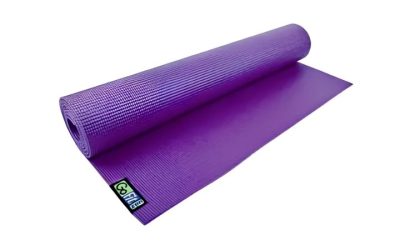
| KEEP Extra Thick NBR Mat, 10mm | Quieting bodyweight training | 10mm depth over a large 72 by 24 area | Soft NBR bottoms out under heavy weights |
| Gaiam Thick NBR Yoga Mat | Light equipment and floor work | Cushioning that dampens small impacts | Compresses quickly under concentrated load |
| Amazon Basics Extra Thick Exercise Mat | General noise reduction | Affordable coverage of a training area | Soft foam transmits heavy impacts |
| CAP Non-Slip Yoga Mat | Keeping equipment from sliding | Textured surface that holds gear in place | Too thin for meaningful sound damping |
How to Choose
- Density absorbs, softness does not: Firm foam dissipates impact energy across its depth. Plush foam collapses and passes the shock straight through.
- Match to the heaviest item: A mat that handles a 15 lb dumbbell will not handle a 50 lb one. Size the density to what you actually set down on it.
- Watch point loads: Dumbbell ends and bench feet concentrate force on small areas. Dense material spreads that; soft foam lets it press through.
- Cover the landing zone: Noise complaints come from where equipment lands, not where you stand. Extend the mat past your working footprint.
- Know the limit: No exercise mat replaces rubber gym flooring for heavy lifting. If you are dropping weight, you need a different product entirely.
Top Picks Reviewed
Best Impact Absorption: CAP Barbell 1/2-Inch High Density Mat
Half an inch of dense foam is the closest thing here to proper gym flooring behaviour. It compresses progressively rather than bottoming out, which means a dumbbell set down firmly produces a dull press rather than a sharp knock through the floor.
It is still an exercise mat, not a lifting platform. Repeatedly dropping heavy weights will drive through it and into the floor, and no half-inch foam layer changes that. Use it for controlled set-downs, not for dropping.
Best Floor Protection: Fitvids 1/2-Inch Extra Thick Mat
Anti-tear construction matters when equipment edges are involved, because dumbbell ends and bench feet cut into softer surfaces. A tougher top layer spreads that contact and keeps both the mat and the floor beneath intact.
Concentrated point loads over a long period can still leave impressions in soft flooring like vinyl or engineered wood. If a bench lives permanently in one spot, put something rigid under the feet as well.
Best for Bodyweight Noise: KEEP Extra Thick NBR Mat
For burpees, jumping jacks, mountain climbers and similar bodyweight work, 10mm of NBR across a 72 by 24 inch area is genuinely effective at softening the landings that neighbours actually hear. It also covers enough ground that you are not landing off the edge.
Put a heavy dumbbell on it and the foam bottoms out. Soft NBR is excellent for distributed bodyweight impact and poor at handling concentrated weight, so pair it with something denser if free weights are part of your routine.
Best for Equipment Stability: CAP Non-Slip Yoga Mat
A thin textured mat is not about noise — it is about keeping things where you put them. Kettlebells that creep, benches that shift and dumbbells that roll are all annoyances a grippy surface solves.
Do not expect any meaningful sound damping from it. There is too little material to absorb impact, so on hard flooring the noise transmission is essentially unchanged from bare floor.
Frequently Asked Questions
Will a mat stop my neighbours hearing me?
It will reduce impact noise substantially, particularly from bodyweight movements. It will not eliminate the sound of dropped weights, which transmits through the structure regardless of what is on top of the floor.
Can I drop dumbbells on an exercise mat?
You can, but you should not. Foam mats are designed for controlled contact, and repeatedly dropping weights will crush the foam and eventually reach the floor. Rubber tiles are the right product for that.
How much area should I cover?
At minimum, the area where you stand plus where equipment gets set down. Extending a couple of feet past your working footprint catches the moments when something lands off-target.
Does thickness or density matter more for noise?
Density, for anything involving weight. For bodyweight landings, thickness helps more. The ideal for a mixed home gym is a dense mat of moderate depth rather than a very soft thick one.
Final Thoughts
If the goal is protecting a floor and keeping the peace, buy density and cover the landing zone. The CAP Barbell and Fitvids half-inch mats absorb equipment impact and shield floor finishes, the KEEP 10mm mat is the better choice for bodyweight landings, and a thin CAP non-slip mat is for keeping gear stationary rather than quiet. Set weights down deliberately — technique reduces more noise than any mat can.
Write Your Review
No reviews yet. Be the first to share your experience!