Key takeaways
- Is the library live, on-demand, or both? Live schedules are a nice-to-have; on-demand is what you will actually use at 6:40 a.m. A library that is 80 percent live-only is worth much less to most households.
- What is the class-length distribution? A library with thousands of 45–60 minute classes is useless if you have 20-minute windows. Look for a deep bench of 10, 15, and 20 minute sessions.
- Does the mirror filter by equipment? If you own two dumbbells and a mat, a library that assumes a barbell, a rower, and a bike will frustrate you.
- Does it work with the subscription off? Almost every fitness mirror becomes a very expensive plain mirror when the membership lapses. A small number keep a rotating free tier or a handful of built-in programs. This single detail changes the five-year math more than any Black Friday discount.
Best Black Friday Fitness Mirror Deals: The Direct Answer
The best Black Friday fitness mirror deals in 2026 are the ones that discount the hardware without locking you into a subscription you cannot cancel — in practice, that means roughly $500–$900 for a 40–43 inch mirror, $1,200–$1,900 for a 50–55 inch model, and a membership line you read before the sale price line, because a $400 saving on the mirror disappears in ten months at $40 per month. The second-best deals are bundle deals: hardware plus 12 months of classes at a combined price lower than buying each separately, but only if you would have paid for the membership anyway. The worst deals are legacy and discontinued mirror hardware sold at a deep discount with no warranty, no firmware updates, and an app that may stop working.
This guide is written for people who have already decided a mirror might fit their room and now need to choose a size, a mounting method, a content library, and a subscription they can live with. It covers display size and viewing distance in feet, wall and floor placement with real clearance numbers, room-size fit for a 10×12 ft space, privacy hardware you can verify with your own hands, and what actually wears out over five years.
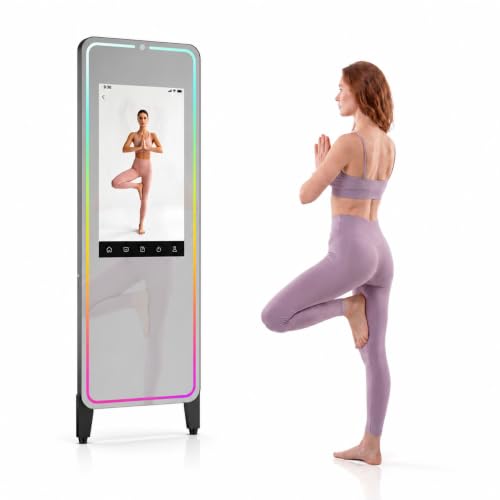
Smart Gym Mirror with 32 Inch FHD Touchscreen, Full-Length Fitness Mirror
Included for 'Best Black Friday Fitness Mirror Deals' because the listing specifies Full-Length Fitness Mirror, details this guide uses to compare options.
View on AmazonSix Things That Decide Whether a Fitness Mirror Works in Your Home
1. Display Size, Viewing Distance, and Weight
Fitness mirrors are sold by screen size the way televisions are, but the physics are different: you are standing, sweating, and moving, so you sit farther back than you would for a TV and you look at the screen from odd angles. A 32-inch mirror at four feet is fine for a guided stretch session and miserable for a HIIT class where the instructor is demonstrating footwork. A 50-inch mirror in a room where you can only back up five feet is worse than a 40-inch mirror in the same room, because you cannot see the whole panel without turning your head.
The other number nobody advertises is shipping weight. A mirror-finish panel is glass with a reflective coating, a touchscreen digitizer, a frame, and a power supply, so it weighs substantially more than a television of the same size. That weight determines whether you can mount it yourself, whether two people are needed to lift it, and whether your wall can hold it.
| Screen size | Typical resolution | Comfortable viewing distance | Wall width to reserve | Typical shipping weight | Fits best in |
|---|---|---|---|---|---|
| 32 in | 1080p | 3.5–5 ft | 30–34 in | 25–40 lb | Studio apartments, single user, yoga and mobility only |
| 40–43 in | 1080p or 4K | 5–7 ft | 40–46 in | 40–60 lb | Bedrooms, spare rooms, most apartments |
| 50 in | 4K | 6–8 ft | 48–54 in | 65–90 lb | Dedicated workout rooms, finished basements |
| 55 in | 4K | 7–9 ft | 52–58 in | 80–110 lb | Garages, basements, rooms 120 sq ft and up |
Add roughly 0.5–1 inch of depth and 5–10 lb to any of those figures if the unit uses a thick mirror-finish glass sandwich rather than a coated panel. If your room is under 8 feet deep in the direction you would face the mirror, buy 40 inches and stop shopping.
2. Class Libraries: What “Thousands of Classes” Actually Means
A class count is a marketing number. What matters is whether the library covers the thing you personally do three times a week. Ask four questions before you buy:
- Is the library live, on-demand, or both? Live schedules are a nice-to-have; on-demand is what you will actually use at 6:40 a.m. A library that is 80 percent live-only is worth much less to most households.
- What is the class-length distribution? A library with thousands of 45–60 minute classes is useless if you have 20-minute windows. Look for a deep bench of 10, 15, and 20 minute sessions.
- Does the mirror filter by equipment? If you own two dumbbells and a mat, a library that assumes a barbell, a rower, and a bike will frustrate you.
- Does it work with the subscription off? Almost every fitness mirror becomes a very expensive plain mirror when the membership lapses. A small number keep a rotating free tier or a handful of built-in programs. This single detail changes the five-year math more than any Black Friday discount.
3. Subscription Costs and the Five-Year Math
Black Friday pricing pushes hardware discounts and quietly leaves subscriptions alone. That is why a $600 mirror with a $40 monthly plan costs more over five years than a $1,000 mirror with a $15 monthly plan. Typical 2026 market ranges for the major platforms land between $13 and $60 per month, with annual plans usually saving two to three months.
| Platform class | Typical monthly | Typical annual | What you keep if you cancel |
|---|---|---|---|
| Premium mirror ecosystems | $35–$45 | $350–$450 | Mirror mode, sometimes a small free class set |
| Wall-mounted strength trainers | $50–$60 | $500–$650 | Very limited functionality; resistance features are gated |
| General fitness app tiers (usable with a DIY mirror setup) | $13–$25 | $130–$250 | App access ends; your hardware still works |
| Free or ad-supported app tiers | $0 | $0 | Everything except premium programs |
| Scenario | Hardware | Monthly | 5-year membership | 5-year total |
|---|---|---|---|---|
| Premium 50 in mirror, full membership | $1,800 | $40 | $2,400 | $4,200 |
| Mid 43 in mirror, full membership | $900 | $40 | $2,400 | $3,300 |
| Mid 43 in mirror, budget app tier | $900 | $15 | $900 | $1,800 |
| Budget 40 in mirror, no subscription | $500 | $0 | $0 | $500 |
| DIY full-length mirror plus wall TV and app | $700 | $15 | $900 | $1,600 |
4. Wall-Mounted vs Floor-Standing Placement
Wall-mounted is the safer and better-looking option, and it is the one that requires real planning. Standard stud spacing is 16 inches on center, though some homes use 24 inches. A 5/16-inch lag bolt driven into a stud holds far more than any mirror weighs, but a single stud is not enough for a 50-inch unit because the panel will twist. Plan on two studs, or four heavy-duty toggle anchors rated 50–100 lb each in half-inch drywall.
- Mounting height: put the center of the screen 58–62 inches above the floor for standing workouts, and 42–48 inches if you will only ever use it lying on a mat. Bottom edge usually lands 30–36 inches up; top edge 78–84 inches. With an 8 ft ceiling (96 inches) that leaves 12–18 inches of clearance above the panel.
- Depth: a wall-mounted mirror sits 1.5–3 inches off the wall. A floor-standing or leaning unit on a base eats 12–18 inches of floor depth, which matters in a small room.
- Power: most units ship with a 5–8 ft cord. Plan an outlet within 6 ft, or budget for a low-profile cord channel. Never run the cord under a rug or a mat — it traps heat and it is a trip hazard during burpees.
- Tethering: a leaning 55-inch mirror is a tip-over hazard for kids and pets. If you go floor-standing, use the supplied anti-tip strap into a stud, and consider mounting above 48 inches instead.
5. Room Requirements: Real Numbers for Real Rooms
A 10×12 ft room is 120 square feet. Once a bed, desk, or dresser is in it, usable open floor is usually 6×8 ft. That is enough for a yoga mat (typically 68×24 inches) with 7×3 ft of clear space, and enough for bodyweight HIIT if you can move one piece of furniture. It is not enough for a 55-inch mirror at a 9-foot viewing distance.
- Clear workout zone: 8×8 ft for a full mat plus arm reach, or 6×8 ft for standing classes.
- Camera field of view: most built-in cameras capture a full body at 6–10 ft. If you can only back up 4 ft, form-correction features will not track you — this is the most common reason fitness mirrors get returned.
- Ceiling height: 8 ft minimum for standing overhead reach; 9–10 ft if you press a 7 ft barbell overhead, plus a foot of clearance above the plates.
- Moisture and heat: keep the mirror at least 3 ft from a shower and off radiators. Above 60 percent relative humidity, condensation forms on the cool glass surface and electronics do not enjoy it.
- Sunlight: avoid mounting opposite a window. Direct sun on a mirror panel creates glare at eye level and localized heat on the frame.
- Flooring: 4–6 mm rubber over hardwood is the sweet spot. Thick 3/4-inch foam on carpet makes balance work unreliable.
6. Privacy Features You Can Verify Before Buying
Every fitness mirror with form feedback has a camera, and most have a microphone array. The difference between a thoughtful design and a careless one is whether the privacy controls are physical or software-only.
- Physical camera shutter: a sliding cover you can close with a finger. This is the gold standard because it cannot be defeated by a firmware bug.
- Hardware microphone mute: a switch that cuts the mic at the circuit level, not a software toggle that shows a crossed-out icon.
- Camera-active indicator: an LED that lights only when the sensor is powered. If the LED is software-driven, it proves nothing.
- On-device processing: some systems run pose estimation locally and never upload video; others stream frames to a server. Ask which, in writing, before you buy.
- Guest and multi-profile modes: useful if you share a household and do not want your metrics merged with someone else’s.
- Class playback without the camera: most libraries let you take a class with form feedback off. Confirm that the camera stays off when you do.
- Network hygiene: budget 10–15 Mbps for HD streaming and 25 Mbps for 4K. Put the mirror on a guest Wi-Fi network if your router supports one — it isolates the device from your computers and file shares for no cost.
Decision Matrix: Match the Mirror to Your Situation
| Your situation | Prioritize | What fits | Avoid |
|---|---|---|---|
| Apartment under 500 sq ft | Zero floor footprint, small screen | 32–40 in wall-mounted | 50–55 in, floor stands, base cabinets |
| Renter, no drilling allowed | Freestanding mirror plus a tablet, or two small anchor points | Full-length mirror plus tablet or wall-mounted TV on a stand | Systems needing four studs or professional install |
| Kids and pets in the house | Tempered glass, anti-tip tether, physical camera shutter | Wall-mounted above 48 in | Leaning mirrors, low floor stands |
| Back pain or rehab | Deep on-demand library with slow, low-impact programming | 43 in with a broad library and adjustable playback speed | Subscription-locked hardware with a narrow strength-only library |
| Strength training focus | Wall width, ceiling height, weight capacity | Wall-mounted resistance trainer or mirror plus a rack | 32 in screens, rooms with 8 ft ceilings and overhead pressing |
| Yoga only | Visibility from the floor | 40–43 in mounted lower, center 44–48 in | 50+ in mounted high where you cannot see it from a mat |
| Two or more regular users | Four or more profiles, fast account switching | Any multi-profile system | Single-profile devices |
| All-in budget under $700 | Hardware you keep forever, content you rent | Unbranded 40–43 in panel plus a general fitness app | Premium ecosystems with $40+ monthly plans |
The Products: A Section for Every Mirror and Mirror-Class System
Echelon Reflect 40″
The Reflect 40 is the most common entry point into mirror-style training and the one most likely to see a genuine Black Friday cut. It is a 40-inch mirror-finish touchscreen designed for wall mounting, with a class library that spans strength, cardio, yoga, and cycling-style sessions, and it pairs with the brand’s bikes and rowers if you already own them. Retail typically sits around $1,000–$1,500; Black Friday pricing usually lands in the $600–$900 band, sometimes with a bundled membership period instead of a deeper hardware cut.
Placement realities: reserve 40–46 inches of wall width, plan on two studs or four heavy toggles, and expect a shipping weight in the 40–60 lb range, which means two people for the lift and one person for the drilling. Center the screen at 58–60 inches if you train standing. Viewing distance of 5–7 ft means the room needs at least 8 ft of depth in the direction you face; a 10×12 ft bedroom with the mirror on the long wall works, a narrow galley room does not.
Subscription: the platform’s membership runs in the $35–$45 monthly range or roughly $350–$450 annually. If you cancel, the hardware reverts to a mirror plus a limited free content set, so treat the membership as part of the purchase price when you do your math. Over five years at $40 per month you will spend about $2,400 on classes — roughly three times the discounted hardware.
Privacy: the unit has a camera for form tracking and a microphone for voice features. Check the current spec sheet for whether the camera cover is a physical slider or a software toggle; if privacy is a deciding factor for you, this is the single specification to confirm before ordering. Classes play fine with form tracking off, which is how most owners use it most of the time.
Who it fits: one or two people in an apartment or spare bedroom who want a broad library and a screen small enough to mount without help. Who it does not fit: anyone who wants a 4K panel, anyone who presses heavy weight overhead, and anyone who will only back up four feet from the wall.
Echelon Reflect Touch 50″
The 50-inch version is the same ecosystem with a much larger canvas, usually 4K, and a price that typically runs $2,000–$2,500 at retail with Black Friday pricing often between $1,300 and $1,800. The jump in size is not cosmetic: at 50 inches you need 48–54 inches of wall width, a viewing distance of 6–8 ft, and a shipping weight of 65–90 lb that realistically requires two adults and a furniture dolly to move through a doorway.
Structure matters here. At 65–90 lb you want two studs minimum, and four anchor points rather than two so the panel cannot rock. Standard interior doorways are 30–32 inches wide and the box for a 50-inch mirror is typically 56–60 inches long and 6–8 inches deep, so it will pass through a doorway upright but not through a narrow stairwell turn with the box on. Measure your stairwell before the delivery date.
Room fit: this is a garage, finished basement, or dedicated 12×12 ft-plus room product. In a 10×12 ft room shared with a bed, you will be standing 5–6 ft away, which is close for a 4K 50-inch panel and close enough that your feet leave the camera frame during lunges.
Subscription and privacy are the same as the 40-inch model: $35–$45 monthly, camera-based form tracking, and the same caveat about confirming whether the privacy cover is physical. If you plan to run classes at 5 a.m. in a shared home, note that the panel doubles as a Bluetooth speaker — useful, but it is not a substitute for headphones, and most systems support Bluetooth audio out.
lululemon Studio Mirror (Legacy Hardware)
The Mirror that defined this category is no longer the center of its own ecosystem. The hardware was a 40-inch-class mirror with a camera and a class library, and the content side has since shifted toward a partnership model where classes are delivered through a third-party fitness app rather than the original Studio subscription. That means most 2026 Black Friday activity on this hardware is remaining stock, refurbished units, and the secondary market, not a fresh manufacturer promotion.
If you find one cheap, it can be an excellent buy: a 40-inch mirror panel, a decent speaker, and a general fitness app tier at $13–$25 per month gets you most of the experience for a fraction of a premium ecosystem’s five-year cost. Two cautions. First, warranty coverage on secondary-market hardware is usually nonexistent, and a failed touchscreen digitizer or power supply is not a user-serviceable part. Second, confirm exactly which app tier unlocks which content before you pay — the value proposition changed after the platform transition, and listings that describe the old subscription may be out of date.
Placement is the same as any 40-inch unit: 40–46 inches of wall width, two studs, center height 58–60 inches, 5–7 ft viewing distance. Privacy-wise, units in this class generally include a camera with a cover and let you run classes with the camera off; verify the cover is mechanical rather than a software toggle on the specific unit you are looking at, because revisions varied.
Who it fits: bargain hunters comfortable with discontinued hardware, renters who want a 40-inch panel and a cheap app, and anyone who already pays for a general fitness app and wants a screen bigger than a phone. Who it does not fit: buyers who want a warranty, guaranteed firmware updates, or a five-year content roadmap.
VAHA (S-Class and X-Class Mirrors)
VAHA is the European answer to this category: a wall-mounted mirror with a touchscreen, a camera, and a class library built around strength, yoga, boxing, and mobility, sold across several sizes. The smaller S-class units sit in the roughly 40-inch range and the larger X-class panels run into the 50-inch-plus range, with corresponding jumps in wall width, weight, and viewing distance. Because the company sells primarily in Europe, Black Friday promotions are usually regional and denominated in euros, and North American buyers should weigh shipping, import duty, and warranty service distance before chasing a discount.
Specs to check on any VAHA listing: screen size and resolution, whether the camera has a physical shutter, whether the microphone has a hardware mute, and what the mirror does without a membership. Membership pricing sits in a roughly $30–$45 monthly equivalent band depending on region and term, with annual plans typically saving two to three months. As with every mirror in this category, the five-year subscription is the dominant cost.
Room fit is standard: 40–46 inches of wall for the small model, 48–54 inches for the large, viewing distance 5–8 ft, two studs minimum, and a shipping weight that climbs from the 40 lb range to the 80 lb range as the panel grows. The larger model benefits from a room of 120 square feet or more, or a wall that faces a genuinely open floor area.
Who it fits: European buyers who want local warranty service and a mirror-first design. Who it does not fit: North American buyers who want same-week service and a domestic returns process.
Fiture Mirror
Fiture is the other significant non-North-American entrant, with mirror panels in the 43-inch and 55-inch classes and a library that leans toward strength, dance, and boxing. Availability is concentrated in Asia and parts of Europe, and the app experience is strongest in the regions where the service operates. For buyers outside those regions, the practical issues are language support, app store availability, and warranty logistics — three things that matter more than a Black Friday discount.
Where it competes well is panel quality for the money: a 43-inch mirror-finish touchscreen at a mid-market price, with a subscription in the roughly $30–$45 monthly equivalent band. Where it competes poorly, for some buyers, is content depth in English and the availability of replacement parts.
Placement: 43-inch units need 40–46 inches of wall width and 5–7 ft of viewing distance; 55-inch units need 52–58 inches of wall and 7–9 ft. Weight runs from the 45–60 lb range up to the 90 lb range, so the larger panel is a two-person, two-stud job. Confirm camera privacy hardware before purchase: the specification varies by generation, and a physical shutter is the only control that cannot be changed by an update.
Who it fits: buyers in supported regions who want a large mirror panel at a lower price than the premium ecosystems. Who it does not fit: buyers who need English-language support, domestic service, or a long content roadmap.
Tonal (Wall-Mounted Digital Resistance Trainer)
Tonal is not a mirror, but it is the product most fitness mirror shoppers end up comparing against, because it occupies the same wall and solves the same “I do not want a rack in my living room” problem with a different mechanism: digital resistance instead of free weights, delivered through articulating arms on a wall-mounted unit. Current-generation hardware typically runs $3,500–$4,500, plus a membership in the roughly $50–$60 monthly range, which makes the five-year total substantially higher than any mirror in this guide.
The installation requirements are the reason it belongs in this article. You need a wall with adequate structure, roughly 7–8 ft of usable wall width, and about 7 ft of clear floor depth in front of it. Ceiling height matters if you use the arms overhead; 8 ft is workable for most movements, 9–10 ft is comfortable. Because the unit replaces a rack, the trade is space for cost: you give up a footprint of roughly 6×6 ft and gain a $4,000 hardware bill.
Content-wise, the library is strength-first with some mobility and yoga. If your primary activity is yoga, dance, or low-impact cardio, a mirror is a better use of the wall and the money. If your primary activity is progressive strength training with measurable load, digital resistance is genuinely different from a mirror, and no Black Friday discount changes that.
Privacy considerations are lighter than a mirror’s: the camera is used for form feedback and can generally be disabled, and the unit does not need to see you to load resistance. If camera-free training matters to you, this is a point in its favor.
Who it fits: dedicated strength trainees with a spare wall, an 8 ft ceiling, and a budget that tolerates a $4,000-plus five-year cost. Who it does not fit: renters, small apartments, and anyone whose main goal is guided classes rather than load progression.
Tempo Studio and Tempo Move
Tempo built two distinct products around the same idea: a screen with 3D sensors that watches your form, plus a weight storage system that doubles as furniture. Tempo Studio is the larger system — a roughly 42-inch touchscreen on a weight cabinet, originally in the $2,000–$2,500 range with a membership around $39 per month. Tempo Move is the smaller sibling: a compact weight storage unit plus a phone-based display, historically in the $400–$600 range, which makes it the cheapest way to get sensor-based form feedback without buying a mirror panel at all.
Because the company’s lineup has changed over time, confirm current availability and support status before you buy, and treat any Black Friday pricing as valid only for units sold with a current warranty. That caution applies to every product in this guide, but it applies most to systems whose hardware is tied to a single company’s app.
Placement is where Tempo Studio differs from a mirror. It is a floor-standing cabinet, not a wall panel, so it consumes roughly 2–3 square feet of floor and about 2 ft of depth, and it needs the same 6–10 ft of camera distance that mirrors do. If your room is tight, the wall-mounted mirror wins; if you want your weights stored and hidden, the cabinet wins. Room requirement: a clear zone of at least 8×8 ft, because you will be lifting and stepping back from a racked barbell.
Privacy: 3D sensors are a different privacy profile from a camera — depth sensing can be processed locally and does not necessarily capture identifiable imagery. Ask whether pose data is processed on-device, and whether the system stores video clips of your sets. Some do, to show you form replays; some keep it local.
Who it fits: strength trainees who want form feedback and hidden weight storage in a room with 8×8 ft of clear floor. Who it does not fit: studio apartments and anyone whose priority is yoga or dance content.
Legacy Mirror Hardware: NordicTrack Vault, ProForm Vue, and Similar Discontinued Panels
A generation of mirror-style products from the connected-fitness boom — including mirrored cabinets with embedded touchscreens and smaller mirror-plus-screen hybrids — has been discontinued or superseded, and those units show up heavily discounted every November. The appeal is obvious: a large mirror with a touchscreen for a few hundred dollars. The catch is that you are buying hardware whose software support depends on a parent platform that has already moved on.
What to check before buying any legacy panel: whether the embedded app still receives updates, whether the subscription platform that powers it is still selling memberships (in these cases the content platform typically still operates even when the hardware does not), whether replacement power supplies and mounting hardware are available, and whether the touchscreen digitizer is still serviceable. A discontinued 32-inch mirrored cabinet with a working screen and a $39 monthly content plan is a legitimate budget option. The same unit with a dead digitizer is a $300 mirror.
Placement for this class is usually floor-standing, which means anti-tip tethering is mandatory if you have kids or large dogs. Reserve 12–18 inches of floor depth for the base and confirm the cabinet height against your ceiling and your sightlines — many of these units put the screen lower than a wall-mounted mirror, which is fine for floor work and awkward for standing classes.
Who it fits: budget buyers who understand they are buying a screen and a mirror with a finite software life, and who are comfortable sourcing parts. Who it does not fit: anyone who wants a warranty, guaranteed app support, or a product they can resell.
Unbranded 43–55 Inch Smart Mirror Displays
Below the brand ecosystems sits a large tier of unbranded and house-brand mirror-finish touchscreen displays, typically sold as 43-inch or 55-inch panels running an open operating system. These are the most interesting Black Friday category for value, because they frequently land between $400 and $900 with no subscription attached, and because the content comes from whatever app you install.
The trade-offs are consistent across the tier. You get less polished form tracking (usually none), a slower processor, a dimmer panel, and speakers that are adequate for a bedroom and thin in a garage. You also get variability: two units with the same listing photos may have different panels, different mounting brackets, and different firmware. Before buying, confirm the VESA pattern and the anchor hardware included, the panel brightness, the resolution (1080p versus 4K at 43 inches is nearly indistinguishable at 6 ft; at 55 inches it is not), and the return window.
Placement is standard: 40–46 inches of wall width for a 43-inch unit, 52–58 inches for a 55-inch, two studs, center height 58–60 inches, 5–7 ft and 7–9 ft viewing distances respectively. Weight runs lighter than branded units of the same size, often 35–55 lb for 43 inches and 60–85 lb for 55 inches, because there is no camera array or heavy sensor housing.
Privacy is actually the strongest argument for this tier: many units have no camera at all, so there is nothing to shutter. If you want guided classes without a sensor watching your living room, an unbranded panel plus a $13–$25 monthly app tier is the cleanest answer in this entire article, and the five-year cost — roughly $1,300–$2,000 all in — undercuts every premium ecosystem.
Who it fits: value buyers, privacy-conscious buyers, and anyone who already pays for a general fitness app. Who it does not fit: buyers who want form feedback, live classes with instructor interaction, or brand-name service.
Compact 32–40 Inch Apartment Mirrors
The smallest tier exists for one reason: rooms where you cannot back up. A 32-inch mirror at 3.5–5 ft is genuinely usable for mobility, stretching, physical therapy routines, and short strength circuits, and it weighs 25–40 lb, which means one person can mount it and a single pair of anchors can hold it.
What you give up is instructor visibility during fast movement and any realistic form tracking, since the camera field of view at that distance rarely captures a full body in motion. What you gain is that it fits: a 32-inch panel needs only 30–34 inches of wall, it can go above a dresser or beside a closet, and it works in a room where the clear floor zone is 5×7 ft rather than 8×8 ft.
Placement note for small rooms: mount the center lower, around 52–56 inches, if you will mostly train on the floor, and keep the bottom edge at least 24 inches up so a rolled mat can stand beneath it. Reserve a wall section with a stud on one side and use a heavy toggle on the other. If you cannot find a stud, two toggles rated 50 lb each plus a wide backing plate will hold a 35 lb panel safely; do not attempt that with a 90 lb unit.
Content strategy matters more here than hardware. With a small screen, favor apps with strong audio coaching and simple visual cues, because you will be listening more than watching. Subscription cost stays in the $13–$25 monthly band if you avoid the branded ecosystems, and the five-year total for a 32-inch panel plus a budget app typically lands around $1,000–$1,400.
Who it fits: studio apartments, dorm rooms, renters, and anyone whose workouts are mat-based. Who it does not fit: HIIT enthusiasts and strength trainees who need to see footwork and bar path.
DIY: Full-Length Mirror Plus Tablet or Wall TV and an App
The most underrated option in this category is not a product at all. A full-length mirror (typically 65×22 inches, 25–45 lb, $80–$250) mounted beside or above a wall-mounted television or a tablet on an articulating arm gives you the reflective surface and the screen separately, and it costs a fraction of an integrated unit.
The advantages are real. The screen is replaceable and upgradeable without throwing away the mirror. The app is your choice, so you can switch from a $13 monthly tier to a free tier whenever you like. There is no camera unless you add one, and if you do add a webcam, you can unplug it. Nothing is locked to a single company’s ecosystem, which means the hardware does not become e-waste when a platform shuts down.
The disadvantages are equally