Key takeaways
- Deck height and stance: Aim for a cutting surface between 34 and 38 inches so your forearms stay roughly level and you push from the hips instead of the shoulders. A saw sitting on a low bench forces a hunch that fatigues you long before the blade dulls.
- Fence repeatability: Lock the fence, then push sideways on its far end. Any deflection you can feel by hand becomes a tapered rip in plywood. Rack-and-pinion or twin-rail fences hold parallel far better than single-point clamps.
- Vibration and motor design: Universal motors are light but buzzy; worm drive and copper-wound induction motors run smoother and cooler, which protects bearings and keeps your hands from going numb on long sessions.
- Frame rigidity versus carry weight: Every pound you remove from the frame is a pound of stiffness gone. Decide honestly whether the saw lives on a stand or travels weekly, and let a wheeled stand carry the mass instead of your lower back.
- Dust path and guard access: A rear or under-table port that accepts a standard hose keeps fine dust below your breathing zone, and a riving knife you can remove without tools is one you will actually reinstall.
What's inside
Most benchtop saw regret has nothing to do with horsepower. It shows up in the shoulders after an hour of ripping at the wrong deck height, in a stand that shuffles sideways mid-cut, or in a fence that reads square in the morning and drifts by lunch. Spec sheets lead with amps and RPM because those numbers are easy to print, but the parts that decide whether a saw is pleasant to use for a decade are quieter: trunnion castings, bearing quality, leg geometry, and how the machine loads your body when you feed stock across it.
This guide looks at bench table saws through an ergonomics-and-durability lens. Below you will find current picks spanning full 10-inch benchtop saws, folding work surfaces that double as saw support, and a compact hobby option, followed by a buying framework built around posture, rigidity, and the failure points that actually end a saw’s service life.
As an Amazon Associate we earn from qualifying purchases.



🛒 Best Price Today on Amazon
Prime members get fast, free shipping on everything above, plus member-only deals. New members get a 30-day free trial — cancel anytime.
How to Choose a Bench Table Saw (2026)
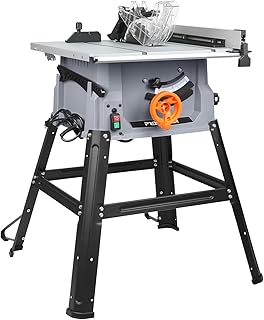
- Deck height and stance: Aim for a cutting surface between 34 and 38 inches so your forearms stay roughly level and you push from the hips instead of the shoulders. A saw sitting on a low bench forces a hunch that fatigues you long before the blade dulls.
- Fence repeatability: Lock the fence, then push sideways on its far end. Any deflection you can feel by hand becomes a tapered rip in plywood. Rack-and-pinion or twin-rail fences hold parallel far better than single-point clamps.
- Vibration and motor design: Universal motors are light but buzzy; worm drive and copper-wound induction motors run smoother and cooler, which protects bearings and keeps your hands from going numb on long sessions.
- Frame rigidity versus carry weight: Every pound you remove from the frame is a pound of stiffness gone. Decide honestly whether the saw lives on a stand or travels weekly, and let a wheeled stand carry the mass instead of your lower back.
- Dust path and guard access: A rear or under-table port that accepts a standard hose keeps fine dust below your breathing zone, and a riving knife you can remove without tools is one you will actually reinstall.
The Best Bench Table Saws of 2026, Reviewed
SKIL SPT99-11 Worm Drive Table Saw
The worm drive gearing delivers torque through hardwood without the pitch drop that makes lighter saws feel strained, and the rack-and-pinion fence is the most repeatable in this price bracket. Its stand puts the deck at a genuinely comfortable working height, which is why it remains the durability benchmark for jobsite-grade benchtop saws.
DOVAMAN DTS10A 10″ Table Saw
A copper-wound motor spinning 5,300 RPM plus 3.35 inches of cut at 90 degrees covers nearly every furniture task short of resawing, and the one-side extension gives sheet goods somewhere to land instead of tipping. Good pick if you want induction-style smoothness and an included stand without stretching the budget.
Prostormer 10″ Table Saw with Stand
The 15A motor and 45-degree bevel handle decking, trim, and casework confidently, and the bundled stand spares you from improvising a base at the wrong elevation. Treat the factory fence alignment as a starting point: spend ten minutes squaring it on setup and this saw punches above its weight.
WORX WX051 Pegasus Folding Workbench
At 31 by 25 inches with a fast fold-flat transition, the Pegasus works as an outfeed table, assembly surface, or sawhorse pair, and the two clamps and four clamp dogs turn it into a real workholding station. Its 32-inch height pairs naturally with a benchtop saw deck, which is exactly what you want for supporting long rips.
2-in-1 Folding Workbench, 500 lb Capacity
Same footprint as the Pegasus but rated to 500 pounds and supplied with six bench dogs, making it the better choice if you are clamping heavy panels or doors. The mobile base means you can reposition it around a saw rather than dragging stock to a fixed surface.
Frequently Asked Questions
What height should my saw table sit at?
Stand relaxed and measure from the floor to your wrist crease; that number, give or take two inches, is your ideal deck height. Most stands land close, and shimming the legs or adding a low platform is a legitimate fix.
Is a worm drive saw worth the extra weight?
If you cut hardwood, wet lumber, or thick stock regularly, yes. The gear reduction keeps blade speed steady under load, which reduces burning, kickback risk, and long-term strain on the motor.
Can a folding workbench replace a saw stand?
It can support a benchtop saw if the deck is level and the saw is fastened down, though a purpose-built stand is more stable. Folding benches earn their keep as infeed and outfeed support, which is where most cutting accidents originate.
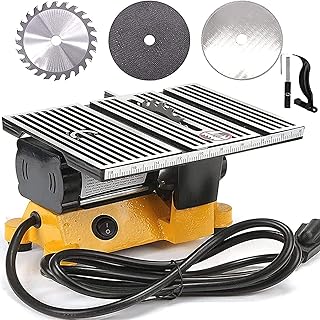
Are 4-inch mini table saws useful?
For balsa, thin plywood, model work, and craft stock, a 60W mini saw is precise and safe in ways a 10-inch machine cannot match. It is a complement to a full-size saw, not a substitute.
Final Thoughts
For a saw you will still trust in ten years, the SKIL SPT99-11 is the clear durability pick, with the DOVAMAN DTS10A offering most of the smoothness and capacity for less. Pair either with the WORX WX051 Pegasus, and you have a compact setup that keeps your stock supported and your posture out of trouble.