Key takeaways
- Airflow: Prioritize CFM at 90 PSI, not maximum PSI alone. A compressor should meet or exceed your spray gun’s stated consumption, preferably with a margin of roughly 25 percent.
- Tank capacity: A larger tank provides a buffer for spraying and reduces motor cycling. For automotive panels, 8 gallons is a workable minimum, while 13 to 29 gallons is more comfortable.
- Moisture control: Compressed air produces condensation, especially during long sessions. Use a regulator, water separator, and suitable air hose to help prevent water spots and finish defects.
- Noise and placement: Quiet operation is valuable in a residential garage, but it should not outweigh airflow. Place the unit on a stable surface with ventilation and enough clearance for cooling.
- Spray-gun compatibility: Check whether your gun is conventional, HVLP, or LVLP. A low-volume LVLP gun can work with smaller compressors, while many full-size HVLP guns demand substantially more air.
What's inside
Painting a car at home is less about peak pressure and more about delivering a steady, clean stream of air. Many compressors advertise impressive PSI figures, yet struggle to maintain the airflow a spray gun needs, causing pulsing, uneven coverage, or frequent pauses while the tank recovers. Noise, condensation, portability, and maintenance also matter when the compressor is being used in a garage rather than a professional booth.
This guide focuses on the practical details that affect finish quality and long-term usability: usable CFM at spray-gun pressure, tank capacity, duty cycle, noise, mobility, and oil-free convenience. The models below cover everything from serious home-garage equipment to compact inflators, with clear guidance on where each one fits—and where it does not.
As an Amazon Associate we earn from qualifying purchases.


🛒 Best Price Today on Amazon
Prime members get fast, free shipping on everything above, plus member-only deals. New members get a 30-day free trial — cancel anytime.
How to Choose an Air Compressor To Paint A Car (2026)
- Airflow: Prioritize CFM at 90 PSI, not maximum PSI alone. A compressor should meet or exceed your spray gun’s stated consumption, preferably with a margin of roughly 25 percent.
- Tank capacity: A larger tank provides a buffer for spraying and reduces motor cycling. For automotive panels, 8 gallons is a workable minimum, while 13 to 29 gallons is more comfortable.
- Moisture control: Compressed air produces condensation, especially during long sessions. Use a regulator, water separator, and suitable air hose to help prevent water spots and finish defects.
- Noise and placement: Quiet operation is valuable in a residential garage, but it should not outweigh airflow. Place the unit on a stable surface with ventilation and enough clearance for cooling.
- Spray-gun compatibility: Check whether your gun is conventional, HVLP, or LVLP. A low-volume LVLP gun can work with smaller compressors, while many full-size HVLP guns demand substantially more air.
The Best Air Compressor To Paint A Car (2026)s Reviewed
Klutch 29-Gallon Air Compressor
The Klutch 29-gallon vertical compressor is the strongest choice here for extended automotive spraying. Its 5.1 CFM at 90 PSI, 175 PSI maximum rating, and large tank offer useful reserve capacity for panel work, while the vertical layout saves floor space. The oil-free design simplifies ownership, although buyers should still install filtration and allow recovery time during larger jobs.
VEVOR 13-Gallon Air Compressor
With 4.6 SCFM at 90 PSI and a 13-gallon tank, the VEVOR offers a practical middle ground for occasional car painting, trim work, and garage repairs. Its 66dB rating is more considerate in a home workspace than many conventional compressors. It is best paired with a modest-air-demand spray gun and used in controlled sections rather than for uninterrupted whole-vehicle spraying.
8.1-Gallon Ultra Quiet Air Compressor
This 1.5HP model delivers a stated 4.52 CFM and a useful 8.1-gallon reserve in a relatively compact package. Its 70dB noise level is still audible but manageable for a residential garage, and the oil-free pump reduces routine servicing. It can support light automotive painting when the gun’s air requirement is compatible, but expect more cycling than with the Klutch.
8-Gallon Quiet Oil-Free Air Compressor
The 8-gallon quiet compressor combines a 2HP motor, 4.2 CFM output, 120 PSI maximum pressure, and included air hose. That makes it a convenient starter setup for small panels, touch-ups, and mixed garage tasks. Its airflow is adequate for lower-demand guns, but its tank is not large enough to eliminate pauses during broad, continuous coats.
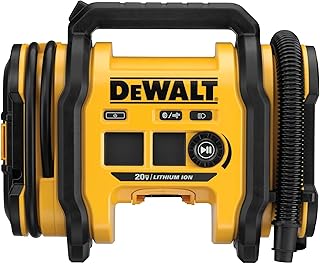
DEWALT 20V MAX Tire Inflator
The DEWALT DCC020IB is highly useful for tire inflation and roadside maintenance, but it is not a car-painting compressor. Its compact battery-powered format and automatic shutoff are excellent for portability, while the lack of a substantial storage tank and spray-gun airflow makes it unsuitable for atomizing automotive paint. Consider it a companion tool rather than a finishing system.
Frequently Asked Questions
What CFM is needed to paint a car?
It depends on the spray gun, but many automotive guns require more air than compact compressors can continuously supply. Compare the gun’s CFM requirement with the compressor’s rating at 90 PSI, and choose extra capacity where possible. LVLP guns generally place less demand on the compressor.
Can an 8-gallon compressor paint a car?
Yes, for small panels, repairs, and carefully paced work, provided the compressor meets the spray gun’s airflow requirement. It will likely cycle frequently, so use short passes, monitor heat, and pause when pressure drops or the motor approaches its duty-cycle limit.
Is oil-free better for automotive painting?
Oil-free compressors are simpler and avoid oil contamination from the pump, which is helpful near paint equipment. However, they can be louder and may generate more heat. Regardless of pump type, a quality regulator, moisture separator, and clean hose are essential.
Why is a water separator important?
Air cools as it travels through the system, allowing moisture to condense inside the tank, hose, and fittings. That water can reach the spray gun and create fisheyes, uneven texture, or discoloration. Drain the tank regularly and use additional filtration close to the gun.
Final Thoughts
For the best reserve and most confident home-garage performance, the Klutch 29-Gallon Air Compressor is the leading pick. The VEVOR 13-Gallon model is a more compact compromise, while the 8.1-gallon ultra-quiet compressor suits occasional, lower-demand painting. The DEWALT inflator remains useful—but only for inflation, not spraying paint.