Key takeaways
- Sustained CFM over peak PSI: Match rated CFM at 90 PSI to your gun’s requirement plus about 30 percent headroom. A 4.6 CFM unit handles a detail or touch-up gun; full panels and clearcoat want the largest CFM figure you can accommodate.
- Tank volume as a buffer, not a promise: Larger tanks smooth out delivery so the pump is not the bottleneck between passes. A 13 to 29 gallon vertical tank keeps pressure steadier than a twin-stack of the same rated output.
- Noise at working distance: 60 to 70 dB machines let you hear the gun’s atomization change, which is real feedback. Anything louder pushes you toward hearing protection and away from that cue.
- Moisture control and drain access: Water in the line is the leading cause of fisheyes. Prioritize a bottom drain you can reach without tipping the tank, then add an inline desiccant filter regardless of model.
- Cart and handle ergonomics: Tall wheels, a handle in the 34 to 40 inch range, and a balanced roll axis mean you tilt rather than lift. Oil-free pumps also let you park the unit on a slope without worrying about sump level.
What's inside
Spraying automotive finish in a home garage exposes a gap that most spec sheets quietly ignore: a compressor can hit an impressive peak pressure and still starve a spray gun within thirty seconds. Paint work is a sustained-draw task, not a burst task. An HVLP gun pulling roughly 9 to 12 CFM at the cap will drain a small tank faster than the pump can refill it, and every recovery cycle shows up in the finish as pressure ripple, dry edges, or orange peel. Buyers also underestimate the physical side of the job. You are on your feet, moving around a panel, dragging hose past a fender, listening to a motor cycle a few feet from your ear for an hour or more.
This guide looks at the compressors people actually buy for home car painting, judged the way a durability and ergonomics specialist would judge them: duty cycle honesty, noise at working distance, tank drainage and corrosion resistance, cart geometry and handle height, and whether the machine can be serviced without a shop press. Each unit below suits a different scope of work, from full-panel refinishing to detail and touch-up passes, and I have flagged where a spec looks generous on paper but thin in practice.
As an Amazon Associate we earn from qualifying purchases.



🛒 Best Price Today on Amazon
Prime members get fast, free shipping on everything above, plus member-only deals. New members get a 30-day free trial — cancel anytime.
How to Choose a/an Air Compressor For Painting Cars At Home (2026)
- Sustained CFM over peak PSI: Match rated CFM at 90 PSI to your gun’s requirement plus about 30 percent headroom. A 4.6 CFM unit handles a detail or touch-up gun; full panels and clearcoat want the largest CFM figure you can accommodate.
- Tank volume as a buffer, not a promise: Larger tanks smooth out delivery so the pump is not the bottleneck between passes. A 13 to 29 gallon vertical tank keeps pressure steadier than a twin-stack of the same rated output.
- Noise at working distance: 60 to 70 dB machines let you hear the gun’s atomization change, which is real feedback. Anything louder pushes you toward hearing protection and away from that cue.
- Moisture control and drain access: Water in the line is the leading cause of fisheyes. Prioritize a bottom drain you can reach without tipping the tank, then add an inline desiccant filter regardless of model.
- Cart and handle ergonomics: Tall wheels, a handle in the 34 to 40 inch range, and a balanced roll axis mean you tilt rather than lift. Oil-free pumps also let you park the unit on a slope without worrying about sump level.
The Best Air Compressor For Painting Cars At Home (2026)s Reviewed
Klutch 29-Gallon 2.5 HP Vertical
The strongest all-round choice here: 5.1 CFM at 90 PSI paired with a 29-gallon buffer and a 175 PSI ceiling gives you genuinely long spray windows before recovery interrupts your rhythm. Large wheels and an accessible tank drain make it the least punishing unit to reposition and maintain over years of use.
VEVOR 13-Gallon 2HP
A sensible middle ground at 4.6 SCFM and 66 dB, with a thickened steel body that resists the dents and flex a shared garage inflicts. The 13-gallon vertical footprint suits single-panel and spot repair work more comfortably than full-vehicle repaints.
California Air Tools CAT-4610AC
Its aluminum twin tank is the standout durability feature, sidestepping the internal rust that eventually claims cheap steel vessels. Ultra-quiet and oil-free, though at 4.6 gallons you should treat it as a primer, detail gun, and blow-off machine rather than a clearcoat rig.
15-Gallon 2HP Vertical Twin Cylinder
The twin-cylinder pump runs at a lower stress per cylinder, which usually translates to cooler operation and less vibration transmitted through the frame. At 4.5 CFM and 66 dB it is a comfortable long-session unit for panel work and bodyshop-adjacent tasks.
MZB 2.4 Gallon Ultra Quiet
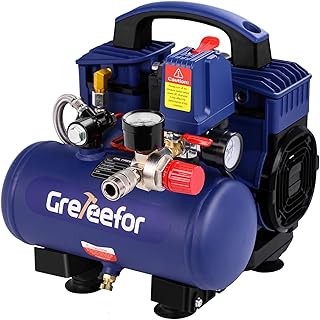
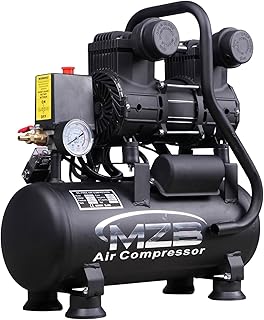
Rated 5.65 CFM from a compact 2.4-gallon package, it delivers respectable flow but the small tank means near-continuous pump duty during spraying. Best used where portability matters most: mobile touch-ups, bumper repairs, and tight-space work.
Frequently Asked Questions
Can I paint an entire car with these compressors?
Realistically, no single unit here matches a professional 60-gallon two-stage setup for continuous clearcoat. Work panel by panel, allow recovery time, and use an LVLP or detail gun to reduce demand.
Does oil-free hurt longevity?
Oil-free pumps have shorter service lives under heavy duty but eliminate oil carryover into your air, which matters enormously for paint. For home-frequency use, the tradeoff favors oil-free.
What filtration do I actually need?
A water separator at the tank, a desiccant dryer downstream, and a regulator at the gun. Skipping any of these three invites contamination defects.
How do I stop tank corrosion?
Drain after every session while the tank is still warm, and store it in a dry space. Neglected drains are what kill steel tanks, not hours of use.
Final Thoughts
For most home refinishers the Klutch 29-Gallon is the pick that removes the most compromise, with the 15-Gallon twin cylinder a quieter, tighter-footprint alternative. If corrosion resistance and portability matter more than spray duration, the California Air Tools CAT-4610AC earns its place.