Key takeaways
- Airflow: Compare CFM at 90 PSI rather than peak horsepower alone. Higher delivered CFM keeps sanders, grinders, spray equipment, and other continuous-use tools productive.
- Electrical requirements: Confirm voltage, phase, breaker capacity, and wiring before ordering. Several high-output models require 230-volt service, while some industrial versions need three-phase power and may not include a plug.
- Pump design: Oil-lubricated, two-stage pumps generally suit demanding, repeated use and can be more serviceable over time. Oil-free designs reduce routine maintenance but may be better suited to lighter-duty expectations.
- Ergonomics: Look for accessible drain valves, readable controls, convenient oil-fill points, and a layout that leaves room for inspection. A compressor that is easy to service is more likely to be maintained correctly.
- Noise and placement: A quieter pump is easier on hearing and conversation, but every 80-gallon compressor still needs ventilation, clearance, a stable floor, and proper vibration control. Never treat a residential garage as automatically suitable.
What's inside
Choosing an 80-gallon air compressor is less about chasing the biggest horsepower number and more about matching sustained airflow, electrical service, noise, and maintenance demands to the work your shop actually performs. A poorly matched unit can leave pneumatic tools starved for air, overload a circuit, or consume valuable floor space while delivering little practical advantage.
This guide evaluates large stationary compressors from an ergonomics-and-durability perspective. The focus is on usable airflow at working pressure, access for draining and servicing, operating noise, tank configuration, and the installation realities that matter in a home workshop, garage, or small furniture-making operation.
As an Amazon Associate we earn from qualifying purchases.




🛒 Best Price Today on Amazon
Prime members get fast, free shipping on everything above, plus member-only deals. New members get a 30-day free trial — cancel anytime.
How to Choose a/an 80 Gallon Air Compressor (2026)
- Airflow: Compare CFM at 90 PSI rather than peak horsepower alone. Higher delivered CFM keeps sanders, grinders, spray equipment, and other continuous-use tools productive.
- Electrical requirements: Confirm voltage, phase, breaker capacity, and wiring before ordering. Several high-output models require 230-volt service, while some industrial versions need three-phase power and may not include a plug.
- Pump design: Oil-lubricated, two-stage pumps generally suit demanding, repeated use and can be more serviceable over time. Oil-free designs reduce routine maintenance but may be better suited to lighter-duty expectations.
- Ergonomics: Look for accessible drain valves, readable controls, convenient oil-fill points, and a layout that leaves room for inspection. A compressor that is easy to service is more likely to be maintained correctly.
- Noise and placement: A quieter pump is easier on hearing and conversation, but every 80-gallon compressor still needs ventilation, clearance, a stable floor, and proper vibration control. Never treat a residential garage as automatically suitable.
The Best 80 Gallon Air Compressor (2026)s Reviewed
VEVOR 80-Gallon Oil-Free Compressor
The VEVOR 80 Gallon Air Compressor combines a 145 PSI tank with a 6.5 HP oil-free pump and a stated 15.5 CFM at 90 PSI. Its oil-free layout reduces oil-checking and spill concerns, while the quiet-oriented design may be attractive for a home workshop. Verify the 220-volt, single-phase electrical requirement and allow generous service clearance around the tank.
Campbell Hausfeld 80-Gallon Vertical Compressor
Campbell Hausfeld’s 5 HP, 140 PSI vertical compressor is a practical choice for buyers who want substantial reserve capacity without moving into the most industrial electrical configurations. Its upright footprint preserves floor area, making it easier to position along a garage wall, although continuous high-demand tools should be matched carefully to its actual delivered CFM.
VEVOR 80-Gallon Heavy-Duty Compressor
This heavy-duty VEVOR model raises the specification considerably, with a 10 HP motor, 17 CFM at 90 PSI, and a maximum pressure of 175 PSI. The oil-lubricated tank and industrial emphasis favor demanding workshop use, but its 230-volt, three-phase configuration and lack of a plug make professional electrical planning essential rather than optional.
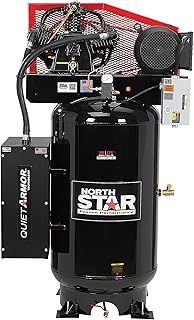
NorthStar 80-Gallon Quiet Armor
NorthStar’s 7.5 HP compressor is rated at 26 CFM and is designed around large-capacity shop-air supply for demanding pneumatic tools. The Quiet Armor approach is useful where operator comfort matters, while maintenance-friendly access can reduce awkward reaching and improve the likelihood of regular service in a busy workshop.
Industrial Plus Silent 80-Gallon Compressor
The Industrial Plus Silent model stands out for its stated 31 CFM output, 7.5 HP motor, vertical two-stage configuration, pressure-lubricated pump, and automatic drain system. Those features target users who value sustained airflow and reduced routine handling; confirm whether the chosen version is single-stage or two-stage, along with the 230-volt installation requirements, before purchase.
Frequently Asked Questions
Is an 80-gallon compressor suitable for a home garage?
It can be, provided the floor is stable, ventilation is adequate, and the electrical system can support the motor. Measure doorways, ceiling height, and service access before delivery; the tank’s footprint is only part of the installation challenge.
What tools benefit most from an 80-gallon tank?
Air-hungry or intermittent tools such as impact wrenches, framing equipment, blow guns, spray guns, and some sanders benefit from the reserve capacity. The tank helps reduce cycling, but the pump’s CFM at 90 PSI remains the key specification for continuous-use tools.
Are oil-free compressors better for furniture workshops?
Oil-free models can simplify upkeep and avoid oil-related contamination concerns. However, oil-lubricated pumps are often the stronger choice for long, demanding duty cycles, provided the compressor is maintained and suitable filtration is installed for finishing work.
Does a higher PSI rating always mean a better compressor?
No. Maximum PSI indicates storage pressure, not necessarily useful production capacity. For most workshop decisions, compare CFM at 90 PSI, motor duty, pump construction, noise, service access, and electrical compatibility first.
Final Thoughts
For low-maintenance ownership, the VEVOR 80 Gallon Oil-Free Compressor is worth considering; the NorthStar Quiet Armor is a compelling balance for demanding tools and operator comfort; and the Industrial Plus Silent model is the airflow-focused pick for a properly equipped workshop. Whichever model you choose, confirm electrical requirements and delivered CFM before giving tank size more weight than the compressor’s complete working system.