Key takeaways
- Carry geometry over raw weight: A balanced 32-pound unit with a wide, centered grip is far easier on wrists and shoulders than a 26-pound unit that hangs crooked. Lift the machine before you commit, and check whether the handle clears the regulator knobs so your knuckles are not doing the load-bearing.
- Pump construction and duty cycle: Oil-free pumps with aluminum cylinders and steel-reinforced valve plates hold up better than all-composite assemblies. Look for a stated duty cycle or thermal-overload protection, since a pump that never gets a rest interval is a pump with a short life.
- Recovery rate at 90 PSI: Ignore max PSI and read SCFM at 90 PSI. Around 2.6 SCFM comfortably feeds one finish or brad nailer; 4 CFM lets two people work off one tank without waiting on the motor.
- Control panel ergonomics: Gauges should be readable while the unit sits on the floor and you are standing. Recessed or shrouded couplers protect fittings from drops, and a regulator you can adjust with gloves on is worth more than an extra 15 PSI of ceiling.
- Maintenance access: A ball-style drain valve with a lever beats a stubborn petcock you need pliers for. If you cannot drain condensate in under thirty seconds, you will skip it, and skipped draining is the single most common reason tanks rust from the inside out.
What's inside
Most people shopping for a 6-gallon pancake compressor are looking at the wrong numbers. Peak PSI gets printed in giant type on the box, but if you are assembling a bookcase, tacking upholstery webbing, or shooting 18-gauge brads into face frames, tank pressure is rarely the thing that limits you. What limits you is how the machine behaves over a long afternoon: whether the handle bites into your palm after the third trip up the stairs, whether the motor shroud survives being set down on concrete a few hundred times, whether the drain valve is reachable without tipping 30-plus pounds onto its side, and whether the noise at head height leaves you willing to keep working.
I evaluate tools the way a furniture maker uses them — repeatedly, in tight spaces, with hands that get tired. This guide looks at six-gallon pancake compressors through that lens: carry geometry and balance, pump construction and expected service life, gauge and regulator placement relative to your line of sight, recovery behavior under real trigger cadence, and the small hardware details that quietly determine whether a compressor is still working in year seven. Below you will find current picks, followed by the criteria I use and answers to the questions that come up most often.
As an Amazon Associate we earn from qualifying purchases.


🛒 Best Price Today on Amazon
Prime members get fast, free shipping on everything above, plus member-only deals. New members get a 30-day free trial — cancel anytime.
How to Choose a/an 6-Gallon Air Compressor (2026)
- Carry geometry over raw weight: A balanced 32-pound unit with a wide, centered grip is far easier on wrists and shoulders than a 26-pound unit that hangs crooked. Lift the machine before you commit, and check whether the handle clears the regulator knobs so your knuckles are not doing the load-bearing.
- Pump construction and duty cycle: Oil-free pumps with aluminum cylinders and steel-reinforced valve plates hold up better than all-composite assemblies. Look for a stated duty cycle or thermal-overload protection, since a pump that never gets a rest interval is a pump with a short life.
- Recovery rate at 90 PSI: Ignore max PSI and read SCFM at 90 PSI. Around 2.6 SCFM comfortably feeds one finish or brad nailer; 4 CFM lets two people work off one tank without waiting on the motor.
- Control panel ergonomics: Gauges should be readable while the unit sits on the floor and you are standing. Recessed or shrouded couplers protect fittings from drops, and a regulator you can adjust with gloves on is worth more than an extra 15 PSI of ceiling.
- Maintenance access: A ball-style drain valve with a lever beats a stubborn petcock you need pliers for. If you cannot drain condensate in under thirty seconds, you will skip it, and skipped draining is the single most common reason tanks rust from the inside out.
The Best 6-Gallon Air Compressor (2026)s Reviewed
DEWALT DWFP55126 Pancake Compressor
The most refined package here in terms of hand feel: a high-efficiency motor that starts reliably in a cold shop, a console with genuinely legible gauges, and 2.6 SCFM at 90 PSI that keeps pace with steady brad and finish nailing. The maintenance-free pump and protected fitting layout are why these units routinely outlive their owners’ interest in the projects they bought them for.
Metabo HPT EC914S
Choose this one if two people will ever share the tank. At 4 CFM and 200 PSI it recovers noticeably faster than the class average, meaning fewer pauses when a framing or roofing nailer is in the mix, and the roll-cage-style protection around the pump earns its keep on a jobsite floor.
CRAFTSMAN 6-Gallon Pancake Kit
A sensible entry point for furniture and trim work, bundling an 18-gauge brad nailer and a ten-piece accessory set so you are not buying fittings twice. The oil-free pump matches the 2.6 SCFM benchmark, and the low center of gravity makes it stable on stair landings and drop cloths.
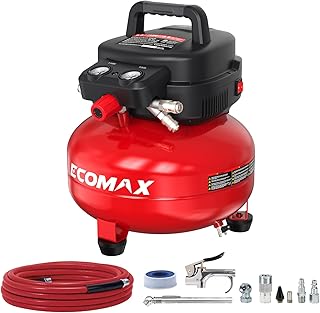
ECOMAX 6-Gallon 150 PSI with 10-Piece Kit
The value option that does not feel like one in the hand: a compact footprint, an oil-free pump, and a full accessory kit including hose and blow gun. Best suited to single-tool use — inflation, dusting, upholstery staplers, and brad nailing at a relaxed cadence.
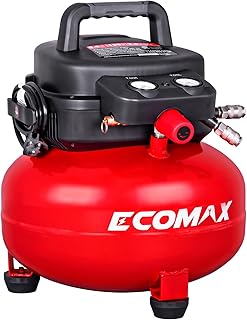
ECOMAX 6-Gallon Red, 1.5 HP
Dual quick couplers are the standout feature, letting you keep an inflation chuck and a nailer connected simultaneously instead of swapping fittings mid-task. The 1.5 HP motor and 3.6 CFM at 40 PSI make it a strong garage and shop generalist.
Frequently Asked Questions
Is 6 gallons enough for furniture and trim work?
Yes, comfortably. Brad nailers, pin nailers, staplers, and finish nailers all draw short bursts, so a six-gallon tank paired with 2.6 SCFM recovery keeps up. Continuous-draw tools like sanders and grinders are where this size runs out of breath.
How loud are these in a home workshop?
Expect roughly 75 to 82 dBA at working distance, loudest during motor recovery. Placing the unit on a rubber mat and a few feet away from reflective walls reduces perceived noise meaningfully; hearing protection is still sensible for extended sessions.
Do oil-free pumps really last?
Modern oil-free pumps regularly reach several hundred hours of hobby use without service. They are louder and wear faster than oil-lubricated pumps under heavy daily duty, but for intermittent shop work the tradeoff favors zero maintenance and any-orientation transport.
How often should I drain the tank?
After every session, without exception. Condensate accumulates with each cycle and corrodes the tank wall from inside, which is both a longevity and a safety issue. Store the drain valve open once fully vented.
Final Thoughts
For most furniture builders and finish carpenters, the DEWALT DWFP55126 is the one I would live with: balanced to carry, easy to read, and built to keep running. Step up to the Metabo HPT EC914S if two nailers will ever share the hose, and take the CRAFTSMAN kit if you want a capable compressor and a brad nailer in the same purchase.