Key takeaways
- Tooth count against your actual work: Roughly 60 to 80 teeth handles the vast majority of furniture crosscutting. Climb to 120 teeth only for veneered panels, melamine, and thin non-ferrous stock, and drop to 32 for framing lumber where speed beats polish.
- Kerf thickness and feed effort: A thin kerf removes less material, so the motor and your arm both work less. On sliding saws especially, a thin-kerf plate reduces the resistance that pushes the head off-line mid-stroke. Full kerf is the better call only on underpowered or badly aligned saws where rigidity beats efficiency.
- Carbide grade over carbide quantity: Micro-grain carbide holds a keen edge substantially longer than commodity tips and survives more resharpening cycles. Tip thickness determines how many trips to the sharpener a blade will tolerate before it’s scrap.
- Plate quality and vibration control: Look for laser-cut expansion slots, tensioning, and a genuinely flat plate. These features suppress the high-frequency chatter that reaches your hands and, over hours, becomes fatigue.
- Grind matched to material: ATB for clean crosscuts in hardwood, TCG for aluminum, plastics, and abrasive sheet goods. Using an ATB blade on aluminum destroys tooth corners quickly and dangerously.
What's inside
A miter saw blade is the only part of your saw that actually touches the wood, and yet it’s usually the last component anyone thinks about. The frustration shows up in familiar ways: splintered crosscuts on prefinished trim, burn marks along walnut end grain, a saw head that fights you halfway through the stroke. Most of that comes down to a mismatch between blade geometry and the work — or a blade that has quietly gone dull without announcing it. Buyers also face a market flooded with near-identical listings, where tooth counts are advertised loudly and carbide grade, plate flatness, and kerf thickness are barely mentioned at all.
I evaluate blades the way I evaluate hand tools: how much effort the operator has to supply, and how long the tool holds its behavior before it changes. Feed resistance matters because a blade that requires shoving translates directly into wrist strain and wandering cuts over a long session. Durability matters because carbide that rounds off after a few hundred feet of poplar was never a bargain. Below, the selections that earned their place on both counts, followed by a buying framework and answers to the questions that come up most often in the shop.
As an Amazon Associate we earn from qualifying purchases.



🛒 Best Price Today on Amazon
Prime members get fast, free shipping on everything above, plus member-only deals. New members get a 30-day free trial — cancel anytime.
How to Choose a/an 10 Miter Saw Blade (2026)
- Tooth count against your actual work: Roughly 60 to 80 teeth handles the vast majority of furniture crosscutting. Climb to 120 teeth only for veneered panels, melamine, and thin non-ferrous stock, and drop to 32 for framing lumber where speed beats polish.
- Kerf thickness and feed effort: A thin kerf removes less material, so the motor and your arm both work less. On sliding saws especially, a thin-kerf plate reduces the resistance that pushes the head off-line mid-stroke. Full kerf is the better call only on underpowered or badly aligned saws where rigidity beats efficiency.
- Carbide grade over carbide quantity: Micro-grain carbide holds a keen edge substantially longer than commodity tips and survives more resharpening cycles. Tip thickness determines how many trips to the sharpener a blade will tolerate before it’s scrap.
- Plate quality and vibration control: Look for laser-cut expansion slots, tensioning, and a genuinely flat plate. These features suppress the high-frequency chatter that reaches your hands and, over hours, becomes fatigue.
- Grind matched to material: ATB for clean crosscuts in hardwood, TCG for aluminum, plastics, and abrasive sheet goods. Using an ATB blade on aluminum destroys tooth corners quickly and dangerously.
The Best 10 Miter Saw Blade (2026)s Reviewed
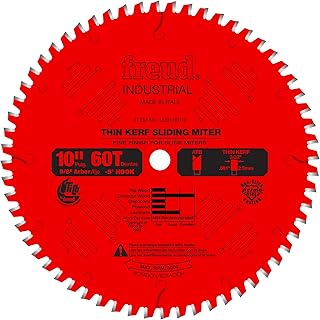
Freud LU91R010 10″ Thin Kerf Sliding Compound Blade
Purpose-built for sliding saws, with a thin kerf and negative hook angle that keeps the blade from self-feeding into the cut and grabbing the workpiece. The tensioned plate and Freud’s micro-grain carbide make this the most predictable option here over the long haul, which is exactly what you want when the stock is expensive.
US1080-MTR 10-Inch 80T Miter Saw Blade
The 80-tooth geometry is tuned specifically for crosscuts and miters rather than repurposed from a general-use design, and the 1/8″ kerf balances low feed effort against plate stiffness. American manufacturing here means consistent grinding, which shows up as square shoulders on picture-frame miters.
WEN BL1080 10-Inch 80-Tooth Carbide-Tipped Blade
The value pick that doesn’t feel like a compromise on furniture-grade hardwood. Expect near-glue-line results in maple and cherry; just moderate your feed rate on thick stock, since the plate is less rigid than premium alternatives.
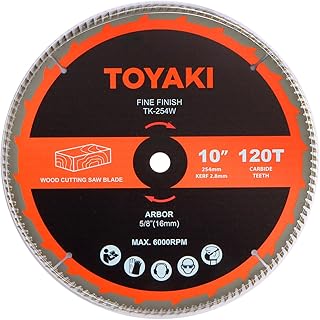
10-Inch 120-Tooth Fine-Finish Blade
Reserve this one for veneered plywood, melamine, and delicate moldings where tearout is unacceptable. The high tooth count clears chips slowly, so let the blade set the pace instead of forcing the stroke.
10-Inch TCG 120-Tooth Aluminum-Working Blade
The triple-chip grind is the correct answer for aluminum extrusion, PVC, and laminate — a specialty blade rather than a wood blade with more teeth. Use lubricant on non-ferrous cuts and the tips will outlast several ATB blades pushed into the same duty.
Frequently Asked Questions
How many teeth do I actually need for furniture work?
Between 60 and 80 covers nearly everything: solid hardwood crosscuts, face frames, mitered casework. Move to 120 only for veneer and thin sheet goods, where surface quality outweighs cutting speed.
Is a multi-pack a smart buy?
Yes, if you swap blades willingly. A 32/60/80-tooth three-pack lets you match the blade to the material rather than forcing one compromise blade through every job, which extends the life of all three.
When should I replace versus resharpen?
Resharpen while the carbide still has body — usually two to four times for a quality blade. Replace once tips are chipped, the plate shows a wobble, or brazing looks compromised.
How do I know a blade is dull?
Feed effort climbs before the cut quality visibly fails. If you’re leaning into the handle, hearing pitch changes, or seeing scorch marks on light woods, the edge is gone.
Final Thoughts
For most furniture builders, the Freud LU91R010 is the blade worth owning first — low feed effort, stable tracking on a slider, and carbide that stays honest. The US1080-MTR is the strongest choice if your priority is miter accuracy on hardwood, while the WEN BL1080 delivers the best finish-per-dollar for anyone equipping a shop without overspending.