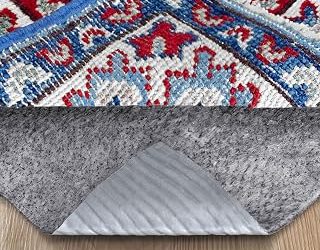
Key takeaways
- Vinyl-safe materials first: Skip anything with a PVC-coated plastic mesh, adhesive tack, or unlabeled “rubberized” film. Felt paired with natural rubber, EVA, or silicone is the reliable category, and manufacturers who explicitly clear their pad for LVP are worth the premium.
- Thickness matched to the room: An eighth-inch pad keeps door swings and thresholds clear. Quarter-inch is the sweet spot for living areas. Half-inch belongs under thin flatweaves where you want genuine cushioning, not under anything near a door.
- Felt density over felt depth: A dense, high-recycled-fiber felt at 1/4″ will outlast a fluffy 1/2″ pad that packs flat under a sofa leg within a season. Compression recovery is what protects the floor long-term.
- Grip appropriate to the rug: Heavy wool rugs need cushioning more than traction. Lightweight machine-washables and runners need real anti-slip backing, since a sliding rug on slick vinyl is a fall risk before it’s a floor-care problem.
- Moisture and heat behavior: Vinyl traps humidity underneath a pad. Waterproof or moisture-resistant construction matters in kitchens and basements, and radiant-heat installations need a pad rated for it.
What's inside
Vinyl plank is engineered for resilience, not for chemistry experiments. The wear layer on LVP is a thin skin of PVC that softens slightly under warmth and pressure, and anything pressed against it for months at a time leaves a record: a yellow halo, a faint waffle print, a ghost of a rug edge you can’t buff out. Most of the damage blamed on rugs actually comes from what sits underneath them, and the cheapest pads are the usual culprits.
This guide looks at rug pads from two angles that rarely get equal attention: how they behave against a vinyl surface over years of contact, and how they behave under your feet during the hours you actually spend standing on them. Kitchens, laundry rooms, entryways, and hallways over LVP put different demands on a pad than a low-traffic bedroom does, so the picks below are sorted by use case rather than ranked on price alone.
As an Amazon Associate we earn from qualifying purchases.


How to Choose a Rug Pad For Vinyl Plank Floors (2026)
- Vinyl-safe materials first: Skip anything with a PVC-coated plastic mesh, adhesive tack, or unlabeled “rubberized” film. Felt paired with natural rubber, EVA, or silicone is the reliable category, and manufacturers who explicitly clear their pad for LVP are worth the premium.
- Thickness matched to the room: An eighth-inch pad keeps door swings and thresholds clear. Quarter-inch is the sweet spot for living areas. Half-inch belongs under thin flatweaves where you want genuine cushioning, not under anything near a door.
- Felt density over felt depth: A dense, high-recycled-fiber felt at 1/4″ will outlast a fluffy 1/2″ pad that packs flat under a sofa leg within a season. Compression recovery is what protects the floor long-term.
- Grip appropriate to the rug: Heavy wool rugs need cushioning more than traction. Lightweight machine-washables and runners need real anti-slip backing, since a sliding rug on slick vinyl is a fall risk before it’s a floor-care problem.
- Moisture and heat behavior: Vinyl traps humidity underneath a pad. Waterproof or moisture-resistant construction matters in kitchens and basements, and radiant-heat installations need a pad rated for it.
The Best Rug Pad For Vinyl Plank Floors (2026)s Reviewed
RUGPADUSA Vinyl Lock (Felt + EVA)
This is the only pad here formulated specifically for LVP and luxury vinyl tile, using EVA instead of natural rubber to eliminate the plasticizer-migration risk that causes discoloration. The 2’x3′ size makes it an easy sanity check before committing to a large room, and the felt layer gives it more substance underfoot than a bare gripper.
RUGPADUSA Basics 1/2″ Felt
All cushion, no grip, which is exactly right under a large heavy rug that isn’t going anywhere. The half-inch felt meaningfully reduces joint loading in rooms where you stand and pivot, and with no rubber component there’s nothing to react with a vinyl wear layer.
RUGPADUSA Dual Surface 1/4″
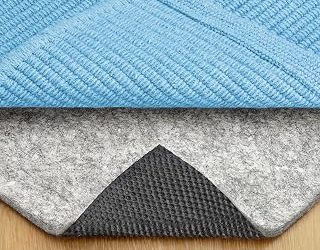
The most broadly useful configuration in the lineup: dense felt for compression recovery, natural rubber for hold, at a thickness that clears most interior doors. It’s the pad I’d default to under a living or dining room rug on LVP, with the caveat that natural rubber wants a clean, fully cured floor beneath it.
1/8″ Felt + Rubber Waterproof Dual Surface
The waterproof layer and slim profile make this the practical choice for kitchens, mudrooms, and anywhere a spill will eventually reach the subfloor side of the rug. At 3×5 it’s sized for runners and utility zones rather than open floor plans.
Veken Cushioned Pad (Felt + Silicone)
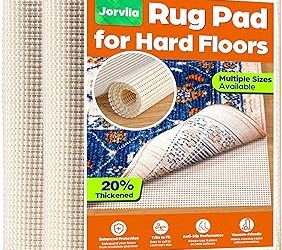
Silicone dot backing delivers strong traction without the staining concerns of cheap plastic grippers, and the quarter-inch felt adds enough give to matter in a standing area. Along with the Jorvila gripper, it’s the budget-conscious option, though neither matches the felt density of the RUGPADUSA pads over a five-year horizon.
Frequently Asked Questions
Can rubber rug pads stain vinyl plank floors?
Quality natural rubber is generally safe, but plasticizers in the vinyl wear layer can migrate into some backings and leave permanent yellowing. If your flooring warranty is specific about it, a felt-and-EVA pad like Vinyl Lock removes the variable entirely.
How thick should a pad be over LVP?
Quarter-inch handles most rooms. Go to 1/8″ for door clearance and thresholds, and 1/2″ only under thin rugs in open areas where added standing comfort is the goal.
Do I need a pad if my rug already has a backing?
Yes. Latex and TPR rug backings are the most common cause of ghosting on vinyl, so a pad acts as a physical barrier as well as a cushion.
How long do felt rug pads last?
A dense felt pad realistically lasts eight to ten years; thin foam grippers crumble in two or three. Check for permanent compression under furniture legs and replace when the pad no longer rebounds.
Final Thoughts
For most vinyl plank installations, the RUGPADUSA Dual Surface 1/4″ is the balanced pick, while Vinyl Lock is the safest choice if your flooring warranty is strict about backings. Choose the Basics 1/2″ felt when a heavy rug needs cushioning rather than grip.