Key takeaways
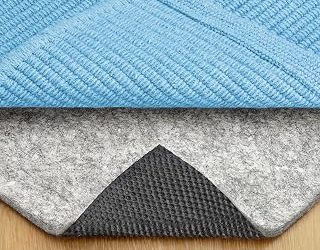
- Construction type: Felt-and-rubber laminates give you cushioning plus grip and suit larger rugs in open rooms. Thin gripper-only mats are for runners, small accents, and low-clearance doorways where added height causes catching.
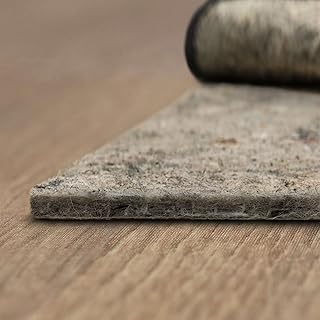
- Thickness versus door swing: A quarter inch is the sweet spot for comfort without lifting the rug into your door’s arc or making the transition to bare floor feel like a step. Measure your clearance before you commit to loft.
- Floor-safe backing: Look for natural rubber rather than PVC or plasticized adhesives. Plasticizers migrate into wood finishes and leave a discoloured pattern that no cleaning removes.
- Compression recovery: Density beats softness. A pad that flattens permanently under a sofa leg stops protecting the rug’s foundation yarns and lets wear show as a visible line.
- Sizing rule: Cut the pad roughly an inch shorter than the rug on each side so it disappears under the edge and the rug can taper naturally to the floor.
What's inside
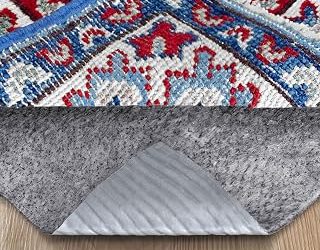
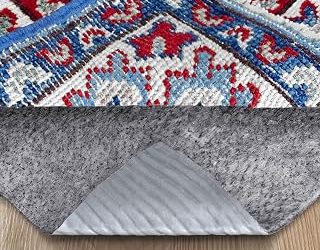
A rug that creeps across an oak floor is more than an annoyance. Every shuffle drags grit under the rug’s backing and burnishes the finish, and the unsupported edge that curls up becomes a genuine trip point. Most people go looking for a pad after the damage starts: a shiny scuff arc near the doorway, a rubber-print haze where a cheap mat sat too long in the sun, or a rug that has to be kicked back into square twice a week. The pad is doing structural work under there, and the wrong one quietly costs you both the rug and the floor beneath it.
This guide looks at rug pads through two lenses that matter over years rather than weeks: how the pad behaves underfoot, and how it holds up. That means compression recovery, whether the gripping layer stays chemically inert against a polyurethane or oil finish, and how well the pad resists shearing apart at the seams. Below are the pads worth your money in 2026, followed by a buying framework and answers to the questions that come up most.
As an Amazon Associate we earn from qualifying purchases.



🛒 Best Price Today on Amazon
Prime members get fast, free shipping on everything above, plus member-only deals. New members get a 30-day free trial — cancel anytime.
How to Choose a Rug Pad For Hardwood Floors (2026)
- Construction type: Felt-and-rubber laminates give you cushioning plus grip and suit larger rugs in open rooms. Thin gripper-only mats are for runners, small accents, and low-clearance doorways where added height causes catching.
- Thickness versus door swing: A quarter inch is the sweet spot for comfort without lifting the rug into your door’s arc or making the transition to bare floor feel like a step. Measure your clearance before you commit to loft.
- Floor-safe backing: Look for natural rubber rather than PVC or plasticized adhesives. Plasticizers migrate into wood finishes and leave a discoloured pattern that no cleaning removes.
- Compression recovery: Density beats softness. A pad that flattens permanently under a sofa leg stops protecting the rug’s foundation yarns and lets wear show as a visible line.
- Sizing rule: Cut the pad roughly an inch shorter than the rug on each side so it disappears under the edge and the rug can taper naturally to the floor.
The Best Rug Pad For Hardwood Floors (2026)s Reviewed
Jorvila Non-Slip Rug Pad Gripper 8×10
Jorvila’s cushioned build handles the everyday job well, holding a large rug square through repeated foot traffic without the tacky residue that plagues budget grippers. It is a sensible choice for bedrooms and low-traffic living rooms where you want padding and stability without paying for a premium felt laminate.
Mohawk Home Dual Surface Felt + Rubber Pad
The quarter-inch felt core here is dense enough to keep its shape under furniture, and the latex rubber gripper layer bonds well rather than sloughing off in crumbs after a year. Made in the USA and genuinely dual-surface, it is the pad I would put under a hallway or dining-adjacent rug that gets walked on daily.
Veken Felt and Silicone Rug Pad 8×10
Veken’s approach uses discrete silicone anti-slip strips instead of a continuous rubber sheet, which keeps the pad breathable and easy to lift for cleaning. Grip is strong on sealed hardwood, and the felt layer softens footfall noticeably in rooms with hard acoustics.
RUGPADUSA Dual Surface 1/4″
This is the durability benchmark. The felt is needle-punched to a high density and the natural rubber backing is formulated to stay inert against finished wood, so it earns its price over a decade rather than a season. Trim it with a utility knife and it cuts cleanly without fraying.
GORILLA GRIP Strong Rug Pad Gripper 2×3
For small accent rugs, entry mats, and anywhere a thick pad would create a lip, this thin gripper is the right tool. It anchors firmly with minimal added height, though expect grip rather than cushioning.
Frequently Asked Questions
Will a rug pad damage my hardwood finish?
A quality natural-rubber or felt-and-rubber pad will not. Damage comes from PVC-coated mesh and adhesive-backed grippers, which react with polyurethane and leave permanent marks.
What thickness should I choose?
Quarter inch for room-size rugs, thinner for runners and doorways. Anything thicker tends to make edges lift and creates a tripping hazard.
Can I cut a pad to fit an odd size?
Yes. Felt pads cut easily with a sharp utility knife and a straightedge. Aim for one inch of inset from each rug edge.
How often should pads be replaced?
Dense felt laminates last eight to ten years. Thin gripper mats usually need swapping every two to three years as the tack fades.
Final Thoughts
For a room-size rug on hardwood, RUGPADUSA Dual Surface is the pad to buy if longevity is the priority, with Mohawk Home offering nearly the same performance at a friendlier price. For small rugs and doorways where height matters, the GORILLA GRIP gripper does exactly what it should without getting in the way.