Our Top Picks
 WEN DT1516 16-Inch 15-Amp 2-in-1 Electric Dethatcher and16-Inch, 15A40.94 x 23.62 x 40.94 inches33.73 poundsCheck on Amazon
 Westinghouse 16" 15-Amp 2-in-1 Electric Dethatcher and Scarifier40.9 x 23.6 x 40.9 inches29.5 poundsCheck on Amazon
 SENIX 13 Amp 15-Inch 2-in-1 Electric Dethatcher and15inch34.45 x 15 x 40 inches24.8 poundsCheck on Amazon
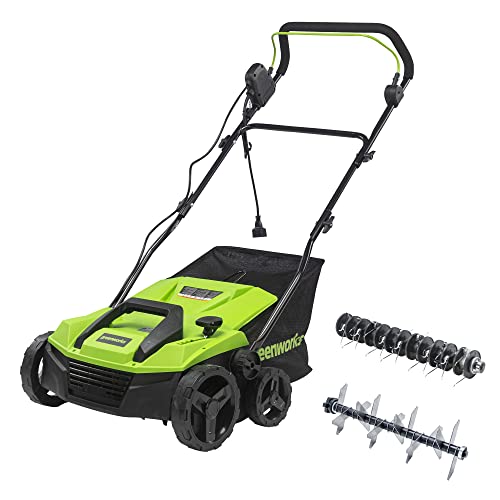 Greenworks 13 Amp 14-Inch Corded Dethatcher / Scarifier13A Dethatcher / Scarifier40.5 x 42.9 x 23.2 inches28.66 poundsCheck on Amazon
The best electric dethatcher scarifier for most small and medium lawns is a corded 2-in-1 machine with a 13 to 15 amp motor, a 14 to 16 inch working width and a depth dial with at least three positions, such as the WEN DT1516 or the Sun Joe AJ805E. If you hate dragging a cord across the yard, the cordless options from Greenworks and WORX do the same job on battery power and cost more. This guide compares seven main picks and four alternatives, then explains how to match a machine to your lawn.
Key takeaways
- An electric dethatcher scarifier is a walk-behind machine with a spinning reel. Spring tines (the dethatching reel) comb out dead grass; fixed blades (the scarifying reel) slice into the turf. Most 2-in-1 models ship with both.
- Corded models are the value pick for lawns where an extension cord can reach every corner. Cordless models cost more and are limited by battery capacity.
- Look at depth positions, collection-bag size and how easily you can swap the reel before you look at amps.
- Do not dethatch unless your thatch layer is over about half an inch. Measure first.
Best electric dethatcher scarifier picks at a glance
| Pick | Power | Width | Depth positions | Best for |
|---|---|---|---|---|
| WEN DT1516 | 15 amp corded | 16 in. | Check listing | Best all-around corded |
| Sun Joe AJ805E | 13 amp corded | 15 in. | Check listing | Two-reel flexibility |
| Westinghouse 16″ 15-Amp | 15 amp corded | 16 in. | Check listing | Wide, no-frills corded |
| Greenworks 13 Amp 14-Inch | 13 amp corded | 14 in. | 3 | Simple push-button start |
| EWORK 14-Inch 12-Amp | 12 amp corded | 14 in. | 5 | Budget and tool-free blade swaps |
| Greenworks 40V 15-Inch | 40V battery, brushless | 15 in. | 5 | Cordless on a shared battery system |
| WORX WG855 40V | 40V battery, brushless | 14 in. | Check listing | Cordless with two batteries included |
We did not personally use these machines. The comparison is built from the product listings, maker descriptions and general lawn-care guidance. Where a listing does not state a spec, the table says so rather than guessing.
WEN DT1516 16-Inch 15-Amp 2-in-1 Electric Dethatcher and Scarifier with Collection Bag, Black
Chosen because it specifies Black.
View on AmazonWestinghouse 16" 15-Amp 2-in-1 Electric Dethatcher and Scarifier with Collection Bag
Picked as a relevant option in this category.
View on AmazonSENIX 13 Amp 15-Inch 2-in-1 Electric Dethatcher and Scarifier with 13.2-Gal Collection Bag,4-Position Depth Adjustment,Walk Behind for Lawn Garden Care Removing Thatch,Quick-Fold(SCE13-M)
Chosen because it specifies 4-Position Depth Adjustment and Walk Behind for Lawn Garden Care Removing Thatch.
View on AmazonGreenworks 13 Amp 14-Inch Corded Dethatcher / Scarifier, 2-in-1 Electric Lawn Rake with 3-Position Depth Adjustment & Push-Button Start, Lawn Care Tool for Healthy Yard Maintenance
Chosen because it specifies Lawn Care Tool for Healthy Yard Maintenance.
View on AmazonDethatcher vs scarifier: what you are actually buying
The names overlap, and the machines blur them. A dethatcher uses flexible spring tines that rake through the grass and lift out dead stems and runners. A scarifier uses fixed steel blades that cut shallow slits into the soil surface and slice through thick thatch and moss. Many electric machines marketed as a “dethatcher scarifier” or a “lawn dethatcher scarifier” are 2-in-1 tools that come with two interchangeable reels, one of each type, and a depth dial that sets how deep the reel works.
- Use the tine reel for routine maintenance, light thatch and cleaning up before overseeding. It is gentler on turf.
- Use the blade reel for heavy thatch, moss, or when you want grooves for seed to fall into. It is harder on the lawn and needs more recovery time.
If your lawn is larger than about half an acre and you own a lawn tractor, a tow-behind dethatcher may fit better. Our separate guide covers those. For small and medium lawns, an electric walk-behind model is easier to store and cheaper to own.
1. WEN DT1516: Best all-around corded pick
- WEN DT1516 16-Inch 15-Amp 2-in-1 Electric Dethatcher and Scarifier
- 16 in. working width · 15 amp corded motor · collection bag included
- 2-in-1 design, per the listing
- Black finish
Best for: medium lawns where you want the widest corded footprint without paying for cordless.
Skip if: your lawn has a lot of trees, beds and fences where a long cord will snag.
Pros
- 16 inches of width means fewer passes than a 12 to 14 inch machine.
- 15 amp rating is at the top of what a standard household circuit supports.
- No battery to charge or replace.
- The collection bag catches the first round of lifted debris.
Cons
- Needs a suitable outdoor extension cord; check the owner’s manual for gauge.
- Wider machines are slightly harder to turn in narrow spots.
2. Sun Joe AJ805E: Best for a dedicated blade reel
- Sun Joe 15-Inch Lawn Dethatcher with Scarifier Blade Reel, AJ805E
- 15 in. width · 13 amp corded motor
- Scarifier blade reel plus collection bag, per the listing
- Marketed as a yard power rake
Best for: lawns with thicker thatch or moss, where you want a scarifier reel in the box.
Skip if: you only need a light annual comb-out; a simpler tine-only machine is enough.
Pros
- The listing highlights a scarifier blade reel, so you are not buying one separately.
- 15 inch width is a good middle ground for turning.
- Established brand with wide accessory availability.
Cons
- Blade reels are tough on thin or stressed turf.
- Check the listing for how many depth positions it offers.
3. Westinghouse 16″ 15-Amp: Best for wide coverage without extras
- Westinghouse 16″ 15-Amp 2-in-1 Electric Dethatcher and Scarifier with Collection Bag
- 16 in. width · 15 amp corded motor
- Collection bag included
- 2-in-1 dethatcher and scarifier
Best for: people who want the 16-inch class from a recognizable name and do not care about extra features.
Skip if: you want a spec sheet with plenty of detail; the listing is short, so confirm depth positions and bag volume on the maker page.
Pros
- Same width and amp class as the WEN pick.
- Collection bag included.
- Straightforward corded design.
Cons
- Listing is thin on details such as depth positions.
- Cord management is up to you.
4. Greenworks 13 Amp 14-Inch: Best for easy starts and simple adjustment
- Greenworks 13 Amp 14-Inch Corded Dethatcher / Scarifier
- 14 in. width · 13 amp corded motor
- 3-position depth adjustment
- Push-button start
Best for: first-time users and smaller lawns who want a machine that is easy to start and set.
Skip if: you want finer depth control than three settings give.
Pros
- Push-button start is simpler than a safety bar and switch combination.
- Three depth settings are easy to remember.
- 14 inch width is easier to turn than 16.
Cons
- Narrower than the 15 and 16 inch picks, so more passes.
- Only three depth positions.
5. EWORK 14-Inch 12-Amp: Best for tool-free blade changes
- EWORK Electric Dethatcher and Scarifier 14-Inch 12-Amp with Collection Bag
- 14 in. width · 12 amp corded motor
- 5-position depth adjustment
- Tool-less blade replacement, per the listing
Best for: shoppers who want fine depth control and easy blade swaps on a budget.
Skip if: your lawn is large, since the 12 amp motor is at the lower end of this group.
Pros
- Five depth positions give more control than the 3-position Greenworks.
- Tool-free blade replacement means less fiddling.
- Collection bag included.
Cons
- Smaller motor rating than 13 to 15 amp rivals.
- Less-known brand, so check the warranty terms.
6. Greenworks 40V 15-Inch: Best cordless pick for existing Greenworks owners
- Greenworks 40V 15-Inch 2-in-1 Dethatcher & Scarifier
- 15 in. width · 40V brushless motor
- 5.0Ah battery and Rapid Charger included
- 5-position depth adjustment
Best for: anyone who already owns Greenworks 40V batteries and wants to skip the cord.
Skip if: your lawn is large enough that one battery may not cover it, and you do not have a spare. Check the listing and maker page for coverage claims.
Pros
- No cord to tangle or run over.
- Brushless motor, which makers say reduces maintenance.
- Battery and charger included in this kit.
- Five depth positions.
Cons
- Costs more than corded models in the same width class.
- Battery capacity limits one-charge coverage; check the maker page.
7. WORX WG855 40V: Best cordless with two batteries in the box
- WORX Cordless Lawn Dethatcher 40V 14″ 2-in-1, WG855
- 14 in. dethatching width · 40V brushless motor
- Two 4.0Ah batteries and a charger included
- PowerShare battery platform
Best for: medium lawns where swapping a second battery is better than stopping to recharge.
Skip if: you want a wider 15 or 16 inch cut or you are on a tight budget.
Pros
- Two batteries in the kit let you keep working.
- Batteries work with other PowerShare tools.
- No cord.
Cons
- The most expensive pick on this list.
- 14 inch width needs more passes than the 16 inch corded models.
Also consider
- WEN 20V Max Cordless 15-Inch (20716): 15 in. width · 20V Max brushless · two 4.0Ah batteries and dual-port charger · collection bag. A cordless choice if you already use WEN 20V batteries.
- Sun Joe 24V-X2-DTS15: 15 in. width · 24V cordless · 5 depth positions. The tool-only version is also listed, which suits Sun Joe 24V owners.
- SENIX 13 Amp 15-Inch (SCE13-M): 15 in. width · 13 amp corded · 13.2-gal collection bag · 4-position depth · quick-fold. A good fit if storage space is tight.
- BILT HARD 16 Inch: 16 in. width · 15 amp corded · 5-position depth · 14.5-gal thatch bag. One of the larger bags in the group.
LawnMaster-branded electric dethatchers also come up in searches. We did not find a current listing to compare, so check the maker page if you are set on that brand.
Match the machine to your lawn
Picking from a list is easier when you start with your yard. This matrix maps common situations to the type of machine that usually fits.
| Your situation | Lean toward | Why |
|---|---|---|
| Open lawn up to about a quarter acre, outlet near the house | Corded, 15 to 16 in. (WEN, Westinghouse) | Fewer passes, no battery cost |
| Small yard with beds, trees and a tight turning radius | Corded 14 in. (Greenworks 13 Amp, EWORK) | Narrower body turns more easily |
| Thick thatch or moss patches | Model with a dedicated blade reel (Sun Joe AJ805E) | Blades slice through dense mats that tines skip over |
| Lawn far from any outlet | Cordless 40V kit (Greenworks 40V, WORX WG855) | No cord run, but plan for battery swaps |
| You already own a cordless battery platform | Same-brand tool-only or kit | Reuse batteries you have already paid for |
| Little storage space | Fold-down handle (SENIX) | Easier to hang or shelve in a garage |
Extension cord and electrical safety for corded dethatchers
Corded machines pull a lot of current, so the cord is part of the purchase. These are general points; the owner’s manual for your model is the authority.
- Use an outdoor-rated extension cord. Indoor cords are not built for wet grass and sun.
- A thicker (lower gauge number) cord loses less power over distance. Many tool makers recommend a heavier gauge as length goes up, so read the table in the manual.
- Plug into a ground-fault protected outlet when the maker says to.
- Keep the cord behind you as you walk. Work away from the outlet, then circle back, so you never run over the cable.
- Never use the machine in rain or on wet grass, and unplug it before clearing a jam or changing a reel.
Common mistakes with electric dethatcher scarifiers
- Setting the reel too deep on the first pass. Start shallow. You can always go over the lawn again.
- Dethatching in summer heat. Cool-season turf struggles to recover when it is hot and dry.
- Skipping the measurement. A lawn with a thin layer does not benefit, and the process thins the turf.
- Forgetting the cleanup. The bag helps, but you will still need a rake or sweeper for the rest.
- Letting the bag overfill. A full bag blocks airflow and reduces pickup. Empty it often.
- Ignoring blade wear. Dull or bent tines pull less thatch. Inspect the reel for damage after each lawn.
Timing by grass type
When you run the machine matters almost as much as which one you own. Dethatching rips at the turf, so do it when the grass is growing strongly and can fill in the gaps. Regional timing differs, so confirm with your local extension service.
| Grass type | Examples | Typical window | Notes |
|---|---|---|---|
| Cool-season | Kentucky bluegrass, fescue, ryegrass | Early fall, with spring as a second choice | Avoid summer heat; overseed right after |
| Warm-season | Bermuda, zoysia, St. Augustine | Late spring to early summer, once fully green | Never while dormant; these grasses build thatch faster |
| Newly seeded lawn | Any | Wait until it has been mowed several times | Young grass has weak roots |
| Drought-stressed lawn | Any | Wait for recovery | Dethatching adds stress |
If you are not sure which grass you have, take a clump to a garden center or your extension office. Bermuda and zoysia can thicken their thatch layer faster than fescue, so owners of those grasses often check it every year.
Care and storage
After each use, unplug the machine or remove the battery, then brush grass and debris out of the housing and off the reel. Wipe the exterior and let the bag dry fully before folding or storing it, since a damp bag can mildew. Keep the reel you are not using in a dry place. Cordless owners should store batteries indoors at moderate temperatures and follow the maker’s charging instructions. A tool with a fold-down handle takes less room on a garage shelf, which matters if your storage space is tight.
How we chose these electric dethatcher scarifiers
We did not personally use any of these machines. We built the list from product listings and maker descriptions, then filtered with these rules:
- Walk-behind electric 2-in-1 machines only, no tow-behind, gas or manual rakes.
- Working width between 14 and 16 inches, which suits small and medium lawns.
- A stated motor rating or battery platform, so you can compare power sources.
- No more than two models from any one brand.
- Current models only; refurbished and parts-only listings were skipped.
- Specs quoted only where the listing states them.
Sources consulted for general guidance: university extension lawn-care pages, Family Handyman, Lawn Love and the makers’ own product pages.
Buying guide: how to choose an electric dethatcher scarifier
Step 1: measure your thatch
Cut a small wedge of turf a few inches deep and measure the brown, spongy layer between the green blades and the soil. Under roughly half an inch is healthy. Over half an inch is where dethatching pays off. For cool-season grasses such as fescue, ryegrass and bluegrass, many guides suggest acting a bit earlier, around a third of an inch. If you are unsure, check your regional extension office.
Step 2: pick corded or cordless
- Corded suits lawns up to roughly a quarter acre where one or two outlets can cover everything. Budget for a heavy-duty outdoor extension cord. For a 13 to 15 amp tool, check the manual for the recommended cord gauge and length.
- Cordless suits lawns with obstacles and no nearby outlets. Dethatching is demanding on batteries, so a kit with two batteries or a spare saves you from stopping midway.
Step 3: check the numbers that matter
| Spec | Good range | Why it matters |
|---|---|---|
| Working width | 14 to 16 in. | Wider means fewer passes but harder turning |
| Corded motor | 12 to 15 amp | Higher draws more current; 15 amp is the upper end for household outlets |
| Depth positions | 3 minimum, 5 preferred | Fine depth control prevents tearing turf |
| Bag size | 8 gal and up | A bigger bag means fewer stops to dump |
| Reels included | Tine and blade | Lets you step up from light to heavy thatch |
| Battery (cordless) | Two batteries or a spare | Prevents a mid-job recharge |
Step 4: plan the job
- Mow the lawn low a day or two before.
- Water lightly if the soil is very dry, but never work on soaked ground.
- Start at the shallowest depth, make one pass, and inspect the debris. Lower only if thatch remains.
- Work in a crossing pattern: one direction, then at right angles.
- Rake or sweep the remaining debris, then overseed and feed, following the product labels.
Step 5: allow for recovery
A freshly dethatched lawn can look rough for a couple of weeks. Skip dethatching a dormant, drought-stressed or newly seeded lawn. Time it for early fall for cool-season grasses and late spring to early summer for warm-season grasses, then avoid hot weather.
Frequently asked questions
What is the difference between a dethatcher and a scarifier?
A dethatcher uses flexible tines to pull up dead material. A scarifier uses fixed blades that cut into the turf. A 2-in-1 electric machine gives you both through swappable reels.
Is a corded or cordless electric dethatcher better?
Corded models cost less and run as long as they are plugged in. Cordless models avoid the cord but are limited by battery capacity and cost more.
How often should I use an electric dethatcher scarifier?
Only when your thatch layer exceeds about half an inch. Many lawns need it every few years, some never.
Can I use one on wet grass?
No. Wet turf tears, and electric tools should not be used in wet conditions. Wait until the lawn is dry, and follow the manual’s safety instructions.
How deep should the reel be set?
Start with the shallowest setting and increase it only if thatch is left behind. Most maker guidance says the reel should just ruffle the soil surface, not dig deep. Check your owner’s manual.
Do I need to overseed after dethatching?
It is the ideal time, because the exposed soil gives seed good contact. Follow the seed label for rates and watering.
Will an electric dethatcher handle a large lawn?
It can, but a half-acre or more is slow with a 14 to 16 inch machine. A tow-behind unit behind a tractor is faster at that size.
Which one should you buy?
- Best value for most lawns: the WEN DT1516 or the Westinghouse 16″ for width, or the Sun Joe AJ805E if you expect heavy thatch.
- Best for beginners: the Greenworks 13 Amp 14-Inch, because of its push-button start.
- Best on a budget with fine control: the EWORK 14-Inch 12-Amp.
- Best cordless: the Greenworks 40V 15-Inch if you already own those batteries, or the WORX WG855 if you want two batteries in the box.
Whichever you pick, measure your thatch first and start at the shallowest setting.
Sources
- Product listings and maker pages for each model named
- Family Handyman
- Lawn Love
- University extension lawn-care publications
Last updated: November 2026
More from Amazon
Programs that pair well with the guide above. Offers and eligibility are set by Amazon and may change.
Collect the home and kitchen items you want in one registry that guests can shop from.
Create a wedding registrySet up recurring deliveries of everyday items on eligible products. Terms and savings are set by Amazon.
Explore Subscribe & SaveFree shipping on eligible items, Prime Video and more. Eligible new members can start with a free trial.
Start a Prime free trialAudiobooks and podcasts to listen to on the go. Eligible new members can start with a free trial.
Try Audible freeAs an Amazon Associate we earn from qualifying purchases.