Key takeaways
- Under 100 lumens: best for outlining railings, planters, and pathways.
- 100–300 lumens: suitable for a balcony, small seating area, or decorative pergola lighting.
- 300–600 lumens: a better range for a patio dining table or outdoor conversation area.
- Over 600 lumens: useful when the strand is intended to contribute meaningful task lighting, although a dedicated outdoor fixture may still be needed.
Best Solar Outdoor String Lights for Any Patio
The best solar outdoor string lights for most patios are warm-white LED strands with 20–40 bulbs, a separate adjustable panel, at least 8 hours of advertised runtime, and weather protection rated IP44 or higher.
The right choice depends less on bulb count than on where the panel can receive sun, how much light you need for eating or walking, and whether the strand must cross a large yard. A small balcony may need only 20 feet of cord, while a pergola or patio dining area may need 48–100 feet plus extra length for sag and routing.
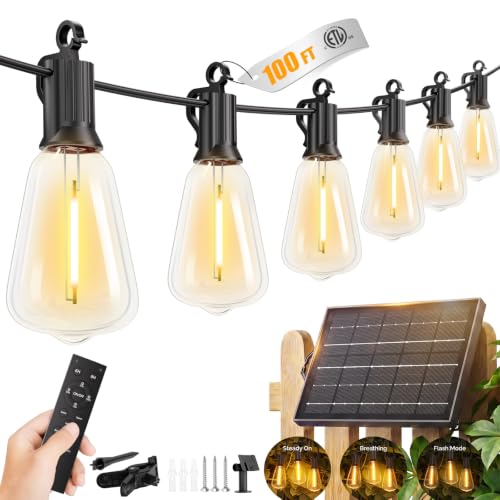
Brightown 100FT Solar String Lights Outdoor, 31+2 Shatterproof LED Bulbs
Included for 'Best Solar Outdoor String Lights for Any Patio' because the listing specifies 31+2 Shatterproof LED Bulbs, details this guide uses to compare options.
View on Amazon
Brightown 108FT 52LED Solar String Lights Outdoor with Remote & USB Port
Included for 'Best Solar Outdoor String Lights for Any Patio' as a relevant option in this category; details come from the product listing.
View on Amazon
Brightech Ambience Pro Solar Powered Outdoor String Lights -27 ft Commercial Grade Waterproof Edison Patio Lights, Shatterproof LED String Lights for Outside, Porch - 12 Bulbs, 1W Soft White
Included for 'Best Solar Outdoor String Lights for Any Patio' because the listing specifies Shatterproof LED String Lights for Outside and Porch, details this guide uses to compare options.
View on Amazon
addlon 54FT(48+6) Solar String Lights Outdoor, Last 20+ Hrs, USB Charging
Included for 'Best Solar Outdoor String Lights for Any Patio' because the listing specifies Last 20+ Hrs and USB Charging, details this guide uses to compare options.
View on AmazonQuick Picks by Patio Situation
| Patio or yard situation | Best light type | Useful specifications | Why it fits |
|---|---|---|---|
| Small apartment balcony | Compact micro-LED or small-bulb strand | 20–30 ft; 100–200 LEDs; 6–8 hour runtime | Uses less railing space and usually has a smaller panel |
| Dining patio | Solar Edison-style or globe bulbs | 25–40 ft; 8–12 inch spacing; 2700–3000K light | Creates visible overhead light without looking harsh |
| Pergola or covered seating area | Heavy-duty hanging-bulb strand with separate panel | 48–100 ft; shatter-resistant bulbs; IP65 or better | Provides longer coverage and better resistance to moisture |
| Kids, pets, or active play area | Low-voltage LED strand with flexible, shatter-resistant covers | 10–12 inch bulb spacing; enclosed wiring; secure mounting clips | Reduces exposed glass and trip hazards |
| Mostly shaded yard | Solar strand with remote panel and larger battery | Panel cable of 10–16 ft; 8–12 hour runtime | Lets the panel reach a sunnier fence, roof edge, or garden bed |
| Renter-friendly installation | Lightweight strand with clips or removable hooks | 20–40 ft; under 3 lb; no-drill mounting hardware | Can be removed without permanent holes or heavy anchors |
Brightness: Decorative Glow or Useful Patio Lighting?
Solar string lights are usually accent lighting, not a substitute for a porch fixture. Look for the total lumen output rather than bulb count alone. A strand with many tiny LEDs may appear bright across a long span but provide little light directly over a table. Larger hanging bulbs generally cast more visible light downward and create a stronger visual focal point.
- Under 100 lumens: best for outlining railings, planters, and pathways.
- 100–300 lumens: suitable for a balcony, small seating area, or decorative pergola lighting.
- 300–600 lumens: a better range for a patio dining table or outdoor conversation area.
- Over 600 lumens: useful when the strand is intended to contribute meaningful task lighting, although a dedicated outdoor fixture may still be needed.
Warm white light around 2700–3000K usually works best around furniture because it complements wood, woven seating, and neutral cushions. Cool white light can look brighter, but it may feel stark and can compete with indoor lighting viewed through a window. If you want flexibility, select a strand with brightness or mode controls rather than assuming every “bright” model will illuminate a table evenly.
Panel Placement and Battery Runtime
Panel placement is often the deciding factor in whether solar lights perform well. A panel mounted on a shaded balcony railing may receive enough light to charge weakly but not enough direct sun to deliver the advertised runtime. A separate panel on a stake or adjustable bracket is more practical for patios bordered by trees, walls, or roof overhangs.
For reliable charging, aim the panel toward the strongest unobstructed sunlight available for several hours each day. Keep leaves and dust off the surface, and avoid placing it behind tinted glass. A panel cable of 10–16 feet gives substantially more placement freedom than a short 3–6-foot lead.
Advertised runtimes commonly range from 6 to 12 hours, but actual performance changes with season, cloud cover, panel angle, battery age, and the selected brightness mode. A strand rated for 8 hours may run much less after a cloudy winter day. For evening meals or late gatherings, choose a larger battery and a strand that can be dimmed. Dimming often extends runtime more effectively than reducing the number of bulbs.
Rechargeable batteries are a wear item. If the battery compartment is accessible and uses a replaceable standard rechargeable cell, maintenance is easier than with a sealed unit. Expect battery capacity to decline before the LEDs themselves fail, particularly when the lights remain outside year-round.
Cord Length, Spacing, and Real Coverage
Measure the route before buying, then add 10–20 percent for corners, vertical drops, and a relaxed drape. A 25-foot strand does not cover 25 feet of straight, tightly stretched railing once it has to travel around posts or dip between attachment points.
| Area to cover | Recommended strand length | Typical bulb spacing | Practical arrangement |
|---|---|---|---|
| 4–6 ft balcony railing | 15–25 ft | 4–8 inches | One perimeter run with a small amount of sag |
| 6 x 8 ft seating area | 25–40 ft | 8–12 inches | Along a wall, railing, or two sides of a canopy |
| 10 x 12 ft patio | 40–60 ft | 10–15 inches | Perimeter run or two parallel overhead rows |
| 12 x 16 ft pergola | 60–100 ft | 10–15 inches | Perimeter plus one or two cross rows |
For a 10 x 12-foot patio with a dining table, two parallel rows can spread light more evenly than one strand around the edge. Leave at least 6–12 inches between the light path and a wall or roof edge so bulbs do not scrape against masonry or collect against a gutter.
Weather Resistance and Construction Details
Check the rating for both the strand and the solar panel. IP44 generally indicates protection from splashing water and is reasonable for a sheltered patio. IP65 offers better protection against water jets and dust, making it preferable for exposed fences, pergolas, and open yards. No rating makes a product suitable for submersion, and a waterproof claim does not eliminate the need to protect plugs, battery compartments, and connection points.
Shatter-resistant plastic bulbs are the safer option near children, pets, and frequently used walkways. Glass bulbs can produce a more substantial appearance, but they add breakage risk and weight. Flexible insulated wiring tolerates movement better than very thin decorative wire, especially where wind causes the strand to sway.
Also inspect the distance between the final bulb and the solar panel or power connection. Some strands have a long unlit lead that is useful for reaching a panel but does not add illuminated coverage. Others place the first bulb close to the panel, which can limit mounting choices.
Installation Options That Hold Up
For a temporary or rental setup, use removable outdoor-rated hooks, railing clips, or light-duty cable ties. Place attachments every 12–18 inches on a straight run and closer together at corners. Avoid hanging the full weight of a long strand from one end; the wire can stretch and the connector may pull loose.
For a permanent pergola or fence, screw-in cup hooks or purpose-made string-light guide wire provide better support. A guide wire is especially useful for long spans, because it carries tension while the light strand hangs from small clips. Do not staple directly through the electrical cable. Before drilling, check that the mounting point will not interfere with doors, retractable awnings, or drainage.
Allow a gentle curve rather than pulling the strand tight. A sag of roughly 4–8 inches between attachment points looks intentional and gives wind-driven movement somewhere to go. Keep cords away from chair legs, mower routes, pet paths, and the opening side of gates.
How to Choose Without Overbuying
- Choose bulb size based on the job: small LEDs for outlining and larger bulbs for visible downward illumination.
- Choose a separate panel when the patio is shaded or the best charging location is more than a few feet from the lights.
- Choose at least IP44 for sheltered areas and IP65 for open exposure.
- Choose 40–60 feet for a typical 10 x 12-foot patio, then add length for corners and drape.
- Choose shatter-resistant bulbs and protected wiring where children, pets, or sports are nearby.
- Choose dimming modes and a replaceable battery when dependable late-evening runtime matters.
For most homeowners, a warm-white LED strand with 25–50 feet of coverage, 300–600 total lumens, a remote adjustable panel, IP65 protection, and an 8–12-hour battery target offers the best balance. Smaller strands suit balconies and railings, while long heavy-duty strands with a support cable are the better investment for pergolas and open yards.