Key takeaways
- Organize unopened printer supplies with a compatibility card, package directions, shelf plan, and clear count units instead of guessing a shelf life.
What's inside
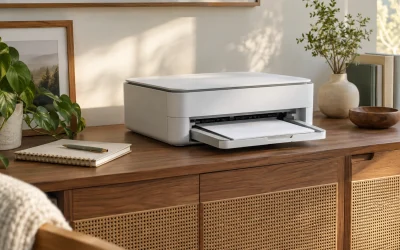
Plan unopened printer supplies as labeled stock with product-specific storage requirements. Start with the printer model, the exact consumable code, and the original package directions. Then choose a location and a small inventory system that keep compatible supplies identifiable without opening them just to organize a shelf.

Separate unopened stock from installed supplies
An unopened cartridge, a cartridge removed from a printer, and an installed cartridge are different situations. Instructions about returning a used cartridge to service do not automatically describe unopened storage. Keep this worksheet limited to sealed stock; follow the printer’s own procedure for anything already opened or installed.
One concrete example is the Epson WF-3820 User’s Guide. Its ink precautions specify a cool, dark storage location, exclude high and freezing temperatures, and direct users to leave the cartridge package closed until installation. It also distinguishes the printed package date from the time limit after opening. These are that model’s ink instructions, not a universal shelf-life rule for toner, paper, or every Epson cartridge.
Build a stock card for each exact item
Use one row for each product code and package type. Include the printer models you actually own rather than writing only a broad brand name. A cartridge bought for a retired machine should not remain counted as a spare for its replacement unless compatibility is confirmed.
| Field | What to record |
|---|---|
| Item identity | Brand, product code, color or media size |
| Compatibility | Exact printer model and source checked |
| Quantity | Unopened packages, with pack size |
| Condition | Seal and outer-package condition |
| Date information | Purchase date and any printed use-by date |
| Storage instructions | Exact label or manual reference |
| Location | Shelf and container identifier |
Distinguish a purchase date from an expiration or use-by date. If a package has no date you can identify, write “not identified” and ask the supplier or manufacturer when that affects your decision. Do not calculate a universal expiration from the day an online order arrived.
Choose the location before buying organizers
Compare candidate locations with each product’s storage instructions. Consider sunlight, nearby heat, and conditions that change when the room is unused. A convenient ledge next to the printer might be less suitable than an interior shelf. A decorative bin does not change the conditions around the supplies inside it.
Keep any manufacturer orientation markings visible and follow them. Do not remove protective packaging to make an item fit a smaller basket. Paper, ink, and toner need separate checks rather than a single temperature or humidity assumption copied across the shelf. Keep supplies away from children as directed by their product instructions.
Size the shelf for the actual packages
Measure unopened packages and the usable storage space, including the opening through which each package must pass. Allow practical room to take out the selected item without tearing other packages or stacking unstable piles. Verify the shelf’s documented load limits for the contents you plan to place on it.
Draw separate sections for compatible current stock, information to verify, and items no longer needed. The last two sections can be labels in your inventory rather than permanent extra bins. Our office storage planning guide provides broader furniture considerations; this stock card adds the supply identity and storage checks.
Set a small, observable reorder trigger
Choose a reorder point from your actual use and supplier lead time, then revise it as you learn. Keep the arithmetic in packages or individual items consistently. A two-pack is one package but two cartridges; switching units halfway through a count can make a nearly empty shelf look fully stocked.
For illustration, suppose your chosen minimum is two unopened units and a count finds three. If you move one unit into service, two remain; that reaches the chosen review point. This is a counting example, not a recommendation that every household keep two spares. Low-use households may need a different approach to avoid buying stock they will not use within its directions.
Review the shelf when equipment changes
Before replacing a printer, check how much compatible unopened stock remains and whether returning it is possible under the seller’s current terms. Do not open an obsolete package in hope of adapting it. Keep questionable or damaged supplies out of the ready-to-use count while seeking product-specific advice.
Finish with a dated shelf count and the next review trigger: a printer change, a replenishment purchase, or a package approaching its documented date. A modest inventory that matches the equipment and storage instructions is more useful than a large drawer of anonymous supplies.