Key takeaways
- Give household mail and business paperwork separate owners, action stages and record destinations inside a shared storage cabinet.
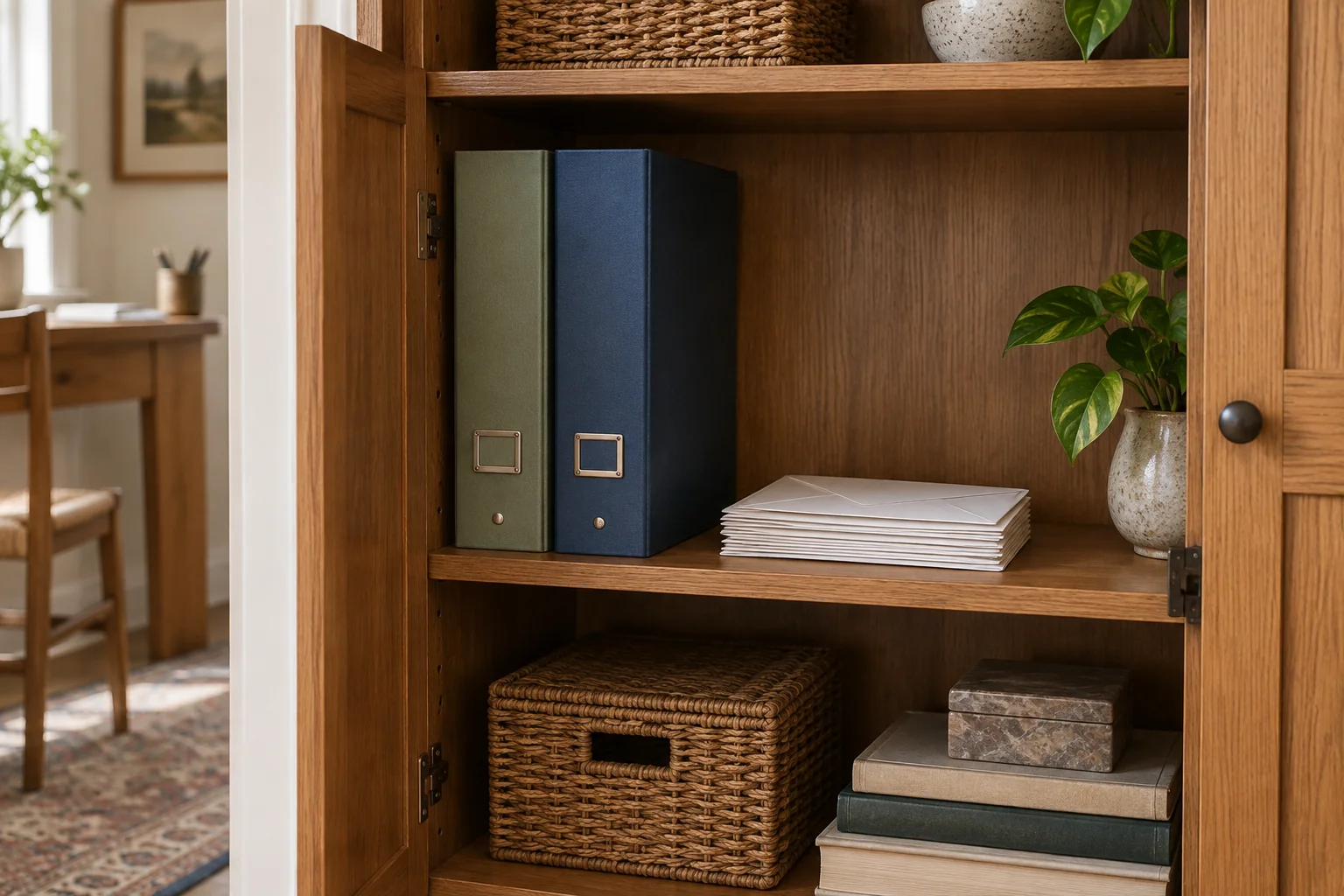
One cabinet can hold household mail and business paperwork without turning them into one filing system. Give each stream a clear destination, an owner and an action stage. The important boundary is not simply the color of a folder: a person should be able to tell whether a document still needs attention and where its authoritative record belongs.
This is a physical organization plan. It does not determine tax deductions, legal retention periods or an employer’s document policy. Use the requirements that apply to your records before deciding what may be copied, moved or destroyed.
Separate ownership before sorting by subject
Start with household and business as distinct streams. If several adults or businesses share the cabinet, identify the authorized owner of each stream. A utility envelope, client invoice and school notice may all arrive together, but they need not share a folder merely because all three involve a payment or deadline.
Do not open mail addressed to another person without their permission. Provide an unopened-mail destination that preserves ownership. Use separate restricted storage when client, employer or other sensitive material cannot appropriately share access with household documents. An ordinary cabinet divider is an organization aid, not a security control.
Use stages that describe unfinished work
Within each stream, choose a few stages that match real tasks: incoming, action, waiting and filed. Define what moves a document between them. Incoming means it has not been assessed; action means an identified person must do something; waiting means a request has been made and a response or confirmation is pending.
Filed should mean the document reached its intended record location, not merely that someone hid it from the desktop. Record the location of the authoritative version if paper and digital copies coexist. A scan on a phone is not automatically the approved business record or permission to discard the original.
| Stream and stage | Owner’s next step | Exit condition |
|---|---|---|
| Household incoming | Identify recipient and route unopened items appropriately | Owner has assessed the item |
| Household action | Record the actual task and relevant date | Task completed or moved to waiting |
| Business incoming | Route under the business’s record process | Responsible person confirms its destination |
| Business waiting | Track the outstanding response or confirmation | Evidence of completion received |
| Filed records | Save in the designated paper or approved digital location | Retrieval location recorded; retention decision separate |
Design around the record process, not the cabinet
The IRS recordkeeping overview explains that business records should support recorded transactions and be kept in an orderly, safe place. It identifies supporting documents such as invoices and receipts. The limited point here is that a tidy cabinet must still serve the business’s recordkeeping process; attractive folders alone do not establish compliance.
Ask the person responsible for business records how incoming paper should be handed over, which originals remain necessary and how a completed transfer is confirmed. Follow employer rules for work documents kept at home. Keep any retention schedule or professional advice with that system rather than inventing a universal number of years for everything in the cabinet.
Try an ordinary week before buying organizers
Use existing folders or temporary labeled envelopes to observe the volume in each stage. Count the items awaiting decisions and note which piles repeatedly stall. A large incoming pile may mean nobody owns the first review; another box will not necessarily fix that.
Measure the actual folders with tabs and envelopes inside before choosing inserts. Check that the drawer opens sufficiently to read labels and remove a folder without crushing it. Follow the cabinet’s load and installation instructions. Do not add hanging rails or change drawer hardware just because another model accepts them.
Illustrative example: two documents, two completion rules
Imagine a household receives a school permission form and a supplier invoice for a home business on the same morning. The school form goes to household action with the named adult and return date. The invoice goes to business incoming for the person who follows that business’s approval and recording process.
After the form is returned, its owner records any confirmation needed under the household routine. After the invoice is submitted for processing, it may move to business waiting until the responsible person confirms the next step. Neither document becomes “finished” merely because it left the kitchen counter.
The example is fictional. It shows why shared physical furniture does not require shared definitions of completion. A short note linking each paper to its next action is more useful than a single mixed folder labeled important.
Keep duplicates and disposal decisions visible
If a document seems duplicated, identify which copy is authoritative before removing either. A statement and a receipt may describe the same transaction without being interchangeable records. Put unresolved items in a clearly owned review location instead of guessing that similar amounts make one redundant.
Keep items awaiting a disposal decision out of the general recycling pile. The appropriate retention and secure-disposal requirements depend on the material and applicable policy. Do not let an overflowing drawer become the reason to destroy records whose status is unknown.
Review the handoff, not just the appearance
At a regular time that suits the household, each owner checks their action and waiting folders. Look for missing ownership, overdue responses and items filed without a retrieval location. Adjust the smallest part of the workflow causing confusion rather than renaming every folder.
A successful shared cabinet lets a permitted user retrieve the right document and understand its next step without rummaging through another person’s records. Keep the two streams distinct, the stages explicit and the final record destinations traceable. Then the furniture supports the work instead of simply storing an increasingly orderly backlog.