The Short Answer
For an ultrawide monitor you size the arm by weight and VESA pattern first, and by screen width second. A 34-inch ultrawide typically weighs 13 to 20 pounds without its stand and needs an arm rated for at least 22 pounds; a 38-inch needs 25 to 30 pounds of capacity; a 45- to 49-inch super ultrawide weighs 25 to 35 pounds and needs a heavy-duty arm rated 33 to 44 pounds. All three use a 100 by 100 mm VESA pattern, so nearly any arm fits mechanically. The arm’s reach matters too: a 34-inch curved panel is about 32 inches (81 cm) wide and sits best with 14 to 18 inches of arm extension so you can push it back toward the wall, and a 49-inch panel at 47 inches (119 cm) wide needs an arm with a gas spring strong enough to hold that mass without sagging over time.
Standard Sizes
The table translates common ultrawide sizes into the arm specs that matter. Panel weights are without the factory stand, which is what the arm actually carries.
Our top picks
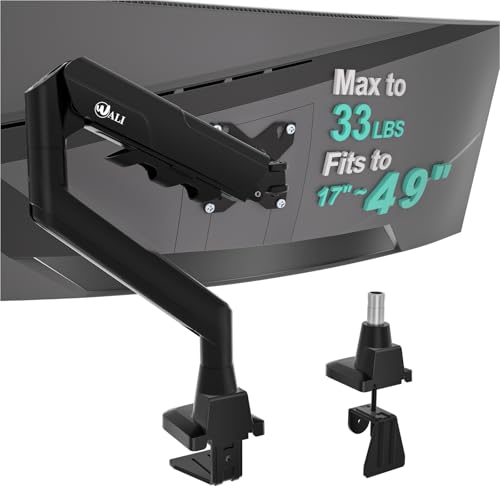
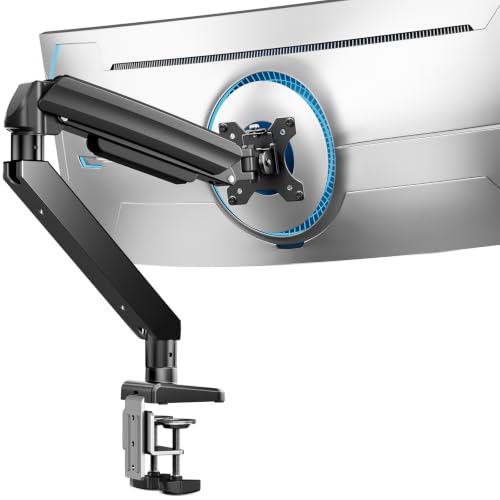
 HUANUO TitanLift Heavy Duty Monitor Arm for
- Fits up to 49" Ultrawide Screens: Ensure your…
- Maximum Support: Crafted from high-strength aluminum alloy, reinforced…
- Fully Adjustable: This ultrawide monitor arm enables precise…

As an Amazon Associate we earn from qualifying purchases at no extra cost to you.
| Ultrawide size | Panel width | Typical weight (no stand) | Minimum arm rating | Recommended arm rating | Arm class and price |
|---|---|---|---|---|---|
| 29 in, 21:9 | 27.5 in (70 cm) | 9 to 13 lb (4 to 6 kg) | 17.6 lb | 19.8 to 22 lb | Standard single arm, $25 to $45 |
| 34 in, 21:9 | 32 in (81 cm) | 13 to 20 lb (6 to 9 kg) | 22 lb | 26 to 33 lb | Ultrawide-rated arm, $30 to $60 |
| 38 in, 21:9 | 35.5 in (90 cm) | 17 to 24 lb (8 to 11 kg) | 26 lb | 33 to 37 lb | Heavy-duty arm, $35 to $80 |
| 40 in, 21:9 | 37.5 in (95 cm) | 20 to 26 lb (9 to 12 kg) | 30 lb | 37 to 44 lb | Heavy-duty arm, $60 to $120 |
| 45 to 49 in, 32:9 | 42 to 47 in (107 to 119 cm) | 25 to 35 lb (11 to 16 kg) | 37 lb | 44 lb or more | Heavy-duty gas spring or post, $80 to $200 |
Real arms in these classes include the VIVO Single 13 to 38 inch Ultrawide Monitor Arm STAND-V001, about $29.99 and rated to 22 pounds, which covers 29- and light 34-inch panels; the WALI Ultrawide Single Monitor Arm for 17 to 49 inch screens, about $31.34 and rated to 33 pounds; the ErGear Heavy Duty Monitor Arm for 13 to 49 inch screens at about $35.99 with a 37.4-pound rating and dual C-clamp; and the HUANUO TitanLift Heavy Duty Monitor Arm at about $97.99, rated to 44 pounds for screens up to 49 inches with a dual C-clamp. As a rule, buy an arm rated at least 30 percent above your panel’s actual weight so the gas spring is not working at its limit.
How to Measure Your Space
- Find the panel weight without stand. It is in the monitor’s spec sheet, usually listed separately from “weight with stand.” If only the combined figure is given, subtract 3 to 6 pounds for a typical stand.
- Confirm the VESA pattern. Look for four threaded holes on the back in a 100 by 100 mm square (about 3.9 inches). A few 49-inch panels use 200 by 100 mm and need an adapter plate.
- Check the mount point on the panel. Curved ultrawides often have the VESA plate recessed or offset from center. Measure the depth of the recess; arms with a flat plate may need spacers of 10 to 20 mm.
- Measure the desk edge. A C-clamp needs 2.5 to 3.5 inches of flat top at the back edge and a thickness of 0.6 to 3.5 inches. Heavy arms spread the load better with a dual clamp or a reinforcement plate under the desk.
- Measure desk depth and viewing distance. For a 34-inch ultrawide you want 26 to 32 inches from eyes to screen. Subtract that from where you sit to find how far back the arm must place the panel; most arms reach 14 to 20 inches from the clamp.
- Check clearance behind. Curved panels swing their edges backward. Leave 4 to 6 inches between the desk’s rear edge and the wall so the arm can retract without the screen edges hitting.
By Room or Use Case
34-inch ultrawide on a 48-inch desk
The most common pairing. A single gas-spring arm rated 22 to 33 pounds with 16 to 18 inches of reach holds the panel 26 to 30 inches from your eyes on a 24-inch-deep desk and clears the surface for a keyboard and notebook.
38- or 40-inch ultrawide for productivity
Step up to a 33- to 37-pound arm with a dual C-clamp. These panels sit 30 to 34 inches from your eyes for comfortable viewing, so a 28- to 30-inch-deep desk or an arm with 20 inches of reach is needed.
49-inch super ultrawide for gaming or trading
At 25 to 35 pounds and 47 inches wide, this is where budget arms sag within months. Choose a 44-pound-rated arm, a dual clamp with a steel reinforcement plate, and a desk top at least 1 inch thick. Some users prefer a fixed post mount over a gas spring here because there is nothing to drift.
Ultrawide plus a second vertical monitor
Two arms on one desk works better than a dual-arm stand, because dual stands are rated for two normal monitors and the shared post cannot carry a 20-pound ultrawide on one side without leaning. Mount the ultrawide on its own heavy-duty arm and the portrait screen on a standard 17- to 22-pound arm.
Common Sizing Mistakes
- Sizing by inches instead of pounds. An arm that “supports up to 49 inches” but is rated 22 pounds will droop under a 30-pound panel.
- Using the weight with stand. This overstates the load by 3 to 6 pounds and pushes you into a bigger arm than you need. Use the panel-only figure, then add 30 percent margin.
- Clamping to a thin or hollow edge. A 30-pound panel on an 18-inch arm applies serious leverage. Particleboard under 0.75 inch thick can crush; use the reinforcement plate or a grommet mount.
- Skipping the VESA recess check. Curved panels with a deep recess bind against the arm’s plate and cannot tilt. Spacers or a longer-screw kit fix it.
- Buying a dual arm for one ultrawide. Dual arms split their rating across two mounts; a single heavy-duty arm is stronger and cheaper.
FAQ
Will a standard monitor arm hold a 34-inch ultrawide?
Often yes, if the arm is rated 22 pounds or more and the panel weighs 13 to 18 pounds without its stand. Arms rated 17.6 pounds are marginal for heavier 34-inch models and will sag over a year or two.
What VESA size do ultrawide monitors use?
Almost all use 100 by 100 mm. Some 49-inch models and a few 40-inch panels use 200 by 100 mm and need an adapter plate, usually $10 to $20, that bolts to the monitor and presents a 100 by 100 pattern to the arm.
Gas spring or mechanical spring for a heavy ultrawide?
Gas spring is smoother and easier to adjust; mechanical-spring or fixed-post arms hold position longer under 30-plus pounds. For panels over 30 pounds many buyers prefer a post-style heavy-duty arm to avoid the slow droop gas springs develop in 2026-era budget models.
How much desk depth do I need for a 34-inch ultrawide on an arm?
About 24 inches (61 cm). The arm pushes the panel 2 to 4 inches past the back edge, giving roughly 28 inches from the front edge to the screen, which is a comfortable viewing distance for a 34-inch curved display.