Key takeaways
- No thickness or density stated. A mat sold only on “ultra comfort” is usually soft, low-density foam that flattens in months.
- Square edges. They curl and trip.
- Kitchen or “chef” mats repurposed for desks; they are designed for constant movement, not stationary standing.
- Mats over 1.25 inches of uniform soft foam. Unstable ankles cause more fatigue than they relieve.
- Balance boards with no stated tilt angle or weight rating.
- Strong chemical smell mentioned repeatedly in reviews; that is PVC or a cheap plasticizer.
- Warranty under 3 years on a foam mat over $40.
- Photos showing the mat only under a desk with no scale; check the actual dimensions against your stance.
What's inside
- Decide These 3 Things First
- Size: Match the Footprint to Your Stance
- Material: Polyurethane Foam vs PVC vs Wood
- Construction: Edges, Base, and Terrain
- Comfort and Performance: What Actually Improves Posture
- Price Tiers: From $20 to $110
- Warranty: Foam Should Be Covered for 5 Years or More
- Delivery and Setup: Unroll and Wait
- Spec Checklist
- Red Flags
- FAQ
- Related Guides
The most common standing desk mat mistake is buying the softest one. A 1 inch slab of squishy foam feels wonderful for the first ten minutes, then your ankles start working overtime to stabilize on an unstable surface, your calves tighten, and by the second hour you are leaning on the desk. The second mistake is buying a kitchen mat, which is designed for someone who shifts around constantly at a counter, not someone who stands still and types for 45 minutes. The third is choosing a flat mat when the real posture problem is that you never move, in which case a contoured or wobble mat that prompts small position changes does far more than an extra half inch of cushion.
- Decide These 3 Things First
- Size: Match the Footprint to Your Stance
- Material: Polyurethane Foam vs PVC vs Wood
- Construction: Edges, Base, and Terrain
- Comfort and Performance: What Actually Improves Posture
- Price Tiers: From $20 to $110
- Warranty: Foam Should Be Covered for 5 Years or More
- Delivery and Setup: Unroll and Wait
- Spec Checklist
- Red Flags
- FAQ
- Related Guides
A standing mat’s job is not to be soft. It is to reduce the pressure on your heels and forefeet enough that you can stand upright for 30 to 60 minute blocks, while encouraging enough micro-movement that your hips and lower back do not lock into one position. Getting that right comes down to a handful of measurable specs: thickness, density, footprint, surface shape, and edge design. This guide covers each with the numbers that matter.
As an Amazon Associate we earn from qualifying purchases at no extra cost to you. Product prices and availability are accurate as of the date shown and are subject to change.


Decide These 3 Things First
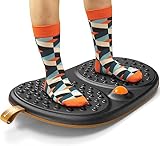
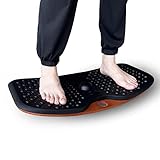
1. Flat, contoured, or active. Flat mats are the traditional anti-fatigue design: a uniform 0.75 to 1 inch slab. Contoured mats, such as the Ergodriven Topo and Topo Mini, add raised edges, a center mound, and varied terrain so your feet find new positions without thinking about it. Active or wobble boards, like the Trobing balance board with rollerball at around $66 or the ZEALTOP rocker board at around $55, tilt underfoot and turn standing into constant low-level balance work. For posture, contoured is the default; active is for people who want to move a lot and already have decent balance.
2. How much floor you have. Measure the clear space in front of your standing desk. A mat needs to sit fully on the floor, not under the desk frame, and you need room to step off it. Small mats are about 20 x 30 inches; standard mats are 24 x 36 to 30 x 40 inches; balance boards are 25 to 30 inches long and 12 to 15 inches wide.
3. Whether you roll a chair over it. If you sit part of the day at the same desk, the mat must move easily or be thin enough to roll over. Contoured mats with a raised lip are designed to be slid aside with one foot; thick flat mats are not, and chair casters will destroy soft foam within months.
Size: Match the Footprint to Your Stance
Stand at your desk in your normal typing posture and measure the width of your stance, heel to heel, plus 6 inches on each side. Most adults land at 24 to 30 inches. Depth should allow a half step back, about 18 to 20 inches minimum. A 20 x 30 inch compact mat works for someone who stands still; a 26 x 30 to 30 x 40 inch mat suits anyone who shifts, steps back, or stands with one foot forward.
Contoured mats are often smaller than they look because the raised features count as usable surface. The Topo Mini at roughly 20 x 26 inches fits a narrow space at around $79, while the full Topo at roughly 26 x 29 inches gives more room to explore the terrain at around $109. Balance boards run 25 to 30 inches long and 12 to 15 inches wide, which is enough for a shoulder-width stance but not for stepping.
Thickness is the other size dimension. Flat mats should be 0.75 to 1 inch; under 0.5 inches gives too little cushion and over 1.25 inches gets unstable. Contoured mats measure 2.5 to 3 inches at their highest features and 0.75 inches at the flat areas.
Material: Polyurethane Foam vs PVC vs Wood
Polyurethane foam is the best all-around material. It compresses under a heel and rebounds, it does not off-gas the way PVC does, and it lasts 3 to 7 years. Density is the spec to look for; a firmer foam of higher density supports longer standing than a soft one. Listings that avoid PVC and PFAS, as the Topo line does, reduce chemical odor out of the box.
PVC and gel-topped mats are cheaper, $20 to $40, but they are heavier, sometimes smell for weeks, and the gel layer can separate from the foam base. They also get slippery when wet.
Wood is the material for balance boards. A 0.5 to 0.75 inch plywood or bamboo deck over a curved base or a rollerball gives a firm, responsive surface. Wood boards need a non-slip pad underneath on hard floors and will scratch hardwood without one.
Construction: Edges, Base, and Terrain
Beveled edges of at least 30 degrees are non-negotiable on a flat mat; a square edge is a trip hazard and curls over time. Contoured mats replace the bevel with a raised rim of 1 to 2 inches, which doubles as a spot to hook a foot and slide the mat.
The base should be textured or rubberized to grip hard floors. On carpet, thick flat mats stay put but balance boards need a wider rocker base or a rubber pad to keep from sliding.
For contoured mats, look at the terrain features: a central mound of 1.5 to 2.5 inches to roll your arches over, side ridges to stretch calves, and a flat zone of at least 12 x 14 inches for neutral standing. A mat that is all bumps and no flat space becomes tiring.
Balance boards fall into two types. Rocker boards tilt on one axis, typically 10 to 15 degrees each way, and are easier to stand on while typing. Rollerball or 360 degree boards move in every direction and are harder to type on but engage more muscles. A board with a removable ball or an adjustable pivot lets you scale difficulty.
Comfort and Performance: What Actually Improves Posture
A mat improves posture by making it comfortable to stand upright longer and by prompting position changes. Flat mats do only the first. Contoured mats do both, and most users report they can stand 45 to 90 minutes on a contoured mat versus 30 to 45 on a flat one before wanting to sit. Balance boards force constant small movements, which is excellent for hips and ankles but can distract from focused typing; many people use them for calls and reading rather than heavy keyboard work.
Weight capacity matters for durability more than safety. Foam mats are generally rated to 300 pounds or more. Wood balance boards are typically rated 250 to 330 pounds; check the figure if you are near that range.
Shoes or barefoot changes the calculus. Contoured mats are designed for barefoot or socks, where your feet can feel the terrain. In shoes, a flat mat performs nearly as well and costs half as much.
Price Tiers: From $20 to $110
Under $30 buys a flat PVC or basic foam mat, 20 x 32 inches, 0.75 inches thick. Expect curling edges within a year and a chemical smell at first. From $30 to $60 you get firmer polyurethane flat mats with proper bevels and 3 to 5 year lifespans, plus entry-level rocker boards like the ZEALTOP at around $55. From $60 to $110 sit the contoured mats and premium balance boards: the Topo Mini at around $79, the Trobing rollerball board at around $66, and the full-size Topo at around $109. Above $110 you are paying for oversized mats, designer finishes, or commercial-grade foam meant for 24-hour use.
Warranty: Foam Should Be Covered for 5 Years or More
Quality polyurethane mats carry 5 to 7 year warranties against compression and cracking. Budget PVC mats offer 1 year or none. Balance boards typically have 1 to 2 years on the deck and base. A short warranty on a foam mat is a direct signal that the manufacturer expects it to flatten quickly.
Delivery and Setup: Unroll and Wait
Flat foam mats ship rolled in a box about 32 x 8 x 8 inches and weigh 4 to 8 pounds; they need 24 to 48 hours flat to lose their curl. Contoured mats ship flat in a box about 30 x 28 x 5 inches and weigh 6 to 9 pounds, ready to use immediately. Balance boards ship in a box of roughly 30 x 15 x 6 inches at 8 to 12 pounds and may need the pivot or ball attached, a 5 minute job. Let any foam mat air out for a day in a ventilated room before use if it has an odor.
Spec Checklist
| Spec | Budget | Mid | Premium |
|---|---|---|---|
| Price | $20 to $35 | $35 to $65 | $65 to $110 |
| Type | Flat PVC or basic foam | Firm flat polyurethane or entry rocker board | Contoured terrain mat or premium balance board |
| Footprint | 18 x 30 to 20 x 32 in | 24 x 36 to 26 x 30 in | 20 x 26 to 30 x 40 in |
| Thickness | 0.5 to 0.75 in | 0.75 to 1 in | 0.75 in flat zone, 2.5 to 3 in features |
| Material | PVC, gel, or low-density foam | Polyurethane foam | High-density polyurethane, PVC-free; bamboo or plywood boards |
| Edge | Slight bevel | 30 to 45 degree bevel | Raised rim 1 to 2 in |
| Weight rating | Not stated or 250 lb | 300 lb | 300 lb+ foam; 250 to 330 lb boards |
| Warranty | None to 1 year | 3 to 5 years | 5 to 7 years mats; 1 to 2 years boards |
Red Flags
- No thickness or density stated. A mat sold only on “ultra comfort” is usually soft, low-density foam that flattens in months.
- Square edges. They curl and trip.
- Kitchen or “chef” mats repurposed for desks; they are designed for constant movement, not stationary standing.
- Mats over 1.25 inches of uniform soft foam. Unstable ankles cause more fatigue than they relieve.
- Balance boards with no stated tilt angle or weight rating.
- Strong chemical smell mentioned repeatedly in reviews; that is PVC or a cheap plasticizer.
- Warranty under 3 years on a foam mat over $40.
- Photos showing the mat only under a desk with no scale; check the actual dimensions against your stance.
FAQ
Is a contoured mat really better than a flat mat for posture?
For most people, yes. The terrain features prompt small position changes that a flat mat does not, which keeps hips and lower back from settling into one locked posture. If you wear shoes at your desk, though, you lose most of the terrain benefit and a firm flat mat is nearly as good for about half the cost.
How thick should a standing desk mat be?
Three quarters of an inch to 1 inch for a flat mat. Thinner does not relieve heel pressure; thicker becomes unstable. Contoured mats measure 2.5 to 3 inches at their peaks but stand on a 0.75 inch base.
Can I type while standing on a balance board?
On a rocker board with a 10 to 15 degree tilt, yes, after a week of practice. On a rollerball or 360 degree board, typing is harder and most users reserve it for calls, reading, or video. Many boards let you remove the ball or lock the pivot for a stable mode.
How long does a standing desk mat last?
A quality polyurethane mat lasts 5 to 7 years of daily use before the foam noticeably compresses. Budget PVC mats last 1 to 2 years. Wood balance boards last indefinitely if the non-slip base is replaced when it wears, usually every 2 to 3 years. Prices in 2026 for a good contoured mat, $80 to $110, work out to roughly $15 a year over its life.