Key takeaways
- Adjustable lumbar. The pad should travel at least 2 inches vertically so it lands on your lower back rather than your tailbone or mid-back. Depth adjustment of 0.5 to 1.5 inches lets you tune pressure. The Marsail and TRALT chairs both have adjustable lumbar; the Marsail adds 3D armrests that move up, forward, and in.
- Backrest height. High-back chairs run 26 to 30 inches from seat to top of frame, which supports the shoulders. Mid-back chairs at 18 to 22 inches leave the upper back unsupported during recline.
- Recline and tilt tension. A 90 to 120 degree recline range with a tension knob lets you lean back and let the chair carry some of your torso weight, which unloads the lumbar discs.
- Seat depth. A 17 to 20 inch seat with a waterfall front edge keeps pressure off the back of the knees. Sliding seat depth is rare under $150.
- Headrest. Useful during recline breaks, mostly irrelevant while typing upright.
What's inside
The Short Answer
Yes, but only if the chair has a separately adjustable lumbar support. A mesh back by itself does not support your spine; it is a tensioned fabric that follows whatever shape your back gives it. Back support comes from the frame curve and the lumbar pad behind the mesh. A mesh chair with a fixed, poorly placed lumbar bump will leave you sore just as fast as a cheap padded chair, while a mesh chair with an adjustable lumbar that you can move up, down, and in or out is one of the best tools available for long desk sessions.
The good news is that adjustable lumbar has become standard at the $100 to $130 price point. The Marsail high-back mesh chair at $118.94 and the TRALT mesh desk chair at $102.59 both include adjustable lumbar support, headrests, and multi-directional armrests, features that were $300 territory a few years ago.
As an Amazon Associate we earn from qualifying purchases at no extra cost to you. Product prices and availability are accurate as of the date shown and are subject to change.


What You Actually Get
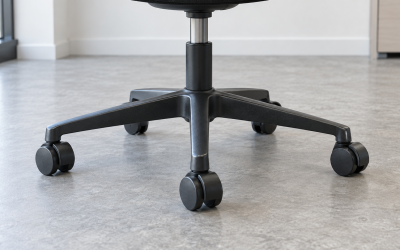
A mid-range mesh office chair is built around a nylon or steel frame with a woven elastomer mesh stretched across the backrest. The seat is usually a foam cushion topped with fabric or mesh, and the base is a five-star nylon or aluminum hub on 50 to 60 mm casters. Weight ratings in this tier run from 250 to 300 pounds; heavy-duty models rated for 350 to 400 pounds start around $200 to $250.
The features that actually affect back support are these:
- Adjustable lumbar. The pad should travel at least 2 inches vertically so it lands on your lower back rather than your tailbone or mid-back. Depth adjustment of 0.5 to 1.5 inches lets you tune pressure. The Marsail and TRALT chairs both have adjustable lumbar; the Marsail adds 3D armrests that move up, forward, and in.
- Backrest height. High-back chairs run 26 to 30 inches from seat to top of frame, which supports the shoulders. Mid-back chairs at 18 to 22 inches leave the upper back unsupported during recline.
- Recline and tilt tension. A 90 to 120 degree recline range with a tension knob lets you lean back and let the chair carry some of your torso weight, which unloads the lumbar discs.
- Seat depth. A 17 to 20 inch seat with a waterfall front edge keeps pressure off the back of the knees. Sliding seat depth is rare under $150.
- Headrest. Useful during recline breaks, mostly irrelevant while typing upright.
Mesh quality varies widely. Tight, dense weaves hold their shape for years; loose, stretchy mesh sags within 12 to 18 months and starts pushing you forward into a slouch. You cannot measure this from a product listing, so look for reviews mentioning sagging after a year of use.
Pros
- Airflow. Mesh dissipates heat and sweat far better than foam, which matters for anyone working eight hours in a warm room or a home office without strong air conditioning.
- Even pressure distribution. A tensioned mesh conforms to your back’s curve, spreading contact across a larger area than a fixed foam shape.
- Adjustable lumbar is now cheap. Chairs in the $100 to $130 range routinely include it.
- Lighter weight. A mesh high-back chair typically weighs 35 to 45 pounds versus 50 to 65 pounds for an equivalent padded executive chair, making it easier to move and assemble.
- Visible construction. You can see the frame and lumbar mechanism, so problems are easier to diagnose than with a chair hidden under upholstery.
- Recline support. Most mesh task chairs in this price class offer 120 degree recline with tension control, which encourages posture changes through the day.
Cons
- Mesh does nothing on its own. Without a well-placed lumbar pad, a mesh back can actually encourage slumping because it gives way under load.
- Budget mesh sags. Expect looser weaves to lose tension within one to two years, at which point the back support degrades noticeably.
- Hard frame edges. The plastic rim around a mesh back can dig into shoulder blades or the upper back on chairs where the mesh is stretched too flat.
- Cold in winter. The same airflow that helps in summer is unwelcome in a chilly room.
- Mesh seats are polarizing. A mesh seat pan can feel like sitting on a trampoline edge after a few hours; many buyers prefer a foam seat with a mesh back.
- Fixed lumbar on the cheapest chairs. Under $80, most “ergonomic mesh” chairs have a molded bump that cannot move, which is worse than no lumbar at all if it hits the wrong spot.
Who Should Buy It
Buy a mesh chair with adjustable lumbar if you sit for six or more hours a day, run warm, and have a history of lower back stiffness after long sessions. It is also the right choice if you weigh under 250 pounds and want a high-back chair with headrest for occasional recline breaks. People who alternate between an upright typing posture and a reclined reading or video-call posture get the most from the tension-controlled tilt that comes standard on chairs like the Marsail and TRALT models.
Who Should Skip It
Skip mesh if you strongly prefer a plush, cushioned feel or work in a cold room where a foam back is more comfortable. Skip it if you weigh over 275 pounds; budget mesh frames flex and the mesh stretches faster under heavier loads, so a heavy-duty chair rated 350 pounds or more with a steel frame is a better investment. Skip it if you already have a chair with good lumbar support and are only experiencing heat discomfort; a $20 to $40 mesh seat cushion or back panel solves that for far less. And if you have a diagnosed disc issue, a chair alone is not the fix; talk to a physical therapist before spending money on furniture.
Cheaper Alternatives
| Option | Cost | Trade-off |
|---|---|---|
| Strap-on lumbar cushion for your current chair | $15 to $35 | Adds support where you need it, but slides around and does nothing for seat height or recline. |
| Mesh mid-back task chair with fixed lumbar | $60 to $90 | Airflow and a low price, but the lumbar bump cannot be repositioned and there is no headrest or shoulder support. |
| Kneeling chair | $60 to $120 | Opens the hip angle and encourages an upright spine, but hard on the shins for sessions over 45 minutes and offers no back support at all. |
| Padded executive chair without mesh | $90 to $150 | Warmer and cushier, but heavier, hotter, and foam compresses unevenly over time. |
| Standing desk converter used part of the day | $60 to $150 | Reduces total sitting time, which helps any back, but you still need a decent chair for the seated hours. |
FAQ
Is mesh or cushion better for lower back pain?
Neither material fixes back pain by itself. What matters is an adjustable lumbar support that sits at the curve of your lower back, roughly at belt level, and a seat height that lets your feet rest flat with knees near 90 degrees. Mesh wins on heat and even pressure; foam wins on plush feel. Pick the one you will sit in correctly.
How should I set the lumbar support on a mesh chair?
Sit all the way back so your hips touch the backrest, then raise or lower the pad until it fills the inward curve just above your belt line. Adjust depth so you feel gentle contact, not a push. If you find yourself sliding forward to escape it, it is too deep or too low.
How long does a $100 to $130 mesh chair last?
With daily use, expect three to five years from the frame and mechanism, and one to three years before the mesh loses noticeable tension. Gas cylinders and casters are the most common failures and are cheap to replace. Chairs in 2026 at this price commonly carry a one to three year warranty, so check the coverage on the tilt mechanism specifically.
Do I need a headrest for back support?
No. A headrest supports your neck during recline but plays no role in lumbar support while you type. It is a comfort feature for breaks and video calls, and it is worth having on a high-back chair, but it should not be the deciding factor.