Our Top Picks
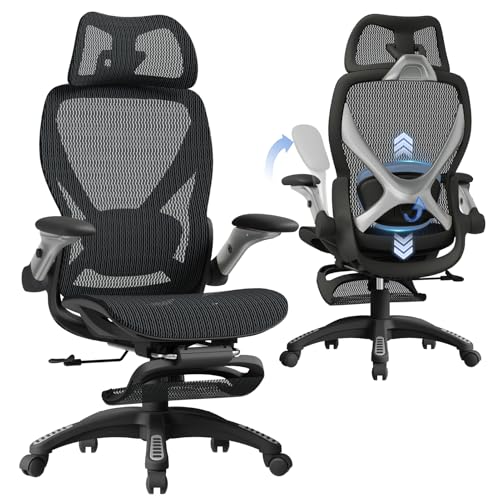 ELABEST X100 Ergonomic Mesh Office Chair with Footrest18.3 in x 20.47 in x 41 in26 x 24 x 41 Inches43 poundsCheck on Amazon
Pros & cons
- 3D lumbar system tracks natural spine curvature
- 18-inch extendable footrest adds a relaxation mode
- Dual-Stripe AirMesh adds extra airflow over standard mesh
- At 43 pounds, it is heavier than typical desk chairs
- Multiple adjustment systems add a learning curve to set up
Pros & cons
- Four support points cover head, back, hips, and hands
- Flip-up armrests let the chair tuck under the desk
- Backed by a 3-year coverage period
- Comfortable fit spans roughly 5 foot 2 to 6 foot 1
- At 41 pounds, it is heavier than basic task chairs
The best home office chairs in 2026 for most people are fully adjustable ergonomic mesh task chairs like the Herman Miller Aeron, Steelcase Leap, and Haworth Zody for all-day support, with breathable mesh and high-density foam alternatives like the Secretlab Titan Evo offering better value for long hours if you prefer a cushioned seat.
Choosing between them comes down to your body type, how many hours you sit, and whether you prioritize airflow, plush cushioning, or compact size. A chair that fits a 5’2″ person for 4 hours a day will not fit a 6’2″ person working 8+ hours, and the wrong seat depth or lumbar placement is what causes most comfort complaints, not the brand.

Herman Miller Classic Aeron Chair - Size B, Posture Fit
Chosen because it specifies Size B and Posture Fit.
View on Amazon
Herman Miller Aeron Ergonomic Chair - Size B, Graphite
Chosen because it specifies Size B and Graphite.
View on AmazonELABEST X100 Ergonomic Mesh Office Chair with Footrest, Big and Tall Hone Desk Chair with 5D Flip-Up Arms, Adjustable 3D Lumbar Support,Gaming & Executive Computer Chairs
Chosen because it specifies Big and Tall Hone Desk Chair with 5D Flip-Up Arms and Adjustable 3D Lumbar Support.
View on Amazon
GABRYLLY Ergonomic Office Chair, High Back Home Desk Chair with Headrest, Flip-Up Arms, 90-120° Tilt Lock and Wide Cushion, Big and Tall Mesh Chairs for Man Woman, Black Task Chair
Chosen because it specifies High Back Home Desk Chair with Headrest and Flip-Up Arms.
View on AmazonHow to Choose a Home Office Chair: The 4 Measurements That Matter
Before comparing features, match the chair to your body and desk. These numbers determine comfort more than any marketing claim:
- Seat height: Standard desks are 29-30 inches high. Most people need a seat height of 16-21 inches to keep feet flat and thighs parallel to the floor with elbows at 90 degrees. If you are under 5’4″, look for a low minimum height (15.5-16.5 inches). If you are over 6’0″, you need at least 19-20 inches maximum height.
- Seat depth: Measure from your back to the back of your knees. Ideal seat depth leaves 2-3 inches of clearance between the seat edge and your calves. Shallow depths (15-16 inches) suit smaller frames; deep seats (18-19 inches) suit taller users or those who like to sit cross-legged. A sliding seat pan is essential if multiple people use the chair.
- Lumbar height and depth: Effective lumbar support should hit your natural lower-back curve, roughly 6-10 inches above the seat pan. Fixed lumbar pads often miss the mark. Look for height-adjustable and depth-adjustable lumbar (or tension-controlled mesh) that can move 2-4 inches vertically.
- Armrest adjustability: 4D armrests (height, width, depth, pivot) let you bring support close enough to prevent shoulder shrugging at the keyboard. For desks with keyboard trays or compact 48-inch desks, armrests that slide fully under the desk save 4-6 inches of floor space.
For room fit, plan on 36 inches of clearance from the wall to the back of the desk for a chair to recline and roll. In a typical 10×12 ft home office, a chair with a 26-28 inch wheelbase needs at least a 5×5 ft open area to move freely without hitting filing cabinets or walls. Most home office chairs are 25-27 inches wide; compact models under 25 inches are better for small apartments and closets converted to offices.
Material Trade-Offs: What Wears First
No single material is best for everyone. This table compares what you will actually notice after 12-24 months of daily use.
| Material / Construction | Comfort & Breathability | Durability (5-Year Outlook) | Best For | Common Drawback |
|---|---|---|---|---|
| Mesh Back + Mesh Seat (e.g., Aeron-style) | Excellent airflow, firm support, no heat buildup | Mesh can sag slightly after 3-5 years; frame lasts 10+ years | Hot environments, 6-10 hour sitters who run warm | Firm feel, not plush; mesh can feel rough on bare skin |
| Mesh Back + Foam Seat | Balanced: breathable back, cushioned seat | Foam compresses over 2-4 years depending on density | Most home offices; best overall compromise | Foam edge wears where thighs press |
| High-Density Cold-Cure Foam (50-60 kg/m³) with Leatherette/PU Leather | Plush, supportive initially, traps heat | PU leather can peel/flake in 2-3 years in dry or sunny rooms; foam holds shape 4-5 years | Gamers, users who want racing-style bolstering | Requires cool room; leatherette is less breathable |
| Fabric Upholstery (Woven Polyester/Blends) | Soft, warm, moderate breathability | Pilling and staining; pet hair adheres; foam beneath still compresses | Cold rooms, users who prefer textile feel | Harder to clean; absorbs spills and odors |
| Genuine Leather | Develops patina, breathes better than faux leather | Lasts 7-10 years with conditioning; cracks without care | Executive offices, long-term investment | Usually $800-$1,500+; needs maintenance |
On foam, density matters more than thickness. Standard office chair foam is 30-40 kg/m³ and flattens within 18 months for users over 180 lbs. Chairs advertising cold-cure or high-resilience foam at 50+ kg/m³ will maintain height and support for 3-5 years. Weight limits tell the same story: budget mesh chairs are often rated for 225-250 lbs, mid-range for 275-300 lbs, and heavy-duty models for 350 lbs. Exceeding the limit accelerates cylinder and armrest failure first.
Best Home Office Chairs by Situation in 2026
Match your situation to the chair type that solves it, not just the most popular model.
1. For 8+ Hours a Day and Back Pain: Full Ergonomic Mesh
If you sit through most of the workday and need posture support, prioritize a mesh-back chair with independent adjustments for lumbar depth, backrest tension, and seat depth.
Types like the Herman Miller Aeron (available in sizes A/B/C to match body size), Steelcase Leap, and Haworth Fern and Zody usually fall in the $800-$1,400 range and are designed for 8-12 hour use. They offer synchro-tilt recline that keeps your feet on the floor while opening your hip angle to reduce lower-back pressure, and live-back or flexible mesh that moves with your spine. Look for at least 5 years of warranty coverage on the mechanism; premium brands typically offer 10-12 years.
2. For Small Apartments and Compact Desks: Compact Task Chair Without Headrest
In rooms under 100 sq ft, every inch counts. A headrest adds 6-8 inches of height and prevents pushing the chair fully under a 29-inch desk, which can block walkways. A compact mesh task chair around 24-25.5 inches wide with flip-up armrests solves this.
Models like the Haworth Soji, Steelcase Series 1, or branch-style all-mesh chairs usually cost $350-$650 and have a smaller 25-inch base that fits tight corners. They still need 30 inches of depth to recline, so position the desk 4 inches from the wall and leave the space behind the chair open. Box weight for these is typically 35-45 lbs, versus 55-65 lbs for larger ergonomic chairs, which matters for upstairs apartments and narrow 28-inch doorways.
3. For Pet Owners, Kids, and Easy Cleaning: Foam Seat with Durable Fabric or Coated Mesh
Woven fabric traps pet hair and juice-box spills. A mesh back with a wipeable foam seat or coated mesh seat resists both. Avoid PU leatherette if your chair sits in direct sunlight, as UV accelerates peeling along the seat edges within 18-24 months.
Chairs with replaceable seat pads are a practical advantage here. The ability to swap a $80-$150 seat cushion after 3 years extends the chair’s life far more than a sewn-in seat.
4. For Tall or Large Users (Over 6’0″ or 250+ lbs): Large Seat and High Weight Capacity
Standard chairs run out of seat depth and cylinder height for tall users, forcing you to perch on the edge. Look for seat depth of 18.5-19.5 inches (or adjustable to that), seat width of 20+ inches, and a cylinder that reaches 20-21 inches high. Models like the Secretlab Titan XL, Steelcase Leap Plus, or heavy-duty Big & Tall mesh chairs usually support 350-400 lbs and use reinforced bases. Expect box weights of 60-75 lbs and assembly that requires two people to lift the back onto the base.
5. For Budget Home Offices Under $400: Prioritize Adjustability Over Looks
Usually $250-$400 buys a capable mesh task chair if you choose adjustments over extras like leather or thick headrests. At this range, insist on at least three features: height-adjustable lumbar, seat depth adjustment or a waterfall edge, and tilt lock with tension control. 3D armrests are a bonus. Avoid chairs that only offer fixed lumbar and fixed armrests, as they cannot be tuned to different body types and force slouching.
Decision Matrix: Which Chair Type Fits Your Needs
| Your Situation | Recommended Type | Key Spec to Check | Market Range |
|---|---|---|---|
| Work 8+ hours, history of lower-back stiffness | Full mesh ergonomic with adjustable lumbar | Lumbar adjusts 3-4 inches vertically and depth-adjustable | Usually $800-$1,400 |
| Small apartment / 10×12 ft or smaller room | Compact mesh task chair, no headrest, flip-up arms | Width under 25.5 inches, base 25 inches, fits under 29-inch desk | Usually $350-$650 |
| Renters who move often | Lightweight mesh task chair (35-45 lbs boxed) | Tool-free or 4-bolt assembly, fits through 28-inch doorway boxed | Usually $300-$600 |
| Pets or young kids at home | Mesh back + coated foam or mesh seat | Replaceable seat pad, no woven fabric on contact areas | Usually $400-$750 |
| Over 6’1″ or over 250 lbs | Big & Tall with sliding seat pan | 19+ inch seat depth, 350+ lb rating, 20+ inch max seat height | Usually $500-$1,000 |
| Prefer plush, racing-style look | High-density foam bucket seat | Foam density 50+ kg/m³, breathable fabric sides to reduce heat | Usually $400-$700 |
Assembly, Moving, and Durability Realities
Box dimensions for most home office chairs are 28-34 inches long and 24-28 inches wide, so measure your elevator and hallway before delivery. Budget chairs ship with the base and back separated and require 8-12 bolts (15-30 minutes with an Allen key). Premium ergonomic chairs often arrive with the mechanism pre-assembled; you only attach the base, cylinder, and armrests (10-15 minutes).
What wears first is predictable: the gas cylinder loses height after 3-5 years of heavy use, armrest pads crack or peel, and foam seats develop a permanent dip where your sit bones rest. Mesh longevity depends on tension; keeping recline tension moderate rather than fully locked reduces stress on the mesh anchors. Casters wear quickly on hard floors without a chair mat. A $30-$50 polyurethane chair mat prevents both caster wear and floor scratches, especially on luxury vinyl or hardwood.
Check the warranty before buying. A 5-year warranty on mechanism and cylinder is the minimum for daily use. Chairs offering 10-12 year warranties typically cover the frame, mechanism, and cylinder but exclude upholstery and arm pads after 2-5 years. Keep the chair out of direct sun and away from heaters; heat dries out PU leather and stiffens mesh fibers.
Final Fit Check Before You Buy
Sit and check three points: feet flat with no pressure under thighs, lumbar pad filling your lower back curve without pushing you forward, and armrests supporting elbows without lifting shoulders. If buying online, compare your torso height and weight to the manufacturer’s size chart, and confirm return windows. A 30-day return policy is essential because comfort issues from seat depth or lumbar placement usually appear after a full work week, not five minutes in a showroom.