Key takeaways
- A mesh chair with no mention of lumbar support at all. The mesh is doing nothing for your spine.
- Fabric chairs that do not state foam thickness. Assume under 2 inches.
- Mesh stretched so tight it looks flat in photos, with a visible plastic rim; the rim will catch your shoulder blades.
- Reviews describing sag or a “hammock” feel within a year on mesh, or a “sinking” seat on fabric.
- Bonded leather marketed as fabric or “leather fabric.” It peels.
- No weight rating listed.
- Warranty under 1 year, or one that excludes tension loss and foam compression.
- Headrest promoted as the main ergonomic feature. It only matters in recline.
Most people choose between mesh and fabric office chairs based on a five-minute sit in a showroom, or worse, on the product photo. Mesh looks modern and airy; fabric looks cushioned and warm. Neither impression tells you what the chair will feel like at hour six on a hot afternoon, or whether the back will still hold its shape in two years. The result is a lot of returned chairs and a lot of people convinced that mesh is uncomfortable or fabric is sweaty, when the real problem was a bad lumbar or thin foam.
The material is the least important part of the decision, and also the part people spend the most time on. What matters is the combination of back material, seat material, lumbar adjustment, and how you sit. This guide separates the true trade-offs from the marketing and gives you the specs to compare so the chair you pick works for your body and your room.
Our top picks



As an Amazon Associate we earn from qualifying purchases at no extra cost to you.
Decide These 3 Things First
1. How warm is your workspace? If your office regularly sits above 74 degrees Fahrenheit, or you run warm, a mesh back is the single biggest comfort upgrade available. If your space is cool or air-conditioned to 70 degrees or below, fabric’s warmth is an asset and mesh can feel drafty.
2. Do you sit upright or recline? Upright typists load the seat and lumbar; recliners load the upper back and headrest. Mesh backs excel at recline because they flex evenly. Fabric over molded foam gives a more defined shape for upright sitting.
3. Mesh seat or foam seat? This is the decision most people skip. A mesh back with a foam seat, the most common configuration at $65 to $160, gets the airflow benefit where it matters most while keeping cushion under the thighs. Full mesh seats are cooler but firmer and can feel like sitting on a taut edge after a few hours.
Material: What Each Actually Does
Mesh is a woven elastomer or polyester blend stretched across a frame. Its job is to spread pressure across the back and let air through. Quality is about tension and weave density; tight, springy mesh holds shape for 4 to 6 years, while loose mesh sags within 12 to 18 months and starts pushing you forward.
Fabric chairs use a woven polyester or nylon cover over molded foam. The foam does the shaping; the fabric protects it. Foam thickness of 2.5 to 4 inches with a density of 1.8 pounds per cubic foot or higher holds up for 4 to 5 years. Thin foam under 2 inches, common on chairs under $80, bottoms out in a year.
Fabric traps heat, roughly speaking, because the foam behind it has no airflow. It is also more absorbent: spills soak in and need cleaning, while mesh wipes off. On the other hand, fabric is quieter, does not have a hard frame rim to catch shoulder blades, and looks at home in a living room in a way black mesh does not.
Size: Back Height, Seat Width, and Weight Rating
Both materials come in the same size classes, but mesh chairs skew toward high backs with headrests, and fabric chairs skew toward mid backs and executive styles. High backs run 26 to 30 inches from seat to top of frame and support the shoulders in recline; the NEO CHAIR high back with headrest at around $65 and the FelixKing high back with flip-up arms at around $120 are typical mesh examples. Mid backs at 18 to 22 inches, like many fabric task chairs, suit upright typists and fit under a desk more easily.
Seat width should be your hip width plus 2 inches, usually 19 to 21 inches; seat depth 17 to 19 inches with a waterfall front edge. Weight ratings are 250 pounds on most chairs in this class regardless of material, and 300 to 330 pounds on chairs built with steel frames and Class 4 cylinders.
Construction: Frame, Lumbar, and Mechanism
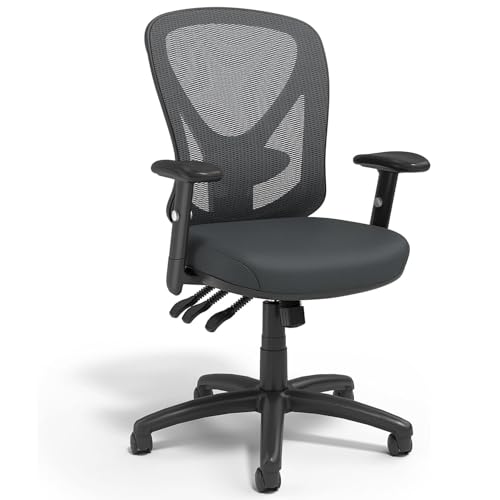
The frame around a mesh back must be rigid. Nylon frames on chairs under $100 flex under heavy recline, which changes the mesh tension and can cause creaking. Steel or glass-fiber-reinforced nylon frames on chairs from $120 to $160, like the Staples Carder at around $160, keep tension stable.
Lumbar support is where the material question becomes irrelevant. A mesh chair needs a separate lumbar pad or an adjustable bar behind the mesh; the mesh alone provides no support. A fabric chair needs the foam contoured into a lumbar curve, ideally with an adjustable insert. In both cases look for 2 inches of vertical travel and some depth adjustment.
The tilt mechanism, gas cylinder, and base are identical across materials at any given price. Look for a Class 3 or 4 cylinder, a tilt lock with at least 2 positions, and a 25 to 27 inch base with 50 to 60 mm casters.
Comfort and Performance: Hour Six, Not Minute Five
Mesh feels firm at first and then disappears; you notice it less as the day goes on because it does not build up heat or compress. Fabric feels better in the first minute and then depends entirely on the foam beneath it. A good foam seat stays comfortable all day; a cheap one develops a hot spot under the sit bones by mid-afternoon.
For back comfort, mesh wins in recline because the whole back flexes. For upright posture, fabric over well-shaped foam gives more definition. Headrests, like the 3D adjustable headrest on some mesh chairs around $120, matter only when reclining; they are irrelevant to the material choice.
Noise is a minor but real difference. Mesh can squeak at the frame attachment points; fabric is silent. Durability favors fabric slightly for the seat and mesh for the back, which is exactly why the hybrid configuration dominates.
Price Tiers: The Same Money Buys Different Things
Under $80, mesh chairs offer a high back, a headrest, and a fixed lumbar; fabric chairs offer a mid back with thin foam. Mesh gives more features per dollar here, as the NEO CHAIR at around $65 shows. From $80 to $130, both materials gain adjustable lumbar, flip-up or 2D armrests, and better foam or mesh; this is where hybrid chairs like the FelixKing at around $120 sit. From $130 to $200, frames become steel, mesh gets denser, fabric gets thicker high-density foam, and warranties extend to 2 to 5 years. Above $200, you are paying for seat depth adjustment, 4D arms, and mesh or fabric rated for commercial use.
Warranty: Mesh Sag Is the Clause to Check
Budget chairs carry 1 year. Mid-range chairs offer 2 to 3 years, and better ones split coverage: 5 years on frame, 2 years on mechanism and cylinder. For mesh, confirm that loss of tension is covered; many warranties exclude it as normal wear. For fabric, check that foam compression is covered. Neither is universal, and its absence tells you how long the manufacturer expects the chair to last.
Delivery and Assembly: 20 to 40 Minutes
Both types ship in a box about 30 x 26 x 14 inches. Mesh chairs weigh 30 to 40 pounds boxed; fabric chairs 38 to 50 pounds. Assembly is the same: casters into the base, cylinder into the base, seat onto the mechanism with four bolts, back onto the seat, armrests, headrest. Plan 20 to 40 minutes. Mesh backs are lighter and easier to align; fabric backs with heavy foam sometimes need a second person to hold while you bolt.
Spec Checklist
| Spec | Budget | Mid | Premium |
|---|---|---|---|
| Price | $60 to $90 | $90 to $160 | $160 to $400 |
| Back material | Basic mesh or thin fabric over foam | Dense mesh or fabric over 3 in foam | Commercial mesh or high-density foam, 4 in |
| Seat | 2 to 2.5 in foam | 3 in foam, waterfall edge | 3.5 to 4 in high-density, sliding depth |
| Lumbar | Fixed | Adjustable height | Height and depth |
| Frame | Nylon | Reinforced nylon or steel | Steel or aluminum |
| Armrests | Fixed or flip-up | Flip-up or 2D | 3D or 4D |
| Weight rating | 250 lb | 250 to 300 lb | 300 to 330 lb |
| Cylinder | Class 3 | Class 3 or 4 | Class 4 |
| Warranty | 1 year | 2 to 3 years | 5 years or more |
Red Flags
- A mesh chair with no mention of lumbar support at all. The mesh is doing nothing for your spine.
- Fabric chairs that do not state foam thickness. Assume under 2 inches.
- Mesh stretched so tight it looks flat in photos, with a visible plastic rim; the rim will catch your shoulder blades.
- Reviews describing sag or a “hammock” feel within a year on mesh, or a “sinking” seat on fabric.
- Bonded leather marketed as fabric or “leather fabric.” It peels.
- No weight rating listed.
- Warranty under 1 year, or one that excludes tension loss and foam compression.
- Headrest promoted as the main ergonomic feature. It only matters in recline.
FAQ
Is mesh or fabric better for long hours?
For eight-hour days in a room above 72 degrees, mesh back with a foam seat. For cooler rooms and upright typing, fabric over 3 inch or thicker foam. The lumbar adjustment matters more than either material for how your back feels at the end of the day.
Does mesh wear out faster than fabric?
Budget mesh loses tension in 1 to 2 years; quality mesh lasts 4 to 6. Fabric covers last 5 years or more, but the foam beneath compresses in 1 to 4 years depending on density. Over a 5 year window, a mid-range chair of either material performs similarly if you buy the right density or weave.
Can I get a fabric seat with a mesh back?
Yes, and it is the most common configuration from $65 to $160. Most chairs marketed as mesh in 2026 actually use a foam seat under a fabric or mesh cover, with true mesh only on the back. Check the seat description specifically if you want full mesh.
Which is easier to clean?
Mesh. Dust vacuums off and spills wipe away. Fabric absorbs liquid and needs upholstery cleaner; light colors show wear at the front edge within a year. If you eat at your desk or have pets, mesh back and a dark fabric seat is the practical combination.