Key takeaways
- Working height: A rolling chest’s top surface should land between 36 and 40 inches for standing work, putting your elbows near 90 degrees. Shorter cabinets force sustained trunk flexion, which is what actually wrecks your lower back over a long project. Taller combo units shift frequently-used drawers into the comfortable 30-to-50-inch reach zone.
- Slide mechanism: Ball-bearing runners glide under load and resist sagging; friction slides bind once a drawer passes roughly 30 pounds. Check whether the rating is per drawer or for the whole cabinet, and look for full-extension travel so you aren’t blind-groping at the back.
- Steel gauge and joinery: Lower numbers mean thicker metal — 16-gauge is meaningfully stiffer than 20-gauge. Inspect corner construction too: welded or double-folded seams stay square, while spot-welded thin panels rack over time and throw drawers out of alignment.
- Caster size and locking: Wheels under 3 inches stall on cords, chips, and expansion joints. Larger swivel casters with at least two brakes roll over debris and hold position when you’re pulling hard on a stuck fastener. Total capacity should exceed your planned load by a comfortable margin.
- Security and containment: A central lock bar that engages every drawer beats a single latch on the top one. Drawer liners cut noise and stop tools sliding into a pile during transit, and a lip or retaining catch prevents a loaded drawer from rolling out onto your foot.
What's inside
Tool chests fail in predictable ways. A drawer slide binds under 40 pounds of sockets, a caster snaps crossing a threshold, a thin steel top bows the first time you lean on it with a torque wrench. The frustrating part is that none of this shows up in a spec sheet. Load ratings get quoted per-drawer or per-unit with no standard behind them, and “heavy-duty” appears on 18-gauge boxes and 16-gauge boxes alike. Meanwhile the thing you actually feel every day — whether the top drawer sits at knuckle height or forces you into a stoop — rarely gets mentioned at all.
This guide looks at tool storage the way a fatigue-and-failure assessment would: drawer bearing type and travel, gauge and weld quality, caster diameter versus floor reality, and working height relative to a standing adult’s neutral posture. Below are six chests spanning portable totes to full 72-inch workbench systems, each evaluated on how it holds up over years of loading, rolling, and reaching — not how it photographs on day one.
As an Amazon Associate we earn from qualifying purchases.




🛒 Best Price Today on Amazon
Prime members get fast, free shipping on everything above, plus member-only deals. New members get a 30-day free trial — cancel anytime.
How to Choose a Who Makes The Best Tool Chest (2026)
- Working height: A rolling chest’s top surface should land between 36 and 40 inches for standing work, putting your elbows near 90 degrees. Shorter cabinets force sustained trunk flexion, which is what actually wrecks your lower back over a long project. Taller combo units shift frequently-used drawers into the comfortable 30-to-50-inch reach zone.
- Slide mechanism: Ball-bearing runners glide under load and resist sagging; friction slides bind once a drawer passes roughly 30 pounds. Check whether the rating is per drawer or for the whole cabinet, and look for full-extension travel so you aren’t blind-groping at the back.
- Steel gauge and joinery: Lower numbers mean thicker metal — 16-gauge is meaningfully stiffer than 20-gauge. Inspect corner construction too: welded or double-folded seams stay square, while spot-welded thin panels rack over time and throw drawers out of alignment.
- Caster size and locking: Wheels under 3 inches stall on cords, chips, and expansion joints. Larger swivel casters with at least two brakes roll over debris and hold position when you’re pulling hard on a stuck fastener. Total capacity should exceed your planned load by a comfortable margin.
- Security and containment: A central lock bar that engages every drawer beats a single latch on the top one. Drawer liners cut noise and stop tools sliding into a pile during transit, and a lip or retaining catch prevents a loaded drawer from rolling out onto your foot.
The Best Who Makes The Best Tool Chest (2026)s Reviewed
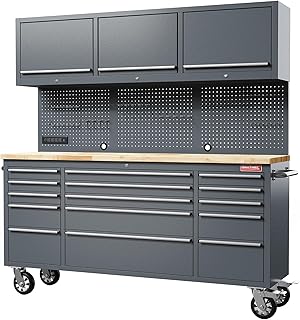
HAUTMEC 72″ Rolling Tool Chest (HT0428)
This is the ergonomics benchmark of the group: 16-gauge steel, a solid oak top that takes clamping and hammering without denting, and 15 drawers plus three upper cabinets that let you stage tools by frequency of use rather than by whatever fits. The integrated pegboard and 51 hooks pull high-turnover items out of drawers entirely, which is the single biggest reduction in repetitive reaching you can make.
WORKPRO 52″ x 20″ Rolling Tool Chest
A 1,000-pound rating paired with a wooden workbench top makes this the practical middle path — genuine bench height for standing tasks, with adjustable shelving behind the door for bulk items that don’t belong in drawers. The onboard power strip removes the extension-cord trip hazard that plagues most mobile setups.
Goplus 5-Drawer Rolling Tool Cabinet
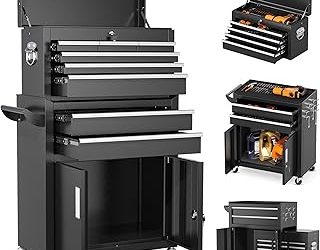
The detachable top box is the smart part here: lift it to the job and leave the cabinet parked, which spares you carrying a full chest. Universal lockable casters, a full-height lock bar, and protective liners cover the durability basics at a modest footprint suited to one-car garages.
8-Drawer Rolling Tool Chest with Detachable Top
Eight drawers on ball-bearing runners give you enough granularity to keep sockets, drivers, and consumables genuinely separated, and the tray dividers stop contents migrating as you roll. Arriving assembled matters more than it sounds — factory-squared frames keep drawers tracking straight for years.
Craftsman 3-Drawer Portable Chest
A compact steel tote for the tool kit that travels, with a form factor that has survived decades of jobsite abuse largely unchanged. Keep it under about 25 pounds loaded if you’ll be carrying it any distance single-handed.
Frequently Asked Questions
How much weight can a rolling tool chest really hold?
Treat advertised totals as ceilings, not targets. Load heavy items in the bottom two drawers to lower the center of gravity, and stay around 70 percent of the stated capacity to keep slides gliding smoothly and casters from flat-spotting.
Do I need a wooden top?
If you assemble, clamp, or repair on the chest, yes. Oak absorbs impact and won’t dent or transfer vibration into your wrists the way sheet steel does, and it accepts a vise mount cleanly.
Portable box or rolling cabinet?
Rolling cabinets win for stationary shops because they eliminate carrying loads entirely. A portable metal box, like a 24-inch five-drawer unit with a carry handle and top tray, makes sense as a secondary kit you take to the vehicle or the far side of the house.
How do I stop drawers from sagging?
Sagging is almost always a slide problem, not a steel problem. Choose ball-bearing runners, distribute weight across the drawer width rather than clustering it at the front, and re-level the cabinet if the floor slopes.
Final Thoughts
For a permanent shop where you’ll stand and work for hours, the HAUTMEC 72″ chest earns its footprint through thick steel, an oak worktop, and vertical storage that keeps your hands in the neutral zone. The WORKPRO 52″ delivers most of that ergonomic benefit at a friendlier size, and the Goplus 5-drawer cabinet with its detachable top box is the sensible pick if your tools need to move as often as they sit still.