Our Top Picks
 FLEXISPOT V9 Exercise Bike with 2D DesktopV9 Base 37.6*16.4"37.6 x 23.2 x 37.1 inches58 PoundsCheck on Amazon
The flexispot v9 desk exercise bike is a solid choice for working while cycling if you want quiet, low-to-moderate resistance and an integrated height-adjustable desktop, but it is not ideal if you need heavy resistance or a full-size office chair feel for 8+ hour days.
What the FlexiSpot V9 Is Designed to Do
The V9 combines an upright exercise bike with a built-in desktop surface, targeting remote workers, students, and anyone trying to add movement to a sedentary workday. Unlike an under-desk pedal unit or a separate bike-plus-standing-desk combo, the V9 integrates the pedals, seat, and desk into one frame, which saves space and eliminates wobble between separate pieces of furniture.
FLEXISPOT V9 Exercise Bike with 2D Desktop,8-Level Magnetic Friction,White
Chosen because it specifies 8-Level Magnetic Friction and White.
View on Amazon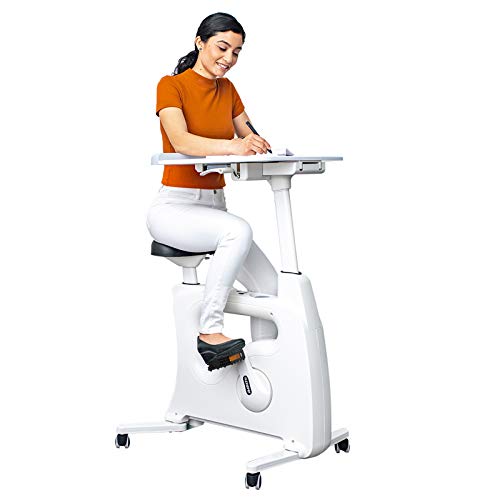
FLEXISPOT Exercise Bike with 2D Desktop, Space Saving Under Desk Bike with Removable Desk, Stationary Bikes Indoor Cycling Bikes with 8 Level Resistance Upgraded Max Flywheel LCD Tracking, V9MAX-White
Chosen because it specifies Space Saving Under Desk Bike with Removable Desk and V9MAX-White.
View on Amazon
FLEXISPOT V9 Exercise Bike with 2D Desktop,8-Level Magnetic Friction,Black
Chosen because it specifies 8-Level Magnetic Friction and Black.
View on AmazonIn the current market, this type of all-in-one desk bike usually sits in the $400–$650 range, placing the V9 between basic under-desk cycles and premium treadmill desks or separate bike-desk setups.
Ride Feel: Pedaling Resistance and Motion
The V9 uses magnetic resistance with 8 levels, adjusted by a tension knob under the desktop. The range is calibrated for activity while working, not for high-intensity training:
- Levels 1-3: Very light, easy to maintain 50-60 RPM while typing or on video calls. Leg movement is barely noticeable under a desk.
- Levels 4-6: Moderate effort that raises heart rate slightly without heavy breathing. Most users find typing accuracy starts to dip above level 5.
- Levels 7-8: Firm resistance for a break between calls, but cadence slows and upper-body movement increases, which makes precise mouse work harder.
The pedal stroke is smooth at low RPMs due to the belt drive and flywheel, with no jerky catch at the top of the stroke that chain-drive models sometimes produce. Pedal spacing is narrow enough to avoid knee strain, and the cranks have a relatively short throw, so your knees stay below the desktop. Users around 5’2″ to 6’2″ report the most natural pedal circle; those outside that range may find the fixed crank length too short or too long.
Resistance is entirely manual. There is no motorized or app-controlled auto-adjust, which keeps the bike quieter and simpler but means you cannot run programmed interval workouts.
Desk Fit: Height Adjustment and Workspace Size
The desktop is height-adjustable to maintain a neutral wrist position while pedaling. This is critical because your effective seated height changes slightly as you pedal.
| Measurement | Spec / Range | What It Means for Fit |
|---|---|---|
| Desktop Height from Floor | Approx. 38.5 to 46.5 inches | Fits users 5’1″ to 6’2″ with elbows at ~90 degrees; taller users may need to stay near max height |
| Desktop Size | Approx. 22 x 20 inches | Enough for a 14-16 inch laptop + mouse, or a keyboard and small notebook; not enough for dual monitors |
| Seat Height from Floor | Approx. 34 to 38 inches (adjustable) | Upright posture with feet flat on pedals; inseam range ~28 to 34 inches |
| Overall Footprint | Approx. 38.5 x 25 inches | Requires a 50 x 36 inch clear area for safe mount/dismount and pedal clearance |
| User Weight Capacity | 300 lbs | Includes body weight plus anything on desktop; desktop load limit approx. 35-40 lbs |
| Bike Weight | Approx. 56-62 lbs assembled | Light enough for one person to slide, heavy enough to stay planted while pedaling |
In a 10×12 ft home office, the V9 occupies about the same floor space as a small armchair, leaving room for a bookshelf, file cabinet, or side table along the opposite wall. Allow at least 12 inches of clearance behind the seat for recline and standing up, and 8-10 inches on the side of the pedals so your feet do not hit walls or furniture. Doorway width is not an issue once assembled (25 inches wide), but the box requires a 32-inch doorway to bring inside.
The desktop tilts slightly and is fixed left-to-right. It does not slide forward/back like some standing desks, so monitor distance is determined by seat position. For laptop work this is fine. For an external keyboard and monitor, consider a low-profile monitor riser to keep the screen at eye level.
Seat Comfort for Work Sessions
The V9 uses a wide, cushioned saddle-style seat with a backrest, rather than a narrow spin-bike saddle. The cushion is medium-firm foam (estimated density around 35-40 kg/m3) with a breathable mesh or faux-leather cover depending on the finish. This shape supports short to medium sessions well:
- 30-60 minutes: Comfortable for most users without padding or breaks. The backrest reduces lower-back fatigue compared to backless pedal exercisers.
- 60-120 minutes: Pressure points can build on sit bones, especially for users over 180 lbs. Standing and stretching between meetings helps.
- All-day use: The V9 is better as a rotation option rather than a sole 8-hour chair. Alternating with a regular office chair reduces fatigue.
The backrest is fixed angle, not reclining, and provides lumbar support at a modest height. It does not have adjustable lumbar depth, so users with significant back pain may want a small lumbar cushion added. The seat is ventilated but not heavily padded, which is a trade-off between heat buildup and long-term foam durability.
Construction and Material Trade-offs
| Component | Material Used on V9 | Trade-off vs Alternatives |
|---|---|---|
| Frame | Powder-coated steel tubing | More stable and durable than aluminum, but heavier to move than plastic-frame cycles |
| Desktop | Engineered wood (MDF with laminate) | Lighter and more affordable than solid wood, resists warping; can chip on edges if knocked during moves vs solid wood which dents but is repairable |
| Seat Cover | Mesh / faux leather | Mesh is cooler for long sessions, faux leather wipes clean faster but traps more heat |
| Drive System | Belt drive with magnetic flywheel | Quieter and lower maintenance than chain drive; less realistic road feel than heavy spin flywheels, but smoother for typing |
Noise Level: Can You Use It on Calls?
Noise is where the flexispot v9 desk exercise bike earns its work-from-home appeal. The magnetic resistance and belt drive produce very low operational sound.
- Ambient room: ~32-35 dB
- Pedaling at levels 2-4, 50 RPM: ~38-42 dB (comparable to a quiet library or soft keyboard typing)
- Pedaling at levels 7-8, 70+ RPM: ~45-48 dB (soft hum, may be faintly audible on sensitive microphones)
- Knob adjustment or shifting weight: Brief 45 dB creak if weight shifts suddenly, but no chain clatter
For context, a typical box fan on low is 45-50 dB and normal conversation is 60 dB. At light resistance, colleagues on video calls generally do not hear the bike, especially with a noise-canceling microphone. At high resistance with fast pedaling, a faint rhythmic sound can come through. Placing the bike on a thin exercise mat or carpet further dampens vibration transfer to floors, which matters in apartments.
Assembly, Moving and Long-Term Durability
The V9 ships in one large box, usually 65-75 lbs. Assembly requires attaching the stabilizer feet, seat post, backrest, pedals, and desktop column. Most people complete it in 35-50 minutes with the included Allen keys and wrench. No drilling is needed, but a second person helps to hold the desktop while securing the column.
Once assembled, the bike has two front transport wheels. Tilt and roll it like a hand truck to reposition. It fits through standard 28-30 inch interior doorways without disassembly.
What tends to wear first on this class of desk bike is not the steel frame but the moving contact points: pedal straps or pedals after 12-18 months of daily use, the tension knob cable if overtightened, and edge laminate on the desktop if dragged against walls. The belt drive itself is typically maintenance-free for several years. Periodically checking pedal tightness and wiping sweat from the seat and desktop helps extend life.
Decision Matrix: Should You Choose the V9?
| Your Situation | Is the V9 a Good Fit? | Consider Instead |
|---|---|---|
| Small apartment or 10×12 ft room, need one piece that is both chair and light cardio | Yes – compact footprint and no need for separate desk | Under-desk cycle if you already own a desk you love |
| Work involves 4+ hours of continuous typing and video calls | Yes for light levels 1-4; alternate with regular chair | Standard ergonomic office chair with standing desk for all-day comfort |
| Want high-intensity cardio or standing climb intervals while working | No – resistance tops out at moderate level | Spin bike or treadmill paired with separate standing desk |
| Renter needing quiet for shared walls and floors | Yes – under 42 dB at work-friendly resistance, no floor pounding | Treadmill desk, which transmits more vibration |
| Kids or pets at home | Use caution – exposed pedals and pinch points; choose a model with enclosed flywheel and pedal locks when not in use | Foldable under-desk cycle that can be stored vertically |
| Back pain or need full lumbar adjustability | Moderate – backrest helps vs backless models but lacks depth adjustment | Ergonomic office chair with adjustable lumbar + separate pedaler |
Bottom Line for Work-While-Cycling
Choose the flexispot v9 desk exercise bike if your priority is quiet, steady movement during computer work in a limited space, and you are comfortable with light to moderate effort that lets you keep typing. Look elsewhere if you need heavy training resistance, a large dual-monitor desktop, or a chair built for uninterrupted all-day sitting without breaks. For most home offices, it works best as part of a rotation: pedal for focused work blocks, then switch to a traditional chair for long meetings or tasks requiring maximum precision.
Frequently Asked Questions
Can you type accurately while pedaling?
At resistance levels 1-4 and a steady 45-55 RPM, most people maintain normal typing speed after 2-3 days of adaptation. Accuracy drops at higher resistance or faster cadence because upper-body sway increases.
Does the desktop wobble while you pedal?
The integrated frame keeps wobble low compared to a laptop placed on a separate bike handlebar tray. At light resistance there is minimal shake. At high resistance with aggressive pedaling, slight desktop vibration is noticeable, especially with a lightweight laptop.
How much space do you really need around it?
Plan for the 38.5 x 25 inch bike plus an extra 20 inches of clearance in front of the pedals for your feet and 12 inches behind the seat to stand up comfortably. In practice, a 50 x 36 inch open rectangle works well.