Our Top Picks
Pros & cons
- Four memory presets simplify switching between heights
- Aerospace-grade lifting columns aim for long-term stability
- Low-VOC materials support a healthier indoor workspace
- 48 x 24 inch top limits room for larger multi-monitor setups
- At nearly 44 pounds, assembly needs some help
Pros & cons
- FSC-certified wood supports a more sustainable build choice
- Three memory presets simplify sit-stand height switching
- Motor runs under 45 decibels during adjustment
- 176-pound load capacity trails some heavier-duty desks
- 48 x 24 inch top limits space for larger setups
 HUANUO 32x19 Inch Small Electric Standing Desk32" X 19"19 x 32 x 28 Inches24.5 PoundsCheck on Amazon
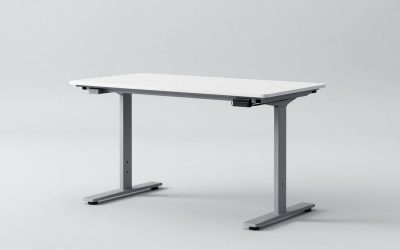
A computer desk that raises and lowers is only worth buying if three specs line up: a height range covering both your seated and standing elbow heights, a lift mechanism rated well above your real load, and a frame stable enough that typing doesn’t shake your monitors. For most home offices that means a dual-motor electric desk with roughly 25–50 inches of travel, at least 220 lb of capacity, and a top sized to the room — usually 48 × 24 inches in small spaces.
Manual vs. electric lift mechanisms
Three mechanisms dominate the market, and they differ less in durability than in how often you’ll actually use them. The honest trade-off: manual desks cost less and never need power, but the friction of cranking means owners tend to switch positions less often — which defeats the point. Electric desks add memory presets and anti-collision sensors, and the motor is rarely the part that fails.

ErGear 48 X 24 Inch Height Adjustable Electric Standing Desk, Black | Stand Up office Desk, Home Office Computer Desk with 4 Memory Presets, Stable Steel Frame, 176 lbs Capacity, Easy Assembly
Chosen because it specifies Black.
View on Amazon
FEZIBO Standing Desk 48 × 24 Inch Electric Height Adjustable, Maple | Sit and Stand Up Adjustable Desk, Home Office Computer Desk with 3 Customizable Memory Presets
Chosen because it specifies Maple.
View on AmazonHUANUO 32x19 Inch Small Electric Standing Desk, Adjustable, Light Walnut | 176 Lbs Capacity, Rounded Corners, Wheel-Ready Feet, Compact Desktop, Apartment Workspace, 28.3–46.5 Inch Height Range
Chosen because it specifies Adjustable and Light Walnut.
View on Amazon
Huuger 47 X 24 Inch Electric Standing Desk with Power Outlets and USB-C Port, Height Adjustable Desk, Sit Stand Desk for Home Office, Computer & Gaming Desk with 3 Presets, Stable Steel Frame, Black
Chosen because it specifies Height Adjustable Desk and Sit Stand Desk for Home Office.
View on Amazon| Mechanism | Adjustment speed | Realistic capacity | Typical price | Best for / weak point |
|---|---|---|---|---|
| Hand crank | ~20–40 sec per change | 90–150 lb | $150–$400 | Budget buyers switching 1–2× daily; crank gears and cables wear first |
| Pneumatic / counterbalance | Nearly instant | 15–60 lb | $100–$350 | Laptop-only desks and converters; springs sag and need push-assist at heavier loads |
| Single motor | ~0.8–1.2 in/sec | 150–180 lb | $200–$500 | Laptop + one monitor; the control box, not the motor, is the usual failure point |
| Dual motor | ~1–1.5 in/sec | 220–355 lb | $300–$800+ | Multi-monitor setups, daily heavy use; check motor synchronization warranty |
| Triple motor (L-shaped) | ~1–1.4 in/sec | 250–330 lb | $700–$1,500 | Corner desks; sync drift shows first at the corner joint |
Established brands like Uplift, FlexiSpot, Vari, and IKEA all sell electric frames at various tiers, and IKEA also sells a crank model for buyers on a strict budget. Whichever you pick, plan to stay under about 70–80% of the rated capacity — motors running near their limit every cycle age faster and move slower.
The height range that actually fits your body
Don’t shop by the desk’s marketing range — shop by your elbow. Sit in your normal chair, bend your elbows to 90°, and measure floor to elbow. Do the same standing. Your desk needs to go roughly 1–2 inches below the seated number and reach the standing number. Most fixed desks sit at 29–30 inches, which is already too tall for anyone under about 5’8″ — the whole point of an adjustable desk is fixing that.
| Your height | Typical seated elbow | Typical standing elbow | Desk range to look for |
|---|---|---|---|
| Under 5’2″ | 23–25″ | 36–39″ | Min ≤ 23″ (or add a keyboard tray) |
| 5’3″ – 5’8″ | 25–27″ | 39–43″ | ~25–44″ |
| 5’9″ – 6’1″ | 27–29″ | 43–46″ | ~26–47″ |
| Over 6’2″ | 29–31″ | 46–49″ | Max ≥ 49–50″ — needs 3-stage legs |
Two gotchas: many budget two-stage frames bottom out around 27–28 inches, which leaves shorter users stranded — fix it with an under-desk keyboard tray that drops the typing surface 2–4 inches, or buy a frame that reaches 23–24 inches. Tall users have the opposite problem and need three-stage legs for a 49–50 inch maximum. And if the desk will live under a windowsill (typically 30–36 inches high) or a shelf, confirm the desk’s maximum stays below it.
Weight capacity, and what wobble really tells you
Add up your real load before trusting a spec sheet. A realistic dual-monitor setup looks like this: 48 × 24 laminate top (25–35 lb), two 24–27 inch monitors on a dual arm (28–40 lb combined), desktop tower on the desk (15–40 lb), plus keyboard, speakers, and mic (5–10 lb). That’s roughly 80–130 lb — fine for a single motor, but a dual-motor frame running at half capacity will feel noticeably smoother and last longer.
Every sit-stand desk wobbles more at full height; the question is how much. A practical test: at maximum height, push the front edge with the force you’d use opening a stuck drawer — about 10 lb. Deflection under roughly a quarter inch means typing will feel solid; more than that and your monitors will visibly bounce. Also push side-to-side, since T-frame designs (feet front-to-back, no crossbar) rock laterally more than frames with a rear crossbar. Monitor arms amplify wobble, so clamp them near the frame’s center column rather than a far corner. On carpet or uneven floors, adjustable leveling glides matter more than any other single feature.
What wears out first, in order: membrane keypads and control boxes on budget electrics, gear housings on crank desks, and edge banding on laminate tops. Motors themselves usually outlive their controllers. Warranty norms run 5–15 years on frame and motors at the premium end and 1–3 years on electronics at the budget end — that gap tells you what the manufacturer expects to break.
Sizing a desk for a small room
For a 10 × 12 ft room, a 42–48 inch wide, 24 inch deep desk is the sweet spot: placed on the short wall it leaves 36–42 inches of chair pull-out space plus room for a bookcase or filing cabinet. Go to 30 inches deep only if you skip a monitor arm and need paperwork spread out — depth costs floor area twice as fast as width. Leave 3–4 inches behind the desk for cable slack and monitor-arm travel when the desk rises, and never place it where a raised monitor will strike a wall, shelf, or sill.
Moving and assembly realities listings skip: tops ship flat, so standard 30–32 inch doorways are no obstacle, but a complete desk arrives at 70–130 lb total across boxes — a two-person carry. Assembly means bolting legs upside-down on the top and flipping the whole thing over, which is genuinely a two-person job for anything 48 inches or wider.
L-shaped desks that raise and lower
An l shaped desk that raises and lowers is the answer for a corner office or anyone needing two work zones, but it changes the math. Most use three legs and three synchronized motors, run 60–72 inches on the main side with a 48–72 inch return, and need a clear corner of roughly 5 × 5 ft plus the same 36–42 inch chair zone — realistically a room of 11 × 11 ft or better. Capacity runs 250–330 lb but is split across the frame, so keep heavy towers on the main side, not the corner. The corner splice is the wobble-prone joint; favor designs with a leg directly under it. Expect $700–$1,500, delivery in two or three boxes of 40–60 lb each, and assemble it close to its final position — moving a built L-desk through a doorway means disassembly.
Quick picks by situation
| Your situation | What to buy |
|---|---|
| Small apartment, 10×12 room | 42–48 × 24″ top, dual motor, min height ≤ 25″ |
| Renter who moves often | One-piece top ≤ 48″, lightweight laminate; avoid 72″ tops |
| Dual/triple monitors + tower | Dual motor ≥ 275 lb, 30″ depth, crossbar frame |
| Back pain, frequent switching | Electric with 4 presets + anti-collision; a crank will discourage you |
| Kids or pets nearby | Keypad lock and anti-collision sensor are non-negotiable |
| Budget under $300 | Hand crank or single motor; accept slower travel and lower capacity |
| Over 6’2″ | Three-stage legs, max height ≥ 49–50″ |
| Corner office / two work zones | Triple-motor L-shaped frame, third leg under the corner |
FAQ
How many memory presets do I actually need?
Two minimum — one seated, one standing. Four is worth paying a little extra for if two people share the desk or you want a midway “reading” height.
Is a hand-crank desk annoying to use daily?
For one or two height changes a day, no — it’s about 20–40 seconds of easy cranking. If you plan to alternate every 30–60 minutes, the friction adds up and most people simply stop switching, which is when the electric version pays for itself.
Will my dual monitors make the desk wobble?
Monitors themselves don’t — monitor arms do, by cantilevering weight off the back edge. Clamp the arm near a leg column, keep capacity under ~80% of rated, and wobble stays minor on any decent dual-motor frame.
Do electric standing desks use much power?
Very little. Standby draw is a fraction of a watt, and each lift uses about as much energy as running a microwave for a few seconds — a few dollars per year at most.