Our Top Picks
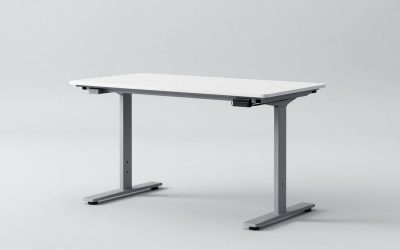
 OffiGo 55 Inch U Shaped Electric Standing Desk55 Inch29.1 x 55.1 x 33.1 inches52.9 poundsCheck on Amazon
 OffiGo 55 Inch U Shaped Standing Desk with55 Inch29.1 x 55.1 x 33.1 inches52.9 PoundsCheck on Amazon
A U-shaped desk with a standing option needs a room of at least 10 × 10 ft to be usable and roughly 11 × 12 ft to be comfortable — and the detail most listings bury is that on the majority of these desks, only one of the three surfaces actually rises. Understanding which sections move, how much clearance the U needs, and how cables behave through 20-plus inches of vertical travel will save you from an expensive mistake.
What “standing option” actually means on a U-shaped desk
There are three distinct designs sold under this label, and they behave very differently:
OffiGo 55 Inch U Shaped Electric Standing Desk with Keyboard Tray, White
Chosen because it specifies White.
View on Amazon
OffiGo 55 Inch U Shaped Electric Standing Desk with Keyboard Tray, Black
Chosen because it specifies Black.
View on AmazonOffiGo 55 Inch U Shaped Standing Desk with Keyboard Tray, Rustic Brown
Chosen because it specifies Rustic Brown.
View on Amazon- Partial-lift U (most common): A standard sit-stand main desk — usually 60–72 in wide — flanked by two fixed-height returns at about 29–30 in. When you stand, only the main surface comes with you; the returns stay at sitting height. Typical total cost: $1,000–$2,500.
- Full-lift U: All three surfaces rise on four to six synchronized legs. These are rare, mostly sold through commercial or custom desk makers, and usually run $3,000–$5,000+. Lift capacity on the best versions exceeds 400 lbs.
- Fixed U + standing converter: A conventional U-shaped desk with a desktop riser placed on the main surface. Total cost $500–$1,200, but converters typically hold only 30–35 lbs and consume a ~26 × 18 in footprint, which eats your primary work zone.
For most home offices, the partial-lift layout is the practical choice — but plan your workflow so everything you need while standing (monitors, keyboard, mouse) lives on the lifting section.
Room dimensions: the math before you buy
A U-shape’s footprint is deeper than it looks on a spec sheet. Add the main desk depth (24–30 in), the inner legroom opening, and the chair zone behind it. Then add clearance rules: 36 in minimum behind the desk for a chair (42 in if you want to step back freely while standing), 30–36 in for walkways, and roughly 30 in for a door swing.
| U-desk configuration | Approx. footprint | Minimum room | Comfortable room |
|---|---|---|---|
| Compact: 60 in main, two 36–42 in returns | ~60 × 66 in | 9 × 10 ft | 10 × 11 ft |
| Standard: 66–72 in main, two 42–48 in returns | ~72 × 80 in | 10 × 11 ft | 11 × 12 ft |
| Executive: 72 in+ main, deep returns + credenza | ~84 × 96 in | 11 × 12 ft | 12 × 14 ft |
Two measurements people forget: the inner opening of the U should be at least 36 in wide so a chair can swivel and roll; and if the desk faces a window, check sill height — most sills sit at 30–36 in, so a desktop raised to 48–51 in will block part of the window.
Layout ideas that work
- Corner wrap: Two sides of the U pushed into a corner. Best for smaller rooms, but cable routing to wall outlets gets awkward on the far side — plan for the farthest leg being 6+ ft from an outlet.
- Cockpit facing the room: Main desk against the wall, returns reaching toward you. Great for video calls and keeping the wall outlet close; the open U needs clear floor on three sides.
- Freestanding island: Only realistic in 12 × 14 ft rooms or larger. Requires a floor outlet or a cable run under a rug; anything else creates a trip line through your walkway.
Fixed vs. adjustable sections: the real trade-offs
| Partial-lift U | Full-lift U | Fixed U + converter | |
|---|---|---|---|
| Typical price | $1,000–$2,500 | $3,000–$5,000+ | $500–$1,200 |
| Lift capacity (moving section) | 220–355 lbs (dual motor) | 400+ lbs (quad motor) | 30–35 lbs |
| Usable surface while standing | Main desk only | All of it | Converter area only |
| Under-desk storage compatibility | Excellent on fixed returns | Limited — weight counts against lift | Excellent |
| Surface height mismatch standing | ~15–20 in step between levels | None | ~15 in step |
The mismatch matters: on a partial-lift desk raised to standing height, your fixed returns sit roughly at your elbow-to-hip level — fine for setting down papers, useless for typing. Dual-motor frames in the 220–265 lb range handle two monitors and a desktop PC comfortably; choose 300+ lbs if you run three monitors or heavy audio gear.
Storage trade-offs
Fixed returns are a storage opportunity — a rolling file pedestal (typically 24–28 in tall) tucks under them with room to spare. The lifting section is different: every drawer unit or pedestal placed on or under it either counts against lift capacity or blocks its travel. Keep the space under the rising surface open to at least the desk’s lowest setting (usually 22–25 in), and use modesty panels sparingly — they block the cable slack you’ll need.
Cable management for a desk that moves
This is where standing U-desks fail in practice. The fix follows three rules:
- Everything rises together: Mount a surge protector under the lifting desktop so all device cables travel with it. Only one cable — the power feed — drops to the wall.
- Size the service loop: Desks travel roughly 20–25 in from low to high. Leave a 24–30 in slack loop in the power drop, and run it through a cable spine (a vertebra-style chain, usually $20–$40) so the loop stays vertical instead of puddling on the floor.
- Bridge carefully: Cables crossing from a fixed return to the moving section — say, from a tower parked on a return — need slack at the bridge point, or they’ll pinch at full height. Clamping a CPU holder under the lifting desk avoids this entirely.
Clamp monitor arms to the lifting surface and route cables through the arm channels — it’s the cleanest way to keep two or three screens moving as one unit.
Which setup fits your situation
| Your situation | Best configuration | Why |
|---|---|---|
| Spare bedroom ~10 × 10 ft | Compact partial-lift, corner-wrapped | Fits with 36 in chair clearance if the door swings away |
| Back pain, standing 2+ hrs/day | Full-lift or partial-lift with memory presets | Preset buttons make switching a one-touch habit |
| Heavy gear (3 monitors, tower, audio) | Partial-lift, 300+ lb dual/quad motor | Single-motor frames strain near 200 lbs |
| Budget under $1,000 | Fixed U + converter | Accepts the surface trade-off at a fraction of the cost |
| Need drawers and files daily | Partial-lift with credenza return | Fixed sections carry storage without taxing motors |
Assembly and moving realities
Expect 4–8 separate boxes, with the heaviest — a one-piece desktop or frame pack — running 80–120 lbs. Flat-packed pieces clear standard 30-in doorways easily, but a 72-in one-piece desktop can be tight on stair turns; split desktops solve that at the cost of a visible seam. Multi-leg frames have three to six motor cables to route and hide, so budget 2–4 hours with a second person, and assemble the frame upside-down on the desktop rather than flipping it solo. What wears first is rarely the motors — it’s the laminate edge banding on the inner U opening where the chair armrests rub.
FAQ
Do all three surfaces of a U-shaped standing desk rise?
Usually not. Unless the listing explicitly says “full-height adjustable” or shows motors on every section, assume only the main desk lifts and the returns are fixed at ~29–30 in.
Can a U-shaped desk fit in a 10 × 10 ft room?
A compact configuration (~60 × 66 in) fits with workable chair clearance, provided the door doesn’t swing into the desk zone and closet access isn’t blocked. Standard-size U-desks need closer to 11 × 12 ft.
How high does the standing section go?
Most quality frames top out at 48–51 in, which suits users up to about 6’4″–6’6″. If you’re taller, look for a three-stage leg frame, which typically adds 2–3 in of range over two-stage legs.