Key takeaways
- Mix the descaler with cold water at the ratio on the label, into the reservoir only. Never pour concentrate directly onto the evaporator fingers.
- Run one full clean cycle if your machine has a dedicated button, or a normal ice cycle and discard everything it makes.
- Drain, then hand-wipe the reservoir, chute, and bin with a soft cloth. This is where biofilm hides.
- Refill with plain water and run two rinse cycles, discarding the ice each time. Cloudy or acidic-smelling ice means you need a third.
- Leave the lid open for an hour before storing so the interior dries fully.
What's inside
An ice maker is one of the few appliances in a home that runs water through a sealed loop, freezes it, and then asks you to eat the result. That makes it a fixture worth maintaining properly. Minerals from tap water plate onto the evaporator, slime forms in the reservoir where light never reaches, and the harvest cycle slowly loses efficiency. The symptoms arrive in order: cloudy cubes, then smaller cubes, then a machine that hums for twenty minutes and drops four sad crescents into the bin. Almost none of that is a mechanical failure. It’s deferred cleaning.
I evaluate appliances for how they hold up under repeated human handling, so I approach this the same way I’d approach a drawer glide or a chair caster: the cleaning method matters, but so does how much strain the process puts on you and on the machine’s moving parts. Below you’ll find a repeatable routine, guidance on choosing a descaler that won’t attack nickel-plated evaporators, a realistic schedule based on your water, and the small handling habits that keep gaskets, pumps, and hinges alive for years instead of seasons.
🛒 Best Price Today on Amazon
Prime members get fast, free shipping on everything above, plus member-only deals. New members get a 30-day free trial — cancel anytime.
Our Recommended Picks
As an Amazon Associate we earn from qualifying purchases.




Why Scale and Biofilm Are Two Different Problems
Mineral scale is inorganic: calcium and magnesium deposits that need an acid to dissolve. Biofilm is organic: a soft, sometimes pinkish film of bacteria and yeast that thrives in standing water and needs a sanitizer to kill. Descalers do not sanitize, and sanitizers do not descale. A complete clean is always two passes. Skipping the second one is why some machines still produce off-tasting ice after a thorough acid rinse, and why the reservoir smells faintly sweet within a week.
Set Up for Access Before You Add Any Chemicals
Unplug the unit, drain it fully, and move it to a spot where you can work at counter height with the lid open and both hands free. This is the step most people skip, and it’s the one that causes damage. Cleaning a countertop model while it’s wedged under a cabinet means levering the lid past its stop, twisting the drain plug at a bad angle, and putting side load on the water pump housing while you reach for the basket. Give yourself clearance and the whole job takes ten minutes without stressing a single component.
Running the Cycle Correctly
- Mix the descaler with cold water at the ratio on the label, into the reservoir only. Never pour concentrate directly onto the evaporator fingers.
- Run one full clean cycle if your machine has a dedicated button, or a normal ice cycle and discard everything it makes.
- Drain, then hand-wipe the reservoir, chute, and bin with a soft cloth. This is where biofilm hides.
- Refill with plain water and run two rinse cycles, discarding the ice each time. Cloudy or acidic-smelling ice means you need a third.
- Leave the lid open for an hour before storing so the interior dries fully.
Choosing a Formula That Won’t Shorten the Machine’s Life
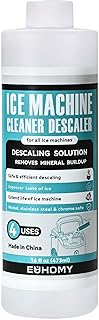
The single most important label term is nickel safe. Most evaporators are nickel-plated, and aggressive citric or phosphoric blends can etch that plating permanently, which accelerates future scaling. Tablets are the easiest to dose without guessing: the ACTIVE 24-tablet descaler and the 36-pack tablets both list compatibility with Frigidaire, Opal, GE Profile, and KitchenAid nugget machines, and the 24-tablet nickel-safe kit covers countertop and commercial units alike. If you prefer a liquid, Affresh is the widely stocked option for hard-water buildup, and the EUHOMY 16 oz descaler doubles as a coffee and espresso machine solution, which reduces the number of bottles under your sink. For anyone maintaining several machines or a commercial unit, the 1 gal nickel-safe cleaner meets Manitowoc spec GES-6 and is USDA authorized, which is the level of documentation worth having if you serve ice to guests.
Building a Schedule Around Your Water
Every three to four months is the sensible default. Push it to every six weeks if you’re on well water, in a hard-water region, or running the machine daily. Two low-effort habits stretch those intervals considerably: use filtered water, and empty the reservoir whenever the unit will sit idle more than a couple of days. Standing water is where biofilm starts, and a dry machine simply doesn’t grow anything.
Tips
- Photograph the reservoir before your first teardown so reassembly is quick and you never force a part back at the wrong angle.
- Keep a dedicated soft brush for the drain port; cotton swabs shed fibers that end up in the pump.
- Log cleaning dates on a strip of tape inside the lid rather than trusting memory.
- If cubes stay cloudy after a full clean, check the water filter or supply line before assuming the machine is failing.
Frequently Asked Questions
Can I use vinegar instead of a commercial descaler?
It will dissolve light scale, but household vinegar is unbuffered, hard to dose consistently, and can degrade seals and nickel plating over repeated use. Most manufacturers exclude vinegar damage from warranty coverage, which is reason enough to use a purpose-made formula.
Do I need bleach to sanitize?
No, and it’s easy to get wrong. Follow your descaling pass with the sanitizer your manufacturer specifies, or a food-safe sanitizing solution at label dilution, then rinse thoroughly.
How many rinse cycles are actually enough?
Two minimum, three if the ice tastes or smells of anything at all. Rinsing is free; a batch of chemical-tinged ice is not.
Why is my ice smaller after cleaning?
Usually residual moisture or air in the water line. Run two or three normal cycles and cube size should return to normal. If it doesn’t, the evaporator may be scaled beyond what one pass can clear and needs a second treatment.
Conclusion
Clean ice comes down to a two-stage process done on a schedule, with a nickel-safe formula and enough workspace that you’re never forcing a lid, plug, or basket. Ten minutes a quarter protects the taste of every drink you pour and adds years to a machine that most people replace long before it was actually worn out.