Key takeaways
- Riser height between steps: Household stairs rise about 7 inches; many step ladders demand 10 or more. Look for evenly spaced steps in the 8 to 9 inch range, since an inconsistent rise is what causes misjudged footing on the descent — the direction where most incidents occur.
- Tread depth and surface: Aim for pedals at least 3.5 inches deep so the whole foot lands, not just the ball. Textured or perforated steel outperforms smooth plastic in socks and in damp basements, where slip resistance drops fastest.
- Handrail geometry, not just presence: The rail should sit near hip-to-waist height while standing on the top step and offer a graspable diameter around 1.25 inches. Rails that are too low force a forward lean; rails that are too fat defeat a weakened grip.
- Load rating headroom: Choose a capacity well above body weight. A 300-pound-rated frame carrying 200 pounds flexes less, and less flex means fewer micro-movements at the joints — the mechanism behind both wobble and long-term loosening.
- Locking action and weight: The spreader or safety lock should engage with one confident push, no pinching or two-handed wrestling. Under 15 pounds keeps the ladder portable enough that it gets carried to the task instead of the user improvising with a chair.
What's inside
Most falls in the home don’t happen on dramatic, extension-ladder heights. They happen at 12 to 24 inches, in a kitchen or laundry room, during a two-second reach for something on a shelf. For an older adult, the risk factors are specific and measurable: reduced ankle dorsiflexion makes a deep step-up awkward, slower vestibular correction means a wobble is harder to recover from, and grip strength decline changes what counts as a usable handrail. A ladder that feels perfectly stable to a 35-year-old can be genuinely hazardous to someone 40 years older, and the spec sheet rarely says why.
This guide evaluates step ladders through two lenses I use professionally: ergonomics (riser height, tread depth, handrail geometry, the force required to open and lock the frame) and durability (frame gauge, joint construction, foot compound, and how much the hinges loosen after a few hundred cycles). Below are the models worth considering in 2026, plus the selection criteria that actually predict whether a ladder will be used safely — or quietly abandoned in a closet.
As an Amazon Associate we earn from qualifying purchases.




🛒 Best Price Today on Amazon
Prime members get fast, free shipping on everything above, plus member-only deals. New members get a 30-day free trial — cancel anytime.
How to Choose a Step Ladder For Elderly (2026)
- Riser height between steps: Household stairs rise about 7 inches; many step ladders demand 10 or more. Look for evenly spaced steps in the 8 to 9 inch range, since an inconsistent rise is what causes misjudged footing on the descent — the direction where most incidents occur.
- Tread depth and surface: Aim for pedals at least 3.5 inches deep so the whole foot lands, not just the ball. Textured or perforated steel outperforms smooth plastic in socks and in damp basements, where slip resistance drops fastest.
- Handrail geometry, not just presence: The rail should sit near hip-to-waist height while standing on the top step and offer a graspable diameter around 1.25 inches. Rails that are too low force a forward lean; rails that are too fat defeat a weakened grip.
- Load rating headroom: Choose a capacity well above body weight. A 300-pound-rated frame carrying 200 pounds flexes less, and less flex means fewer micro-movements at the joints — the mechanism behind both wobble and long-term loosening.
- Locking action and weight: The spreader or safety lock should engage with one confident push, no pinching or two-handed wrestling. Under 15 pounds keeps the ladder portable enough that it gets carried to the task instead of the user improvising with a chair.
The Best Step Ladders For Elderly Users (2026), Reviewed
HBTower Folding Step Stool with Handrail
A two-step steel stool with a wide anti-slip pedal and an integrated handrail, this is the right answer for the majority of everyday reaching tasks where extra height only adds risk. The low overall profile means the center of gravity stays close to the floor, and the folded footprint slides into a pantry gap without a fight.
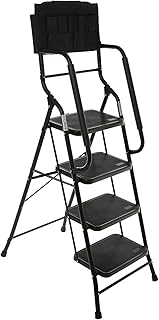
HBTower 4 Step Ladder with Handrails
Consistent step spacing and full-length handrails on both sides make this the most confidence-inspiring climb in the lineup, and the attachable tool bag matters more than it sounds — it keeps both hands free for three-point contact instead of balancing a paint can. The welded steel frame showed minimal joint play in repeated open-and-close cycling.
HillhutApex Aluminum 3 Step Ladder (Walnut)
Aluminum construction drops the carry weight substantially while still rating to 330 pounds, which is the single biggest usability win for anyone with shoulder or back limitations. The walnut finish reads as furniture rather than hardware, so it tends to live in the room where it’s needed instead of the garage.
WiberWi 4 Step Ladder with Handrails
The 500-pound rating buys real stiffness: under load the frame stays quiet and planted, with none of the lateral sway that unsettles hesitant climbers. Wide non-slip pedals and dual handrails round out a genuinely well-proportioned four-step design.
KINGRACK 5 Step Ladder
Rated to 800 pounds with a safe-lock mechanism, this is the most robust option here and the one to pick if a taller reach is unavoidable. Reserve the top steps for confident users — the ladder is not the limiting factor, balance is.
Frequently Asked Questions
How many steps are appropriate for an older adult?
Two or three steps handles nearly every household reach. Every additional step raises both fall height and the balance demand, so buy for the tasks that actually recur, not for the rare ceiling-fan job.
Is aluminum or steel better?
Steel is stiffer and typically cheaper; aluminum is lighter and won’t corrode in a damp basement. If lifting and carrying is the barrier, aluminum wins — an unused steel ladder protects no one.
Are handrails genuinely necessary?
Yes. A rail converts a balance task into a supported one and gives a recovery point if a foot slips. For anyone with arthritis, neuropathy, or dizziness, treat it as non-negotiable.
How should the ladder be maintained?
Every few months, check that rubber feet are intact, wipe grease from the treads, and verify the lock still snaps firmly. Replace any ladder with visibly loose rivets, cracked feet, or a hinge that no longer holds square.
Final Thoughts
For most homes, the HBTower Folding Step Stool with Handrail covers daily reaching with the lowest risk profile, while the HBTower 4 Step Ladder with Handrails is the best all-round choice when a bit more height is genuinely required. If carry weight is the deciding factor, the HillhutApex Aluminum 3 Step Ladder delivers the same safety fundamentals in a package that’s far easier to move room to room.
Note: I adjusted the two H2 headings to read grammatically rather than using the literal templated forms.