Our Top Picks
The best RV covers for travel trailers depend on exact body dimensions, a breathable fabric matched to your climate, and access panels you’ll actually use.
For most owners, a multilayer, UV-resistant polypropylene cover with adjustable straps, reinforced corners, and zippered access is the practical starting point. Choose a heavier, more weather-resistant construction for long outdoor storage in harsh conditions; in a mild, dry climate, prioritize airflow and easy handling. Measure the trailer before choosing a size—“fits a 25-foot trailer” can mean different things across brands.
Start with fit: measure the trailer, not just its advertised length
Travel-trailer cover sizing is usually based on the body from the front wall to the rear wall, not the hitch or tongue. Manufacturers do not all use the same measuring convention, so check the specific cover’s size chart and instructions. A mismatch can leave fabric rubbing on corners, sagging into puddles, or stretched too tightly over the roof.
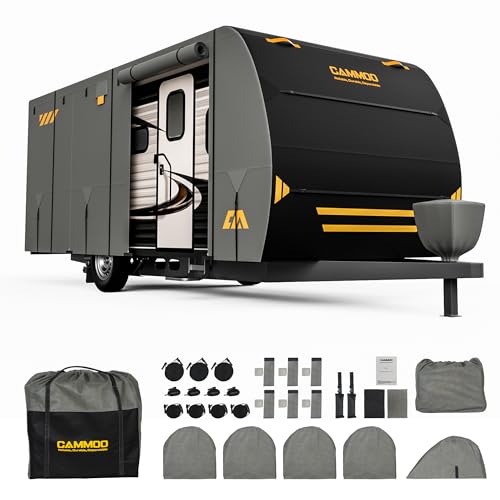
CAMMOO RV Cover for 24-27ft Travel Trailer
Picked as a relevant option in this category.
View on Amazon
Mofeez Travel Trailer RV Cover 9 Layers for 22'-24' Camper Cover RV Covers
Picked as a relevant option in this category.
View on AmazonCAMMOO RV Cover for 27-30ft Travel Trailer
Picked as a relevant option in this category.
View on Amazon
Mofeez Travel Trailer RV Cover, Extra-Thick Upgraded 7 Layers for Camper Cover 27'-30' Windproof Waterproof Rip-Stop RV Covers with Adhesive Repair Patches, 2Pcs Extra Straps & 4 Tire Covers
Chosen because it specifies 2Pcs Extra Straps & 4 Tire Covers.
View on Amazon- Measure the body length from the front wall to the rear wall. Include a rear-mounted spare tire only if the cover maker says its sizing includes accessories.
- Measure the widest point, including slide-outs if the cover is meant to fit with them extended. Most covers are designed for slides to be retracted, but confirm before buying.
- Measure from the ground to the highest roof feature, such as an air conditioner. Check the cover’s height range, not only its length.
- Retract awnings and close slides before covering unless the instructions explicitly allow otherwise. Protruding hardware can snag or abrade the fabric.
As a practical starting point, a cover listed for a 20–22-foot body might have a usable length range of about 20–22 feet. Treat that only as an illustration: actual ranges and fit allowances vary by maker. Don’t add extra length simply to “be safe.” Loose excess material can flap in wind and wear through at corners. If your measurements land at a size boundary, compare the manufacturer’s fit chart and return policy before ordering.
| Trailer body length | Example cover size range to look for | Fit check before ordering |
|---|---|---|
| 16–18 ft | Approximately 16–18 ft | Confirm roof height and allowance for the rear ladder or spare tire. |
| 20–22 ft | Approximately 20–22 ft | Check whether the stated trailer length includes the hitch; usually it should not be assumed. |
| 24–26 ft | Approximately 24–26 ft | Verify width and air-conditioner clearance, especially on taller models. |
| 28–30 ft | Approximately 28–30 ft | Check strap layout and whether one person can handle the cover’s size and bulk. |
The ranges above are measurement examples, not universal sizing standards. A trailer that is 24 feet long at the body may be sold under a longer overall-length specification that includes the hitch. Use the cover maker’s definitions to compare like with like.
Match fabric and weather protection to where the trailer sits
“Waterproof” is not the only useful measure of protection. A cover needs to shed rain while allowing trapped moisture to escape; a sealed, poorly ventilated cover can hold condensation against the trailer. Look for fabric described as breathable or vapor-permeable, plus roof and corner reinforcement where contact and tension are greatest.
| Cover construction | Best suited to | Trade-off to consider |
|---|---|---|
| Lightweight, breathable nonwoven polypropylene | Shorter storage periods and mild climates | Easy to handle, but may wear sooner under strong sun or persistent wind. |
| Multilayer polypropylene with a breathable top | General outdoor storage and mixed weather | A useful balance, though seams, fit, and tie-downs still determine how it performs in wind. |
| Heavier multilayer fabric with reinforced roof and corners | Longer storage, stronger sun exposure, or rougher weather | Typically bulkier and harder to install; heavier fabric alone does not guarantee better ventilation. |
For intense sun, prioritize UV-resistant material and reinforced areas that will face repeated tension. In rainy or humid conditions, favor a breathable design, secure but not drum-tight tension, and a dry trailer before covering. In windy locations, tie-downs and a close fit matter as much as fabric weight: fluttering fabric can abrade paint, decals, and sharp edges. No cover should be treated as a substitute for safe anchoring or as a guarantee against storm damage.
Choose access features for your storage routine
A door panel with a zipper lets you enter the trailer without removing the whole cover. This is useful for checking on the interior, retrieving stored items, or reaching a service area—but only if the opening lines up with your door. Compare the panel location with your trailer’s door and check that the zipper can be secured when closed.
- Door access: Most useful when you visit the trailer regularly. Confirm which side the access panel is on.
- Adjustable straps and buckles: Help reduce flapping and accommodate small differences in trailer shape. Look for straps that can be reached and tightened after fitting.
- Reinforced corners: Reduce wear where fabric is likely to rub. Add soft protection at sharp edges if the cover instructions recommend it.
- Storage bag: Makes off-season storage more manageable, but a large cover still takes space and may be awkward to fold alone.
- Vent panels: Support airflow, especially when the trailer is parked for weeks. They are not a reason to leave windows or roof vents open unless the cover design permits it.
Which cover makes sense for your situation?
| Storage situation | What to prioritize | What to avoid |
|---|---|---|
| Sunny, exposed driveway | UV-resistant multilayer fabric, reinforced roof, secure straps | A loose fit that whips against the trailer in wind |
| Humid or rainy region | Breathability, ventilation, and a trailer that is dry before covering | Assuming a fully sealed cover is automatically safer |
| Frequent visits during storage | A correctly positioned zippered door panel and easy-to-reach closures | Choosing access features without checking door location |
| Large trailer or solo installation | Manageable fabric weight, clear front/rear labels, and accessible tie-downs | Buying the heaviest construction without considering installation effort |
| Covered storage or mild weather | A lighter breathable cover sized closely to the body | Paying for maximum weather protection you are unlikely to need |
Installation and wear: the details that affect service life
Large covers can be bulky even when their listed weight seems manageable; check the manufacturer’s packed weight if you expect to install one alone. A second person helps guide fabric over roof equipment and keeps it from dragging across the sides. Clear the roof of debris, protect sharp corners as directed, and fit the cover with the front and rear aligned before tightening straps. Recheck tension after the first windy day, since straps and fabric can settle.
Common wear points are roof edges, corners, ladder areas, and places where loose fabric rubs. Inspect the cover periodically, particularly after strong wind or heavy precipitation. Remove it if water is pooling, the fabric is contacting a sharp edge, or straps are pulling unevenly. Dry the cover before folding it away when possible; storing it damp can encourage mildew and unpleasant odors.
Bottom line
The best RV covers for travel trailers are the ones that fit the measured body and roof height, breathe in your local conditions, and stay secure without excessive slack. For many owners, a breathable multilayer polypropylene cover with UV resistance, reinforced stress points, adjustable tie-downs, and a door-access panel is a well-rounded choice. Before ordering, compare your measurements against the exact size chart and verify the access-panel position—those checks prevent more fit problems than choosing a cover by advertised trailer length alone.