Key takeaways
- Caster diameter and tread compound: Anything under 3 inches will stall on an extension cord or an expansion joint. Look for 4-to-5-inch polyurethane or TPR wheels, and confirm at least two of them lock. Hard nylon casters roll fast on smooth epoxy but transmit every crack straight into your wrists.
- Drawer slide hardware: Ball-bearing slides with a stated per-drawer rating are the single best durability predictor. Friction slides feel fine empty and drag badly under load. Full-extension travel also matters ergonomically — partial extension means reaching blind into the back of the drawer.
- Push height and handle geometry: A side handle sitting between 34 and 38 inches lets you push with a neutral spine. Telescoping handles are excellent for stairs and truck beds, less so for repeated repositioning across a shop floor.
- Frame construction: For steel chests, 19-to-20-gauge bodies with welded corners and a powder-coat finish hold up to knocks and solvent spills. Structural resin boxes trade absolute rigidity for impact tolerance and immunity to rust — a real advantage in humid garages.
- Stability under load: Wide wheelbases and heavy items in the lowest drawers keep the center of gravity low. Cabinets with drawer interlocks or a single-point lock prevent the classic tip-over caused by two loaded drawers open at once.
What's inside
Most rolling tool chests are sold on a spec sheet: drawer count, gross capacity, a paint color. What that sheet never tells you is how the thing behaves once a real body is pushing 180 pounds of sockets across a cracked concrete slab, or what happens in year three when the bottom drawer has been opened ten thousand times. Those are the two failure points I see over and over. Buyers end up with a chest that rolls beautifully in a showroom and binds the moment it’s loaded, or one that survives the abuse but forces a stooped, twisted reach every time they need a wrench.
This guide looks at rolling tool chests through an ergonomics-and-durability lens instead of a feature-count one. Below you’ll find the models worth your money in 2026, plus the specific hardware details — caster diameter, slide type, push height, steel gauge — that separate a chest you’ll still be using in a decade from one you’ll curse by next summer.
As an Amazon Associate we earn from qualifying purchases.




🛒 Best Price Today on Amazon
Prime members get fast, free shipping on everything above, plus member-only deals. New members get a 30-day free trial — cancel anytime.
How to Choose a Rolling Tool Chest For The Money (2026)
- Caster diameter and tread compound: Anything under 3 inches will stall on an extension cord or an expansion joint. Look for 4-to-5-inch polyurethane or TPR wheels, and confirm at least two of them lock. Hard nylon casters roll fast on smooth epoxy but transmit every crack straight into your wrists.
- Drawer slide hardware: Ball-bearing slides with a stated per-drawer rating are the single best durability predictor. Friction slides feel fine empty and drag badly under load. Full-extension travel also matters ergonomically — partial extension means reaching blind into the back of the drawer.
- Push height and handle geometry: A side handle sitting between 34 and 38 inches lets you push with a neutral spine. Telescoping handles are excellent for stairs and truck beds, less so for repeated repositioning across a shop floor.
- Frame construction: For steel chests, 19-to-20-gauge bodies with welded corners and a powder-coat finish hold up to knocks and solvent spills. Structural resin boxes trade absolute rigidity for impact tolerance and immunity to rust — a real advantage in humid garages.
- Stability under load: Wide wheelbases and heavy items in the lowest drawers keep the center of gravity low. Cabinets with drawer interlocks or a single-point lock prevent the classic tip-over caused by two loaded drawers open at once.
The Best Rolling Tool Chests For The Money (2026) Reviewed
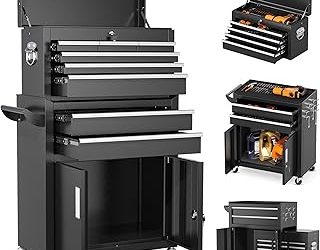
8-Drawer Rolling Tool Chest with Detachable Top
The detachable upper box is the standout here: you can carry just the small-fastener drawers to a job and leave the heavy cabinet parked, which cuts a lot of unnecessary lifting out of your day. Drawer liners and a tray divider come included, and the eight-drawer layout gives you enough shallow trays to sort hardware properly instead of dumping it all in one deep bin.
CRAFTSMAN VERSASTACK 30-Gallon Rolling Tool Chest (CMST17870)
The quick-access lid means the tools you grab twenty times an hour never require unstacking anything, which is exactly the kind of small ergonomic win that compounds over a long project. Its resin body shrugs off dings and won’t corrode, and the VERSASTACK interlocks let it grow with your kit rather than getting replaced by it.
DEWALT TSTAK Rolling Tool Box (DWST17820)
The telescoping handle and deep lower bin make this the best pick for anyone who actually moves tools between locations, not just around a garage. Large wheels and a stout carrier frame handle curbs and gravel far better than typical caster setups, and TSTAK compatibility keeps the whole stack rolling as one unit.
LARBANKE 3-Drawer Rolling Tool Cabinet
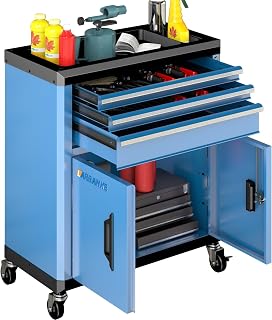
Two doors plus three drawers is a smart split — bulky items like impact wrenches and cordless chargers live behind the doors instead of eating three drawers’ worth of vertical space. The 360-degree casters make tight-shop maneuvering genuinely easy, and the connecting rods let you stack it with the 5- or 7-drawer chests into a proper tower.
TUFFIOM 5-Drawer Rolling Tool Chest
A cushioned top turns this into a legitimate work surface, and the padded height sits well for standing tasks like small-part assembly. Lockable wheels, keyed drawers, and pre-fitted liners cover the practical basics without pushing the price into professional-box territory.
Frequently Asked Questions
How many drawers do I actually need?
Fewer than most people buy. Count your tool categories, then add two. Five to seven drawers suits nearly every home shop; beyond that, drawers tend to become junk zones rather than organized storage.
Are resin tool boxes as durable as steel?
They’re differently durable. Structural resin absorbs impacts that would dent steel and never rusts, but steel holds more weight per drawer and resists deformation under heavy static loads. Choose resin for portability, steel for a stationary heavy-load cabinet.
What caster type works best on a rough garage floor?
Larger diameter with a softer polyurethane or rubber tread. Soft treads deform over cracks instead of catching on them, and the bigger the wheel, the smaller the effective obstacle.
Do I really need locking drawers?
Locks matter less for theft than for transport and safety. A single-point lock keeps drawers shut while you roll the chest and stops a child from pulling out a loaded drawer.
Final Thoughts
For a stationary shop where load capacity and organization matter most, the 8-Drawer chest with its detachable top box delivers the best combination of storage depth and reduced lifting. If your tools travel, the DEWALT DWST17820 handles curbs, gravel, and truck beds better than anything in its class, while the CRAFTSMAN VERSASTACK CMST17870 hits the sweet spot for anyone who wants quick-access convenience and a modular system they can build on gradually.