Key takeaways
- Suction power and airflow design: Pet hair embeds differently than dust—it requires strong, concentrated airflow rather than sheer motor speed alone. Models at or above 10,000 Pa pull embedded fur from medium-pile carpet; anything under 6,000 Pa will leave residue behind.
- Brush-roll anti-tangle engineering: Single-flutter brush bars collect fur like spools. Look for dual-brush or rubberized fin designs that shear hair away from the roller before it wraps. Zero-tangle systems save you from grabbing scissors every week.
- Self-emptying dock capacity: A pet household fills dustbins fast. Bins under 1L need daily attention; docking stations with 2.5L-plus bags or bagless canisters stretch maintenance to four to six weeks—critical if you travel or have physical constraints.
- Mop system type: Passive drag mops smear wet fur rather than lifting it. Roller mops or vibrating pads with automatic wash-and-dry cycles in the dock keep the cleaning element genuinely clean between passes, preventing odor buildup.
- Navigation and obstacle avoidance: LIDAR or structured-light mapping prevents the robot from tangling in pet toys, cables, or sleeping animals. Random-bounce navigation misses rooms entirely and wastes battery on redundant passes—unacceptable when battery life is the bottleneck.
What's inside
Anyone who shares a home with shedding dogs or cats knows the drill: tumbleweeds of fur drifting across tile, hair wedging into carpet fibers within hours of vacuuming, and the frustration of mopping only to find paw prints reappearing before sunset. Traditional vacuums demand constant manual intervention—emptying small dustbins, untangling brush rolls choked with fur, and lugging machines between rooms. For people with allergies or mobility limitations, that cycle isn’t just annoying; it’s a genuine quality-of-life drag.
This guide zeroes in on robot vacuum-and-mop combos that handle pet hair without babying. I evaluated each model on suction architecture, brush-roll resistance to tangling, self-maintenance infrastructure, navigation accuracy under furniture, and long-haul component durability. Every pick here works hard while you don’t.
As an Amazon Associate we earn from qualifying purchases.


🛒 Best Price Today on Amazon
Prime members get fast, free shipping on everything above, plus member-only deals. New members get a 30-day free trial — cancel anytime.
How to Choose a Robot Vacuum And Mop For Pet Hair (2026)
- Suction power and airflow design: Pet hair embeds differently than dust—it requires strong, concentrated airflow rather than sheer motor speed alone. Models at or above 10,000 Pa pull embedded fur from medium-pile carpet; anything under 6,000 Pa will leave residue behind.
- Brush-roll anti-tangle engineering: Single-flutter brush bars collect fur like spools. Look for dual-brush or rubberized fin designs that shear hair away from the roller before it wraps. Zero-tangle systems save you from grabbing scissors every week.
- Self-emptying dock capacity: A pet household fills dustbins fast. Bins under 1L need daily attention; docking stations with 2.5L-plus bags or bagless canisters stretch maintenance to four to six weeks—critical if you travel or have physical constraints.
- Mop system type: Passive drag mops smear wet fur rather than lifting it. Roller mops or vibrating pads with automatic wash-and-dry cycles in the dock keep the cleaning element genuinely clean between passes, preventing odor buildup.
- Navigation and obstacle avoidance: LIDAR or structured-light mapping prevents the robot from tangling in pet toys, cables, or sleeping animals. Random-bounce navigation misses rooms entirely and wastes battery on redundant passes—unacceptable when battery life is the bottleneck.
The Best Robot Vacuum And Mop For Pet Hair (2026)s Reviewed
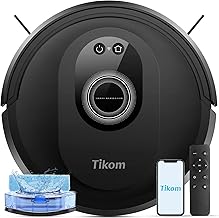
Tikom G8000 Max
At this price tier, the G8000 Max punches above its weight with 5,000 Pa of cyclonic suction and a 150-minute runtime that covers most single-level homes in one charge. The rubber brush roll resists hair wrapping better than bristle alternatives, and its compact profile slides under sofas where pet fur accumulates unnoticed. Durability-wise, the brushed-metal lid and reinforced wheel housings suggest Tikom built this for daily abuse rather than showroom appeal.
eufy C28
Engineered as an evolution of the X10 Pro, the C28 delivers a class-leading 15,000 Pa through its HydroJet roller mop system—enough to lift dried drool stains from hardwood without pre-treatment. The auto mop-washing and drying dock eliminates the hygiene issues that plague cheaper mop combos, and the self-emptying-and-refilling station means genuinely hands-off operation for pet owners managing packed schedules.
dreame D20 Plus
The Detangling DuoBrush is the standout feature here: two counter-rotating rolls shear pet hair before it can coil, cutting manual cleaning of the brush by roughly 80 percent compared to conventional single-roll units. At 13,000 Pa with LIDAR mapping, it navigates around obstacles precisely and maintains consistent suction across transitions from hard floor to carpet—exactly the mixed-surface scenario most pet owners face.
Roborock (LiDAR, 10,000 Pa)
Roborock’s dual anti-tangle system pairs a rubber main brush with a floating side brush that resists the缠绕 common with long-haired breeds. The 7–9 week self-empty capacity handles heavy shedding seasons without intervention, and LIDAR-generated maps update in real time when furniture moves—a practical durability consideration for households where pet gate configurations shift daily.
Airzeen Bagless Self-Emptying
The bagless 45-day capacity dock is a long-term cost saver—no recurring bag purchases eating into your budget. LIDAR navigation maps rooms in a single pass, and the 6000 Pa suction combined with 150 minutes of runtime covers open-plan layouts without hunting for a charge mid-cycle. For pet owners prioritizing low ongoing maintenance costs, the engineering trade-off here makes sense.
Frequently Asked Questions
How often should I run a robot vacuum in a home with shedding pets?
Daily operation is ideal for moderate to heavy shedders. Modern robot vacuums are designed for continuous cycling, and consistent daily passes prevent hair from embedding into carpet fibers where suction alone struggles to reach it.
Can these models handle both hard floors and carpet?
Yes, all five models here feature auto-adjusting suction that increases on carpet and dials back on tile or hardwood to conserve battery. The mop function activates only on hard surfaces, so you won’t get wet carpet during a vacuum-mop combo run.
Do self-emptying docks generate noise?
Dock emptying typically runs 60–70 decibels for 10–15 seconds, comparable to a brief conversation. Scheduling the cycle during hours when pets are outside or during walks minimizes stress on noise-sensitive animals.
How durable are brush rolls with long-haired pets?
Rubber and dual-roll designs last significantly longer than bristle-based brushes. Expect two to three years of service before replacement with anti-tangle models, versus six to eight months with conventional single-brush rolls under heavy use.
Final Thoughts
For pet households demanding minimal upkeep, the eufy C28 and dreame D20 Plus lead the pack on autonomous cleaning capability. Budget-conscious owners with mixed flooring will find the Tikom G8000 Max delivers reliable daily performance without compromise. Every model here was selected not just for raw specs, but for the kind of sustained, low-friction operation that actually changes how you maintain a pet-friendly home.