Key takeaways
- Filter access geometry: The best designs let you reach the media standing up or with one knee down, using a single latch or a quarter-turn base. Units requiring two hands plus a tool to open get cleaned half as often, which erases their advantage entirely.
- Washable versus fully reusable: A washable pre-filter traps hair and lint but sits ahead of a HEPA layer you’ll still replace. Genuinely reusable systems clean the entire stack. Know which one you’re buying before you budget.
- Gasket and frame material: Look for molded rubber or dense foam gaskets and rigid plastic filter frames. Thin cardboard-backed media and glued seals degrade quickly under repeated wetting, and a leaking seal short-circuits airflow around the filter.
- Handling and mass distribution: Anything above 15 pounds needs an integrated recessed handle or low-set grip points. Top-heavy cylinders with no handhold invite the exact awkward lift that ends in a cracked housing.
- Motor duty rating and noise floor: Reusable filters extend service life to years, so the fan becomes the limiting component. Brushless DC motors and AHAM-verified airflow figures signal a drivetrain built for that horizon.
What's inside
Anyone who has knelt on a hardwood floor at an awkward angle, fighting a snap-fit base panel with one hand while balancing a dusty filter cartridge in the other, already understands the real cost of air purification. It isn’t the sticker price. It’s the recurring friction of maintenance: cartridges that run $60 a set, service intervals that arrive every six months, and housings that were clearly designed on a screen rather than tested by human hands. Purifiers with washable filters shift that equation, but they introduce their own considerations — how the media dries, how the seals hold up after fifty cleaning cycles, and whether the motor was specified to survive the years the filter now lasts.
This guide evaluates washable-filter and washable-pre-filter purifiers the way a durability engineer would: access geometry, gasket resilience, panel hinge cycles, chassis weight relative to grip points, and long-term acoustic drift as bearings age. Below you’ll find the current standouts, a buying framework built around serviceability rather than marketing claims, and direct answers to the questions that determine whether a unit stays in service or ends up in a closet.
As an Amazon Associate we earn from qualifying purchases.


🛒 Best Price Today on Amazon
Prime members get fast, free shipping on everything above, plus member-only deals. New members get a 30-day free trial — cancel anytime.
How to Choose a/an Air Purifier With Washable Filters (2026)
- Filter access geometry: The best designs let you reach the media standing up or with one knee down, using a single latch or a quarter-turn base. Units requiring two hands plus a tool to open get cleaned half as often, which erases their advantage entirely.
- Washable versus fully reusable: A washable pre-filter traps hair and lint but sits ahead of a HEPA layer you’ll still replace. Genuinely reusable systems clean the entire stack. Know which one you’re buying before you budget.
- Gasket and frame material: Look for molded rubber or dense foam gaskets and rigid plastic filter frames. Thin cardboard-backed media and glued seals degrade quickly under repeated wetting, and a leaking seal short-circuits airflow around the filter.
- Handling and mass distribution: Anything above 15 pounds needs an integrated recessed handle or low-set grip points. Top-heavy cylinders with no handhold invite the exact awkward lift that ends in a cracked housing.
- Motor duty rating and noise floor: Reusable filters extend service life to years, so the fan becomes the limiting component. Brushless DC motors and AHAM-verified airflow figures signal a drivetrain built for that horizon.
The Best Air Purifier With Washable Filters (2026)s Reviewed
Nuwave Forever Smart
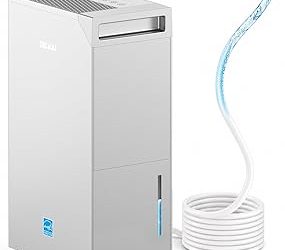
The strongest expression of the reusable concept: a patented seven-stage stack with genuinely washable media across the board, so ongoing cost approaches zero. The adjustable flow panel doubles as your service access, and coverage to roughly 2,000 sq ft means it can anchor an open-plan main floor without running at maximum.
Nuwave OxyPure Zero Plus
Rated near 3,210 sq ft, this is the choice for large great rooms and stairwell-connected spaces where a smaller unit simply recirculates one corner. Its filters are built for repeat cleaning rather than replacement, though the chassis is substantial — plan its position once, then leave it there.
PuroAir 400
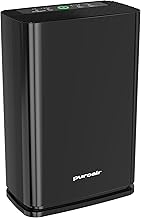
Covers up to 2,000 sq ft with a HEPA CarbonTech filter and a responsive air quality sensor that drives auto mode intelligently instead of hunting between speeds. The washable pre-filter handles pet hair and construction dust, meaningfully extending the life of the sealed media behind it.
3,000 Sq Ft Dual-Intake HEPA Purifier
Dual-sided intake is an underrated ergonomic win: it tolerates being placed nearer a wall or against furniture without choking airflow, which is how most purifiers actually get positioned in furnished rooms. The washable pre-filter and PM2.5 sensor round out a practical package for very large spaces.
VEWIOR 2-Pack with Washable Pre-Filter
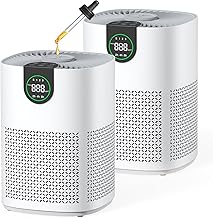
Two H13 HEPA units covering up to 1,200 sq ft combined outperform one large purifier in homes with closed doors and separated bedrooms. Lighter chassis make relocation trivial, and the washable pre-filters keep the pair economical to maintain over years.
Frequently Asked Questions
How often should I wash the filter?
Every two to four weeks in homes with pets, every six to eight weeks otherwise. Inspect rather than guess — visible surface lint is your cue, and a quick vacuum between washes doubles the interval.
Does the filter need to be fully dry before reinstalling?
Yes, without exception. Residual moisture invites microbial growth in the media and can reach the motor housing. Allow 24 hours of air drying, never heat or direct sun, which warps the frame.
Are washable filters as effective as replaceable HEPA?
Washable pre-filters capture large particulate; true HEPA-grade capture of fine particles still depends on the pleated layer behind it. Fully reusable systems achieve comparable results by design but demand disciplined cleaning to maintain rated airflow.
What actually fails first on these units?
Fan bearings and door latches, in that order. Both are worth checking in reviews at the two-year mark, since the filter is no longer the consumable that ends the product’s life.
Final Thoughts
For the lowest lifetime cost and the cleanest maintenance routine, the Nuwave Forever Smart is the clearest recommendation, with the OxyPure Zero Plus taking over when square footage climbs past 3,000. If you’d rather pair a robust washable pre-filter with strong sensor-driven automation, the PuroAir 400 remains the balanced, well-built middle path.