Key takeaways
- Reach zone over raw capacity: A top-freezer layout puts fresh food at chest and waist height, which is where you want daily items. French door units win on shoulder comfort but push the freezer to floor level, so weigh which compartment you open more often before chasing cubic feet.
- Door swing and hinge load: Reversible doors are not a luxury in a narrow galley or an apartment corridor. Check the stated swing arc against your clearance, and favor hinges with visible pin hardware you can shim or replace instead of sealed assemblies.
- Gasket profile and seal pressure: The magnetic gasket is the single highest-wear part on any fridge. Look for a one-piece replaceable strip rather than a bonded liner, and press-test the seal on arrival; a bill of paper should drag when pulled.
- Shelf substrate and load rating: Tempered glass with a steel frame resists sag under gallon jugs far better than unsupported wire or thin polymer. Adjustable shelf tracks should engage with a positive stop so a loaded shelf cannot tip forward.
- Defrost method and compressor access: Frost-free systems save you the biannual thaw but add a heater and timer to the failure list. Either way, confirm the rear panel is accessible without unseating the unit, and that condenser coils can be vacuumed at least annually.
What's inside
Ice makers are the first thing to break and the last thing anyone budgets to repair. The auger jams, the fill valve weeps, the water line frosts over behind the cabinet, and suddenly a working refrigerator is a service call. Buyers who have lived through that cycle tend to want the same thing the second time around: a cold box with fewer moving parts, no plumbing, and a freezer compartment that stores food instead of hosting a machine. The trouble is that most product listings bury this detail, and “no ice maker” is rarely a filter you can click.
This guide approaches the category the way I evaluate any piece of household equipment that gets opened twenty times a day: reach geometry, hinge and gasket loading, shelf deflection under real weight, and how gracefully the unit ages. Below are the models worth shortlisting in 2026, plus the selection criteria that actually predict a ten-year service life rather than a good first month.
As an Amazon Associate we earn from qualifying purchases.


🛒 Best Price Today on Amazon
Prime members get fast, free shipping on everything above, plus member-only deals. New members get a 30-day free trial — cancel anytime.
How to Choose a Refrigerator Without Ice Maker (2026)
- Reach zone over raw capacity: A top-freezer layout puts fresh food at chest and waist height, which is where you want daily items. French door units win on shoulder comfort but push the freezer to floor level, so weigh which compartment you open more often before chasing cubic feet.
- Door swing and hinge load: Reversible doors are not a luxury in a narrow galley or an apartment corridor. Check the stated swing arc against your clearance, and favor hinges with visible pin hardware you can shim or replace instead of sealed assemblies.
- Gasket profile and seal pressure: The magnetic gasket is the single highest-wear part on any fridge. Look for a one-piece replaceable strip rather than a bonded liner, and press-test the seal on arrival; a bill of paper should drag when pulled.
- Shelf substrate and load rating: Tempered glass with a steel frame resists sag under gallon jugs far better than unsupported wire or thin polymer. Adjustable shelf tracks should engage with a positive stop so a loaded shelf cannot tip forward.
- Defrost method and compressor access: Frost-free systems save you the biannual thaw but add a heater and timer to the failure list. Either way, confirm the rear panel is accessible without unseating the unit, and that condenser coils can be vacuumed at least annually.
The Best Refrigerator Without Ice Maker (2026)s Reviewed
KoolMore 28-Inch 14 Cu Ft Top Freezer
A genuinely garage-tolerant build in a 28-inch footprint, with a stainless skin that shrugs off knocks near a workbench. The straightforward mechanical layout is the appeal here: fewer electronics between you and cold air, and a cabinet depth that lets shorter users clear the top shelf without a step stool.
BLACK+DECKER 16.4 Cu. Ft. Top Mount (BR1640KW)
Separate temperature controls for each compartment give you real command over crisper humidity and freezer burn, which matters more than most spec sheets admit. The white finish hides scuffs better than brushed steel in a rental, and auto defrost removes the one maintenance chore people reliably skip.
Upstreman 14.6 Cu. Ft. Frost Free Top Freezer (BD146)
The standout combination in this roundup: ENERGY STAR certification, an electronic thermostat that holds setpoint tightly, and a reversible door that adapts to awkward kitchens. Low compressor noise makes it viable for open-plan spaces where a fridge cycling at 45 dB becomes a nightly irritation.
Upstreman 7.7 Cu. Ft. Double Door (BD75)
For dorms, offices, and studio kitchens, this is the right ergonomic compromise: two doors mean you are not excavating a freezer chest to find frozen peas. The five-position thermostat is manual and mechanical, which is precisely why it tends to outlive its digital counterparts.
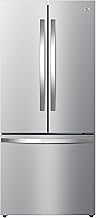
Kenmore 17.5 Cu. Ft. 30-Inch French Door
A rare French door unit that skips the ice hardware entirely, freeing the freezer drawer for actual storage and eliminating a water connection. At 30 inches wide it slots into older cabinet runs that will not accept a 36-inch box, and the shallow door swing suits tight aisles.
Frequently Asked Questions
Does the Sharp SJF2955KS belong on this list?
No, and it is worth saying plainly. That 28.9 cu. ft. French door model includes an ice and water dispenser, so it is a strong large-capacity refrigerator but the wrong choice if avoiding ice hardware is your goal.
Will skipping the ice maker actually improve reliability?
It removes a water valve, a fill tube, a motorized auger, and a heater from the failure inventory. Those components account for a meaningful share of in-warranty service visits, so yes, fewer parts means fewer interventions.
Is manual defrost a dealbreaker?
Not for smaller units used lightly. Budget twenty minutes twice a year, and note that manual defrost systems have no defrost heater to fail, which is a durability advantage some buyers happily accept.
Can these units run in an unheated garage?
Only if the manufacturer rates them for low ambient operation, as KoolMore does. Below roughly 50°F, unrated compressors under-cycle and freezer temperatures drift upward.
Final Thoughts
For most households, the Upstreman 14.6 Cu. Ft. BD146 is the balanced pick: frost free, quiet, efficient, and reversible for real kitchens. Choose the Kenmore 17.5 Cu. Ft. French Door if you want shoulder-height fresh food without adding plumbing, or the KoolMore 28-Inch if the unit will live somewhere it needs to take abuse.