Key takeaways
- Foam density over thickness: An 8-inch pad built from low-density filler will compress further in a year than a 6-inch pad using high-density foam. Ask for density figures or layer counts; thickness alone tells you almost nothing about how long the support surface will hold its geometry.
- Fold geometry and hinge wear: Bi-fold designs concentrate flex along one line, tri-folds distribute it across two. If the futon will be reconfigured daily, tri-fold construction generally ages more evenly, but check that the fold seams are stitched through rather than merely glued.
- Seat height and edge firmness: For sofa use, aim for a compressed seat height of roughly 16 to 18 inches so your feet rest flat and your thighs stay supported. Soft, collapsing front edges are the most common source of hip and lower-back complaints.
- Frame joinery, if you’re buying a frame: Hardwood frames with bolted or mortise-style connections tolerate the torque of repeated conversion far better than stapled softwood. Inspect the arm-to-rail junction, which is where most frames fail first.
- Cover serviceability: Removable, washable covers dramatically extend usable life because the fabric almost always wears out before the core does. Corduroy and twill both resist abrasion well; suede-look microfiber hides marks but can pill under heavy traffic.
What's inside
A queen futon has to succeed at two jobs that pull in opposite directions. Sitting asks for a firm, supportive deck that holds your pelvis level and keeps your knees below your hips. Sleeping asks for enough compliance at the shoulder and hip that your spine can stay neutral on its side. Most queen futons are engineered around one of those loads and simply tolerate the other, which is why buyers so often report a piece that felt fine in the showroom and started sagging, creaking, or bottoming out somewhere around month eight.
This guide evaluates queen size futons the way a load-bearing product should be evaluated: foam density and layer architecture, hinge and fold geometry, frame joinery, cover abrasion resistance, and how each model behaves under the repeated bending cycles that eventually decide its lifespan. The picks below span floor-style Japanese mattresses, tri-fold convertibles, and traditional wood-frame sets, so you can match the format to how the piece will actually be used rather than how it photographs.
As an Amazon Associate we earn from qualifying purchases.


🛒 Best Price Today on Amazon
Prime members get fast, free shipping on everything above, plus member-only deals. New members get a 30-day free trial — cancel anytime.
How to Choose a Queen Size Futon (2026)
- Foam density over thickness: An 8-inch pad built from low-density filler will compress further in a year than a 6-inch pad using high-density foam. Ask for density figures or layer counts; thickness alone tells you almost nothing about how long the support surface will hold its geometry.
- Fold geometry and hinge wear: Bi-fold designs concentrate flex along one line, tri-folds distribute it across two. If the futon will be reconfigured daily, tri-fold construction generally ages more evenly, but check that the fold seams are stitched through rather than merely glued.
- Seat height and edge firmness: For sofa use, aim for a compressed seat height of roughly 16 to 18 inches so your feet rest flat and your thighs stay supported. Soft, collapsing front edges are the most common source of hip and lower-back complaints.
- Frame joinery, if you’re buying a frame: Hardwood frames with bolted or mortise-style connections tolerate the torque of repeated conversion far better than stapled softwood. Inspect the arm-to-rail junction, which is where most frames fail first.
- Cover serviceability: Removable, washable covers dramatically extend usable life because the fabric almost always wears out before the core does. Corduroy and twill both resist abrasion well; suede-look microfiber hides marks but can pill under heavy traffic.
The Best Queen Size Futons Reviewed
8 Inch Corduroy Futon Mattress, Queen
The high-resilience foam fill here does something most thick floor futons don’t: it rebounds rather than slowly conforming, which keeps the seating edge intact after months of use. The corduroy face adds meaningful abrasion resistance, and the two storage straps make the stow-away cycle less punishing on the fold seams than wrestling a loose mattress into a closet.
6th Generation Japanese Floor Futon Mattress, Queen
Nine layers of 100% high-density foam produce a firm, planar sleep surface that suits back and stomach sleepers particularly well, and the layered build resists the localized dishing that plagues single-block foam pads. Side sleepers over roughly 200 pounds may want a thin wool or latex topper to open up shoulder clearance.
Stanford Queen Futon Set with Frame
A conventional bi-fold set that gets the fundamentals right: an 8-inch mattress on a proper frame, with a twill cover that holds up to daily sitting without glazing or pilling. Best suited to rooms where the futon stays in sofa mode most of the week and converts for guests rather than nightly sleep.
Kodiak Monterey Queen Futon Set, Espresso
The most furniture-like option in this group, with a substantial wood frame and espresso finish that reads as intentional rather than provisional. Its suede-look cover forgives scuffs, and the frame’s mass gives it the stability that lighter convertibles lack when someone drops onto the front edge.
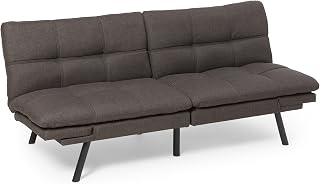
JUIKURY 6 Inch Tri-Fold Memory Foam Mattress, Queen
A well-judged compromise: memory foam over a high-density base gives pressure relief at the hip and shoulder while the support layer keeps the whole assembly from bottoming out. The washable cover and five-position conversion make this the most practical choice for small apartments where the same piece works all day.
Frequently Asked Questions
Can a queen futon work as a full-time bed?
Yes, provided the core uses high-density foam and you rotate the mattress every few months to distribute compression. Thinner pads under about 6 inches are better treated as guest or supplemental sleeping surfaces.
Do I need a frame?
Only if you want proper seat height and back support. Floor-style futons are lighter, cheaper, and easier to store, but sitting on one for long stretches loads the lumbar spine in a way most people find fatiguing.
How firm should a queen futon be?
Firmer than a conventional mattress, because it must also serve as seating. Side sleepers can soften the surface with a topper without sacrificing the structural support underneath.
How long should one last?
Expect three to five years from a high-density foam core in regular use, and longer from a hardwood-framed set where you can replace the mattress independently of the frame.
Final Thoughts
For daily dual-purpose use in a compact space, the JUIKURY 6 Inch Tri-Fold offers the best balance of pressure relief and structural support. If you want a piece that reads as real furniture and can be maintained part by part, the Kodiak Monterey set is the more durable long-term investment, while the 8 Inch Corduroy Futon Mattress remains the strongest frameless option thanks to its high-resilience fill and hard-wearing cover.