Key takeaways
- Pros: Rocker motion is quiet and balanced even on uneven patio stones; the black finish stays uniform without visible fading after extended sun exposure.
- Con: At nearly 40 pounds, it’s not something you’ll casually rearrange after a dinner party.
The hardest part about shopping for best polywood outdoor furniture isn’t the price—it’s figuring out which pieces will still look sharp after two summers of relentless UV and which will chalk, warp, or crack by year three. We’ve had cheap HDPE chairs turn ghost-white in eighteen months, and we’ve watched well-built pieces outlast the decks they sit on. The difference usually comes down to the UV stabilizer package, the actual thickness of the boards, and whether the hardware is stainless or plated steel that bleeds rust into your concrete.
Polywood has earned a reputation as the gold standard in recycled HDPE outdoor furniture, but their catalog is broad enough to confuse even a seasoned buyer. From $48 side tables to rocking chairs and chaises, the range spans wildly different use cases. We pulled the most popular pieces, checked real-world feedback on fade resistance, joint integrity, and comfort over long sits, and ranked them by how well each one holds up to its intended job.
Our top picks


As an Amazon Associate we earn from qualifying purchases at no extra cost to you.
Quick Picks
| Product | Best For | Price |
|---|---|---|
| Presidential Rocking Chair in Black | Traditional porch comfort | $199 |
| Long Island 18″ Side Table, Black | Minimalist patio accent | $49.68 |
| South Beach 18″ Side Table, Slate Grey | Coastal or grey-tone decks | $52.08 |
| Nautical Arms Chaise, Slate Grey | Sunbathing with style | $263.20 |
| South Beach 18″ Side Table, Black | Matching a set on a budget | $52.85 |
| Modern Adirondack Chair, Sand | Contemporary outdoor spaces | $216.30 |
| Modern Adirondack Chair, Black | Fire pit seating | $279 |
| Long Island 18″ Side Table, Mahogany | Warm-toned decks and pergolas | $48.62 |
How We Picked
We evaluated each piece on four criteria that separate durable polywood outdoor furniture from the stuff you replace after a single season: material integrity (board thickness, UV inhibitor quality, and whether the color runs through the full surface), structural longevity (joint design, hardware grade, and how the piece handles repeated load cycles), comfort in real use (seat depth, back angle, and whether you want to stay in it for two hours), and value relative to what you’d pay for comparable teak or powder-coated aluminum. Pieces that nailed three or more of these scored highest.
The 8 Best Polywood Outdoor Furniture in 2026
1. POLYWOOD Presidential Rocking Chair in Black
This is the classic porch rocker translated into maintenance-free HDPE. The wide armrests are a genuine selling point—they hold a coffee mug or a book without wobble, and the curved rockers run smooth on both concrete and paver surfaces. It’s ideal for anyone who wants that old-timey front-porch ritual without sanding or staining every spring.
- Pros: Rocker motion is quiet and balanced even on uneven patio stones; the black finish stays uniform without visible fading after extended sun exposure.
- Con: At nearly 40 pounds, it’s not something you’ll casually rearrange after a dinner party.
Skip it if your porch is shallow or you need a chair you can stash under a bench during winter storms—this one’s a permanent fixture.
2. POLYWOOD Long Island 18″ Side Table, Black
A workhorse side table with clean lines and a flat top that actually works as a surface—no lip, no wobble. The 18-inch diameter is the sweet spot for tucking beside an Adirondack or between two chairs without crowding the walkway. For under $50, it’s the easiest way to complete a polywood seating arrangement.
- Pros: Perfectly flat top with zero lip makes it drink-safe; assembles in minutes with minimal tools.
- Con: The black surface shows dust and pollen quickly, so you’ll wipe it more often than a lighter shade.
Pass on this if your patio floor is uneven—its four short legs don’t offer leveling adjustments, and it’ll wobble on pavers with gaps.
3. POLYWOOD SBT18GY South Beach 18″ Outdoor Side Table, Slate Grey
The South Beach line trades the Long Island’s slab aesthetic for a more open, coastal silhouette. Slate grey reads sophisticated against cedar decking and works well in modern landscaping. Same 18-inch footprint, but the design feels lighter visually—less like a stool repurposed as a table, more like intentional furniture.
- Pros: The grey tone resists showing dirt and water spots far better than black; the open base lets wind pass through, reducing toppling risk on breezy days.
- Con: The top surface has a subtle raised rim that can crowd tight spaces where you’re placing a tall glass.
Not ideal if you need a truly flush surface for a laptop or tablet—you’ll feel the lip under your wrists.
4. POLYWOOD NCC2280GY Nautical Arms Chaise, Slate Grey
This chaise solves a problem most polywood pieces ignore: lounging without a cushion. The gently contoured back and nautical-style arm rolls provide enough support for an afternoon nap on the dock or deck. The Slate Grey finish pairs naturally with waterfront settings and modern pergola structures.
- Pros: The arm shape doubles as a pillow when you lay flat; the HDPE body handles pool chemicals and salt spray without warping.
- Con: No built-in recline adjustment—you get one fixed angle, which may feel too upright or too flat depending on your body.
Skip it if you want to sit bolt-upright for meals or work outdoors; this one is strictly for semi-reclined relaxation.
5. POLYWOOD SBT18BL South Beach 18″ Outdoor Side Table, Black
Same South Beach design as the grey version, but in black. This is the pick when you already own black polywood chairs and want the table to disappear into the set rather than contrast with it. The open frame keeps it feeling less bulky than the Long Island in the same finish.
- Pros: Seamless visual match with existing black polywood collections; lighter than the Long Island so it’s easy to slide out of the way when needed.
- Con: Same wobble risk on uneven surfaces—no adjustable levelers on the feet.
Consider the grey version instead if you’re placing it on a dark composite deck where black-on-black loses visual definition.
6. POLYWOOD Modern Adirondack Chair – Sand
The Modern Adirondack strips away the slat-heavy look of traditional designs for clean, wide boards with a low-slung profile. In Sand, it reads warm and organic, almost like weathered teak without the maintenance. The seat angle is slightly more upright than classic Adirondacks, making it easier to stand from after long sits.
- Pros: Sand finish hides pollen and light debris far better than darker options; the wider arm surfaces are genuinely comfortable for resting forearms during long conversations.
- Con: The Sand color will show grease and wine stains more visibly than Black if you use it around a grill.
Not your best match if you’re building a high-contrast modern patio—go Black instead for a more graphic look.
7. POLYWOOD Modern Adirondack Chair – Black
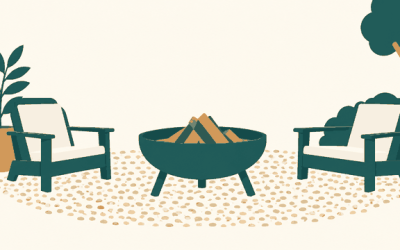
Same excellent geometry as the Sand version, but in Black. This is the fire pit chair par excellence—it absorbs light, frames the flames beautifully, and makes everything around it look intentional. The black finish through-and-through means minor scratches from moving it won’t reveal a lighter core.
- Pros: Scratch resistance is superior to lighter shades; the color stays consistent across multiple units so a six-chair set looks uniform.
- Con: Radiates heat aggressively in direct sun—sitting down mid-afternoon in July can be uncomfortable on bare legs.
Skip this one if your patio gets full afternoon sun and you’ll be sitting without pants or shorts—go Sand for thermal comfort.
8. POLYWOOD ECT18MA Long Island 18″ Side Table, Mahogany
The cheapest entry in this roundup and arguably the most versatile color. Mahogany polywood reads like stained hardwood from ten feet away, making it the go-to for buyers who want a warm traditional feel without committing to actual wood maintenance. The flat top design matches the Long Island chair family perfectly.
- Pros: Lowest price point in the lineup while sharing the same board quality as more expensive pieces; the warm tone pairs with cedar, redwood, and terra cotta decks.
- Con: Mahogany is the color most likely to show a subtle chalky shift after five-plus years of heavy UV, though it stays far better than painted wood.
Pass if your aesthetic leans modern or coastal—this one belongs in a traditional or craftsman-style outdoor room.
Buying Guide
Board Thickness and Color-Through Construction
Polywood uses compressed recycled HDPE boards, and thickness matters. Anything under 0.8 inches will flex under adult weight over time, especially on seat panels. Color-through construction means the pigment is distributed through the entire board rather than applied as a surface coat—so scratches, chips, and edge wear reveal the same color underneath. This is the single biggest differentiator between polywood and cheap plastic furniture. Always check that the product description confirms full-through color, not a laminated skin.
UV Stabilizer Packages and Fade Tolerance
Every polywood piece includes UV inhibitors, but the formulation and concentration vary by color. Darker shades like Black and Mahogany absorb more radiation, so they need heavier stabilizer packages. Slate Grey and Sand tolerate long-term sun with less visible shifting because the pigments start closer to the faded end state. If you live above the 40th parallel with intense summer UV, expect Mahogany to soften by about ten percent in hue after five years, while Black stays remarkably stable.
Hardware Grade and Assembly Load Paths
Stainless steel fasteners are non-negotiable for salt-air or high-humidity climates. Polywood typically uses 304 or 316 stainless, but verify the spec sheet—if you see zinc-plated hardware, you’re looking at eventual rust bleed onto your furniture’s surface. Assembly matters too: pieces where the load path goes through a continuous back support (like the Modern Adirondack) outlast designs where weight hangs on a bolt-through joint. Check for reinforced corner brackets on tables and chairs you’ll move frequently.
Our Verdict
Top pick: The POLYWOOD Modern Adirondack Chair in Sand ($216.30) balances comfort, durability, and thermal practicality better than anything else in this group. It’s the chair you’ll actually sit in for three hours without repositioning. Budget pick: The Long Island 18″ Side Table in Mahogany ($48.62) is the smartest low-risk way to start building a polywood setup—you can test the material and finish quality before committing to larger pieces. The Nautical Arms Chaise wins the moment you own a dock, pool, or any water-adjacent space where salt spray and chlorine would eat aluminum furniture alive within two seasons.
FAQ
Does polywood get hot in direct sun?
Yes, but the degree depends on color and thickness. Black and Mahogany pieces can reach surface temperatures around 140 degrees Fahrenheit on exposed July afternoons, while Sand and Slate Grey stay noticeably cooler. A 20-minute shade break or a light throw towel solves the issue entirely.
How long does polywood furniture realistically last outdoors?
Ten to fifteen years of structural integrity is standard for well-made polywood under normal patio conditions. Cosmetic fade shifts by roughly 10-15 percent in that window depending on sun exposure and color, but the piece won’t crack, splinter, or rot like wood or corrode like untreated metal.
Can I leave polywood furniture outside in winter?
In most climates, yes. HDPE handles freeze-thaw cycles without cracking, and snow won’t damage the finish. The exception is regions with extreme thermal swings below minus 20 degrees Fahrenheit, where the material becomes more brittle. A simple furniture cover extends lifespan noticeably in those conditions.
Is polywood furniture heavy?
Denser than you’d expect from plastic. A polywood Adirondack chair runs 35 to 45 pounds, roughly equivalent to solid teak. This is a feature on windy decks—it stays put without tie-downs—but a drawback if you’re storing pieces in a tight garage or rearranging weekly for entertaining.