Key takeaways
- Height off the floor: Aim for 24 to 40 inches — nightstand, dresser top, low shelf. Cool mist is heavier than room air and needs vertical runway to disperse before it condenses. Floor placement soaks baseboards and carpet backing; anything above shoulder height rains down on whatever sits beneath it.
- Clearance from walls and wood: Leave at least 12 inches on every side, more on the mist-nozzle side. Repeated micro-condensation is what lifts veneer, blisters paint, and swells MDF edges. If the unit must sit on solid or engineered wood, put a sealed tray or stone coaster underneath and treat it as permanent.
- Refill ergonomics: Be honest about the trip to the tap. A full 8L tank is roughly 18 pounds — that’s a two-handed carry at an awkward angle, and it’s why big units get abandoned. Top-fill designs let you bring a pitcher to the humidifier instead, which is the single biggest predictor of whether you’ll actually keep using it.
- Airflow and thermal context: Keep it clear of supply vents, radiators, and direct sun. Forced air strips mist before it humidifies, and warm surfaces accelerate mineral scaling inside the tank. A spot with gentle circulation and stable temperature does more for output than any extra wattage.
- Access for cleaning: If you can’t lift the tank and reach the base without moving furniture, you won’t descale it. Choose a location with an open approach and wide-mouth access, because scale buildup — not motor failure — ends most humidifiers.
What's inside
Most humidifier disappointment has nothing to do with the machine. A well-built ultrasonic unit sitting on carpet in the corner of a room will read as “broken” — the mist never seems to reach you, the floor feels damp, and within three weeks there’s a chalky ring nobody wants to scrub. The hardware was fine. The placement was wrong, and the placement quietly wrecked the hardware.
This guide approaches humidifier placement the way we’d approach siting any piece of household equipment that lives on furniture: with attention to reach, refill posture, moisture load on surfaces, and how long the thing survives real use. Below you’ll find models that tolerate good placement decisions, plus the rules that determine whether your surfaces and your unit both last past year one.
As an Amazon Associate we earn from qualifying purchases.




🛒 Best Price Today on Amazon
Prime members get fast, free shipping on everything above, plus member-only deals. New members get a 30-day free trial — cancel anytime.
How to Choose a Place To Put Humidifier (2026)
- Height off the floor: Aim for 24 to 40 inches — nightstand, dresser top, low shelf. Cool mist is heavier than room air and needs vertical runway to disperse before it condenses. Floor placement soaks baseboards and carpet backing; anything above shoulder height rains down on whatever sits beneath it.
- Clearance from walls and wood: Leave at least 12 inches on every side, more on the mist-nozzle side. Repeated micro-condensation is what lifts veneer, blisters paint, and swells MDF edges. If the unit must sit on solid or engineered wood, put a sealed tray or stone coaster underneath and treat it as permanent.
- Refill ergonomics: Be honest about the trip to the tap. A full 8L tank is roughly 18 pounds — that’s a two-handed carry at an awkward angle, and it’s why big units get abandoned. Top-fill designs let you bring a pitcher to the humidifier instead, which is the single biggest predictor of whether you’ll actually keep using it.
- Airflow and thermal context: Keep it clear of supply vents, radiators, and direct sun. Forced air strips mist before it humidifies, and warm surfaces accelerate mineral scaling inside the tank. A spot with gentle circulation and stable temperature does more for output than any extra wattage.
- Access for cleaning: If you can’t lift the tank and reach the base without moving furniture, you won’t descale it. Choose a location with an open approach and wide-mouth access, because scale buildup — not motor failure — ends most humidifiers.
The Best Place To Put Humidifier (2026)s Reviewed
Levoit Top Fill 2.5L
The sweet spot for nightstand duty: 2.5L is light enough to carry to the sink one-handed, and at 28dB it disappears behind ambient room noise. The top-fill opening and simple internal geometry mean descaling takes minutes, which is the trait that determines whether a bedroom humidifier survives a second winter.
Homvana 3.6L Top-Fill
At 23dB this is the quietest option here, and the wide fill port forgives sloppy pouring — a real consideration when you’re half awake. The 2-in-1 diffuser function is genuinely useful, though oils accelerate residue buildup, so run it on a wipeable surface and rinse the reservoir more often than the manual suggests.
DREO HM311 4L
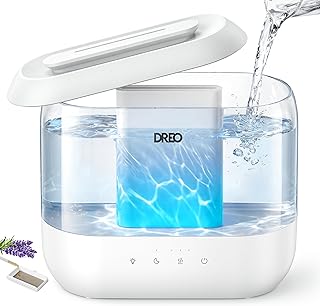
Four liters and 36 hours of runtime put this in dresser-top territory rather than nightstand, and it earns that footprint with a BPA-free tank that’s shaped for a hand to actually get inside. The nightlight is dim enough not to fight sleep, and the wide base resists tipping if someone brushes past it.
ROSEKM 2.0L Cool Mist
The lightest unit reviewed, which makes it the most likely to be refilled daily — no small thing. The 360° nozzle is the practical highlight: you can angle mist away from a wall or headboard, which solves the clearance problem in tight bedrooms where nothing sits 12 inches from anything.
8L Top Fill with Night Light
This is a whole-floor machine, and it should be sited accordingly — a low console or plant stand in a hallway or open living area, never a bedside table. Fill it in place with a pitcher; hauling 2.1 gallons across a room is how tanks get dropped and shells get cracked.
Frequently Asked Questions
How far from the bed should a humidifier sit?
Three to six feet, angled away from bedding. Closer than that and you’ll wake to damp sheets and a cold spot; farther and mist dilutes before it reaches your breathing zone.
Can I put a humidifier on a wood dresser?
Only with a waterproof barrier. Use a sealed tray, stone tile, or silicone mat that extends past the unit’s footprint, and check under it monthly for trapped moisture.
Is a bigger tank always better?
No. Capacity you can’t lift becomes capacity you don’t use. Match tank size to your willingness to carry water, then let top-fill design cover the gap.
Does placement affect how long the unit lasts?
Considerably. Warm, dusty, or cramped locations drive scale and clogging, the two most common failure paths in ultrasonic units.
Final Thoughts
For bedside placement where refill friction decides everything, the Levoit 2.5L and Homvana 3.6L are the durable choices — light, quiet, and easy to keep clean. If you’re humidifying a larger room from a dresser or console, the DREO HM311 offers the best balance of runtime and serviceability without demanding a two-handed water haul.