Key takeaways
- Start at the lowest level: Site the primary unit in the basement or lowest conditioned floor, roughly central and near the base of the stairwell. Drying air at the intake point of the stack means the whole column above it carries less moisture, which usually drops upstairs readings by 5–10% RH without a second machine.
- Respect the airflow envelope: Compressor units need 8–12 inches of clearance on the intake and exhaust faces. Tucking one against a sofa back or inside a closet recirculates its own warm discharge, which shortens compressor cycles and accelerates wear on the start relay.
- Plan the drain before the location: A gravity hose only works if the outlet sits below the unit’s drain port. Choose a spot near a floor drain, sump, or laundry standpipe and you eliminate tank-carrying entirely, which is the single biggest ergonomic win available.
- Check the working height: If you will empty a tank manually, that tank should slide out at or above knee height and weigh under 6 pounds full. Anything heavier, pulled from a low bay while you’re bent forward, loads the lumbar spine in exactly the way physical therapists warn about.
- Protect the floor you’re standing on: Hardwood and engineered flooring don’t forgive a slow drip or vibration transfer. A composite tray and felt pads under the feet cost almost nothing and prevent the ring-shaped finish damage that shows up eighteen months later.
What's inside
Moisture in a two-story house doesn’t sit still. The stack effect pulls air upward through stairwells, wall cavities, and ductwork, so damp air born in a basement or a first-floor bathroom ends up condensing on second-story window frames and inside closets. Buyers usually respond by hauling a dehumidifier upstairs to the room that smells musty, then wonder why the tank barely fills. The unit is treating a symptom two floors above the source.
This guide approaches the placement question the way a specialist looks at furniture: where does the load actually sit, what surfaces will take the wear, and which parts of the machine will you touch every few days for the next five years? We cover the physics of siting a unit in a multi-level home, the ergonomic details that determine whether you’ll keep using it, and the build markers that separate a three-season purchase from a decade-long one, followed by reviews of six current models.
As an Amazon Associate we earn from qualifying purchases.




🛒 Best Price Today on Amazon
Prime members get fast, free shipping on everything above, plus member-only deals. New members get a 30-day free trial — cancel anytime.
How to Choose a Place To Put Dehumidifier In 2 Story House (2026)
- Start at the lowest level: Site the primary unit in the basement or lowest conditioned floor, roughly central and near the base of the stairwell. Drying air at the intake point of the stack means the whole column above it carries less moisture, which usually drops upstairs readings by 5–10% RH without a second machine.
- Respect the airflow envelope: Compressor units need 8–12 inches of clearance on the intake and exhaust faces. Tucking one against a sofa back or inside a closet recirculates its own warm discharge, which shortens compressor cycles and accelerates wear on the start relay.
- Plan the drain before the location: A gravity hose only works if the outlet sits below the unit’s drain port. Choose a spot near a floor drain, sump, or laundry standpipe and you eliminate tank-carrying entirely, which is the single biggest ergonomic win available.
- Check the working height: If you will empty a tank manually, that tank should slide out at or above knee height and weigh under 6 pounds full. Anything heavier, pulled from a low bay while you’re bent forward, loads the lumbar spine in exactly the way physical therapists warn about.
- Protect the floor you’re standing on: Hardwood and engineered flooring don’t forgive a slow drip or vibration transfer. A composite tray and felt pads under the feet cost almost nothing and prevent the ring-shaped finish damage that shows up eighteen months later.
The Best Place To Put Dehumidifier In 2 Story House (2026)s Reviewed
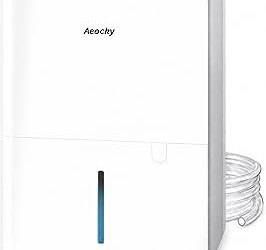
4500 Sq. Ft Quilt Compressor Dehumidifier for Basement
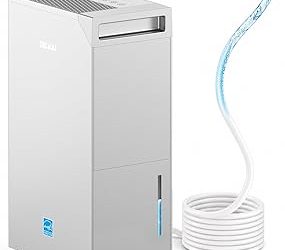
The widest coverage rating here, which makes it the logical anchor unit for an open basement feeding a two-story stack. Continuous drainage through the included hose is the way to run it, since the intelligent humidity control will otherwise cycle often enough to fill a tank faster than most households want to bother with.
34 Pint/D 2500 Sq. Ft. Dehumidifier with Drain Hose
At a rated 40dB it belongs on the second floor near bedrooms, where the low fan speed and 24-hour timer let you run it on a schedule instead of overnight. The 0.53-gallon tank is modest, so confirm you can position it for gravity drainage if you’re treating a persistently damp upstairs bath.
ozeeco 34 Pint/Day Dehumidifier with Ionizer
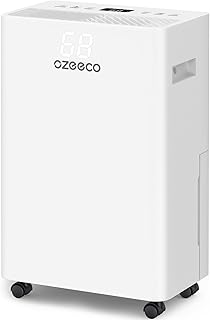
The child lock and ultra-quiet operation make this the most livable choice for a hallway landing or nursery-adjacent space. Its 0.45-gallon reservoir is the smallest in the group, which is fine as a hose-fed unit and tedious as a tank-fed one.
KNKA 2500 Ft² 34-Pint Dehumidifier
A straightforward three-mode machine with a laundry-drying setting that earns its keep in a basement utility corner. The cabinet feels appropriately rigid at the handle mount, a stress point where cheaper enclosures develop flex and eventually cracking.
Waykar 34 Pints 2000 Sq. Ft. Energy Star Dehumidifier
Automatic defrost is the durability feature that matters most in an unheated basement, where coil frosting otherwise forces the compressor to work against ice. The 0.66-gallon tank is the largest here and the 30–80% control range is genuinely usable, making this the safest long-term pick for cold-floor installations.
Frequently Asked Questions
Do I need two dehumidifiers in a two-story house?
Often no. One correctly sited unit on the lowest level handles most homes. Add a second only if upstairs readings stay above 55% RH after two weeks of basement operation, which typically points to a separate source like an unvented bathroom.
Should I run it near the stairwell or in a closed room?
Near the stairwell, with interior doors open. Closed doors turn one dehumidifier into several isolated micro-climates and the machine will over-dry its own room while the rest of the floor stays damp.
Is basement floor placement bad for the compressor?
Cold concrete is fine as long as the unit has automatic defrost and sits level. Elevating it 4–6 inches on a shelf or platform improves intake air temperature and makes the tank far easier to reach.
How long should one of these last?
Five to eight years with a clean filter, unobstructed airflow, and continuous drainage. Manual tank cycling is what usually kills them early, because the repeated pull-and-replace motion loosens the float switch and seal.
Final Thoughts
Place your primary unit low and central, drain it with a hose, and the upstairs problem largely solves itself. The Waykar 34 Pint is the most durable basement choice thanks to automatic defrost and the largest tank, the 4500 Sq. Ft Quilt model suits sprawling lower levels that need real capacity, and the 40dB 34 Pint/D unit is the one to add upstairs if a bedroom hallway still reads damp.