Key takeaways
- Cylinder class over stated weight limit: A Class 4 cylinder is the practical floor for anyone over 250 lbs or anyone who adjusts height daily. Listings that advertise a high capacity without naming the cylinder class often pair a strong base with an under-specified lift, which is where slow sinking begins.
- Seat width and depth, measured against your body: Add roughly two inches to your seated hip breadth for usable width, and leave two to three fingers between the seat edge and the back of your knee. A seat that is too deep forces a forward slide that undoes any lumbar support the chair provides.
- Lumbar that moves up and down, not just in and out: Depth-only lumbar assumes your L3–L5 curve sits where the designer put it. Height-adjustable support is the single most useful feature for lower-back relief, and pocket-spring or high-resilience foam seats hold that alignment longer than standard polyurethane.
- Base material and caster stems: Nylon bases are acceptable at moderate loads; steel or reinforced metal is worth the trade-off in weight for heavier users. Rubber or PU casters roll quieter on hard floors and shed far less over time than bare hard plastic.
- Recline mechanism honesty: Multi-position tilt lock with adjustable tension beats a single-lever recline that either holds you upright or dumps you backward. Look for at least three lock positions and tension calibrated to your body weight.
Most sub-$500 task chairs fail in the same three places, and none of them are the parts you notice in a showroom: the gas cylinder, the seat foam, and the weld seams where the base meets the mechanism. A chair can feel excellent for six weeks and then develop a slow sink, a flattened seat pan, or a wobble that no amount of tightening resolves. That gap between first impression and month-eighteen performance is the real problem buyers face, because the specs that predict durability are rarely the ones printed in bold on the listing.
This guide evaluates chairs under $500 the way a fit-and-durability assessment would: cylinder class and stroke length, seat width relative to hip breadth, foam density and recovery, lumbar adjustability in two planes rather than one, and how load capacity claims translate into frame construction. Every chair below is judged on whether it can hold a neutral posture through an eight-hour day and still do it two years from now.
Our top picks




As an Amazon Associate we earn from qualifying purchases at no extra cost to you. Ratings are shown as listed on Amazon.
🛒 Best Price Today on Amazon
Prime members get fast, free shipping on everything above, plus member-only deals. New members get a 30-day free trial — cancel anytime.
How to Choose an Office Chair Under $500 (2026)
- Cylinder class over stated weight limit: A Class 4 cylinder is the practical floor for anyone over 250 lbs or anyone who adjusts height daily. Listings that advertise a high capacity without naming the cylinder class often pair a strong base with an under-specified lift, which is where slow sinking begins.
- Seat width and depth, measured against your body: Add roughly two inches to your seated hip breadth for usable width, and leave two to three fingers between the seat edge and the back of your knee. A seat that is too deep forces a forward slide that undoes any lumbar support the chair provides.
- Lumbar that moves up and down, not just in and out: Depth-only lumbar assumes your L3–L5 curve sits where the designer put it. Height-adjustable support is the single most useful feature for lower-back relief, and pocket-spring or high-resilience foam seats hold that alignment longer than standard polyurethane.
- Base material and caster stems: Nylon bases are acceptable at moderate loads; steel or reinforced metal is worth the trade-off in weight for heavier users. Rubber or PU casters roll quieter on hard floors and shed far less over time than bare hard plastic.
- Recline mechanism honesty: Multi-position tilt lock with adjustable tension beats a single-lever recline that either holds you upright or dumps you backward. Look for at least three lock positions and tension calibrated to your body weight.
The Best Office Chairs Under $500 (2026), Reviewed
500 lbs Big and Tall Executive Chair with Adjustable Lumbar Support
The pocket-spring cushion is the standout here, distributing load across independent coils rather than compressing as a single foam block, which is exactly what prevents the flat spot that ruins most heavy-duty seats. Combined with a reinforced base and quiet rubber wheels, it holds up as a genuine all-day chair for larger frames.
Ergonomic Office Chair for Long Hours with Padded Lumbar Support
A well-judged choice for anyone whose primary complaint is lower-back ache rather than sizing, with padded adjustable lumbar that can be positioned to your actual lordotic curve. The 330 lb capacity keeps the frame modest, so it suits average builds and smaller work areas better than heavy-duty alternatives.
YFO Brown Leather Executive Task Chair
This is the option for a home office that doubles as a visible room, pairing a traditional leather-look shell with rubber casters that spare hardwood and laminate floors. Expect executive-style comfort and straightforward height and swivel adjustment rather than a deep ergonomic feature set.
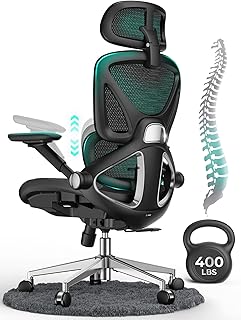
Ergonomic Mesh Chair with 4D Arms and 3D Headrest
The most adjustable chair in this group: 4D flip-up armrests let you set elbow height and width independently, and the three-level tilt plus adjustable headrest supports both upright typing and short recovery reclines. Breathable mesh over a 400 lb frame makes it the strongest pick for warm rooms and long sessions.
500 lbs Extra-Wide Executive Chair with Heavy Duty Base
Extra seat width and thick armrest padding address the two pressure points big-and-tall users report most, while the upgraded wheels and heavy-duty base handle real load rather than nominal load. A sensible alternative if you want the wider seat pan without the pocket-spring premium.
Frequently Asked Questions
How long should a chair in this price range last?
Three to five years of daily use is a fair expectation with a Class 4 cylinder and dense foam. Chairs with lighter cylinders and standard foam typically show sinking or seat collapse somewhere between eighteen months and three years.
Is mesh or padded upholstery better for all-day sitting?
Mesh wins on heat and moisture management and resists permanent compression; padded seats offer more immediate cushioning and better cold-room comfort. For eight-hour days in a warm space, mesh generally holds posture more consistently.
Do heat and massage functions actually help?
They provide short-term relief by increasing circulation and reducing muscle tension, which is useful during long sessions, but they are not a substitute for correct lumbar height and seat depth. Treat them as a supplement to good fit, not a fix for poor fit.
Does a 500 lb rating matter if I weigh far less?
Often yes, indirectly. Higher-capacity chairs typically ship with thicker gauge steel, wider seat pans, and stronger cylinders, so a lighter user gets a substantial durability margin along with the extra room.
Final Thoughts
For most buyers, the Ergonomic Mesh Chair with 4D arms offers the best adjustability-per-dollar and the most forgiving fit across body types. Larger users should go straight to the 500 lbs Big and Tall Executive Chair for its pocket-spring seat and reinforced frame, while anyone focused purely on lower-back relief in a compact space will get more than they paid for from the Ergonomic Office Chair for Long Hours.