Key takeaways
- Joint tension and detent feel: Reach up and rotate a head before you commit to a layout. Good swivels offer firm, consistent resistance through the full arc and hold position one-handed. Loose joints that spin freely will drift within months, and tightening them usually means removing the head entirely.
- Aiming reach and head profile: On a standard eight-foot ceiling, you should be able to adjust a head from flat feet without a stepladder. Compact barrel housings with a grippable knurled body are far easier on wrists than smooth cylinders that require a pinch grip at full extension.
- Replaceable bulbs versus integrated LEDs: E26 and GU10 sockets let you swap a failed lamp in thirty seconds and change color temperature later. Integrated arrays often deliver better optics and dimming, but a single driver failure retires the whole head.
- Thermal path and housing material: Look for aluminum housings that double as heat sinks. LED lifespan is governed by junction temperature, so a plastic shroud trapping heat above a cooktop will fade output long before the rated hour count.
- Track type and rail length: H-type track is the most common and easiest to expand. Measure your run against counter depth, and plan roughly one head per 24 to 30 inches of work surface so beams overlap instead of leaving scallops of shadow.
What's inside
Most kitchen lighting complaints are not about brightness. They are about placement. A single ceiling fixture throws light at the back of your head, which means your own shoulders cast a shadow across the exact eight inches of countertop where the knife work happens. Track lighting solves that geometry problem, but only if the heads actually stay where you aim them. The failure mode nobody mentions in product photos is the slow droop: a ball joint that loses friction after a season of thermal cycling, until every head is pointing politely at the floor.
This guide evaluates kitchen track systems the way a fixture engineer would, prioritizing joint tension, heat management, and serviceability over styling alone. Below you will find the current standouts, followed by a buying framework focused on aiming ergonomics and long-term mechanical durability, plus reviews of the five systems worth your attention in 2026.
As an Amazon Associate we earn from qualifying purchases.



🛒 Best Price Today on Amazon
Prime members get fast, free shipping on everything above, plus member-only deals. New members get a 30-day free trial — cancel anytime.
How to Choose Kitchen Track Lighting (2026)
- Joint tension and detent feel: Reach up and rotate a head before you commit to a layout. Good swivels offer firm, consistent resistance through the full arc and hold position one-handed. Loose joints that spin freely will drift within months, and tightening them usually means removing the head entirely.
- Aiming reach and head profile: On a standard eight-foot ceiling, you should be able to adjust a head from flat feet without a stepladder. Compact barrel housings with a grippable knurled body are far easier on wrists than smooth cylinders that require a pinch grip at full extension.
- Replaceable bulbs versus integrated LEDs: E26 and GU10 sockets let you swap a failed lamp in thirty seconds and change color temperature later. Integrated arrays often deliver better optics and dimming, but a single driver failure retires the whole head.
- Thermal path and housing material: Look for aluminum housings that double as heat sinks. LED lifespan is governed by junction temperature, so a plastic shroud trapping heat above a cooktop will fade output long before the rated hour count.
- Track type and rail length: H-type track is the most common and easiest to expand. Measure your run against counter depth, and plan roughly one head per 24 to 30 inches of work surface so beams overlap instead of leaving scallops of shadow.
The Best Kitchen Track Lighting Reviewed
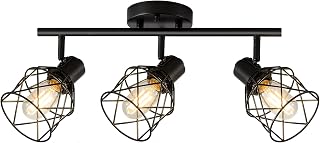
3-Light Farmhouse Kitchen Track Lighting with E26 Heads
The E26 base is the real story here, since it accepts standard bulbs and lets you dial brightness and warmth without replacing hardware. Three heads suit a modest island or a galley run, and the exposed-socket farmhouse styling stays visually light on lower ceilings.
VANoopee 12-Light LED Kit with 13FT Rails
This is the option for long, open-plan kitchens where a single short bar leaves the perimeter dim. Twelve dimmable 10W heads at CRI90+ render produce and painted cabinetry honestly, and the five selectable color temperatures let you commission the room once and stop second-guessing.
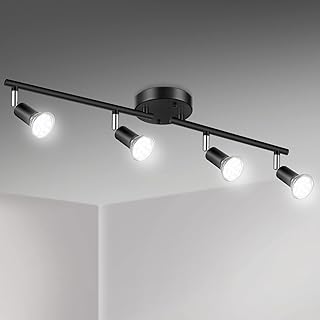
4-Light 24.8″ Black Track Kit with GU10 Bulbs
A tidy, low-commitment kit that arrives complete with four 5000K GU10 lamps, making it a sensible retrofit for a sink wall or coffee station. The GU10 format is the most repairable socket in the category, which matters more than peak lumens over a ten-year ownership window.
KEESFU 6-Light Modern Track Lighting
Six rotatable heads on a single bar give you enough coverage for a full counter run plus a bit of accent aim toward open shelving. The industrial black finish hides fingerprints and cooking film better than brushed metals, which is an underrated durability trait in a kitchen.
AUQUEE 8-Light Matte Black Track Lighting
Eight heads offer genuinely granular control, letting you concentrate three over the prep zone and spread the rest down a hallway or entry. Bulbs are not included, so budget for GU10 lamps and choose a single batch to keep color temperature consistent across the run.
Frequently Asked Questions
How many heads do I actually need?
Plan one head per 24 to 30 inches of countertop you want lit for task work, then add one or two for accent aiming. Four to six heads covers most single-wall kitchens; open-plan layouts benefit from longer rails and eight or more.
Can I install this on my existing ceiling box?
Most kits mount to a standard junction box with an included floating canopy, so a like-for-like swap is usually straightforward. If you are adding a new circuit, extending a run, or working with aluminum wiring, hire a licensed electrician.
What color temperature works best in a kitchen?
3000K to 4000K is the practical sweet spot: warm enough to flatter wood and stone, neutral enough to judge food color accurately. Reserve 5000K for utility spaces unless you genuinely prefer a cool, daylight-toned room.
Will the heads stay aimed over time?
Quality swivels hold for years, but heat accelerates joint wear. Avoid pointing heads directly upward where hot air pools, leave a few inches of clearance from cabinet faces, and re-seat any head that begins to feel loose rather than forcing it.
Final Thoughts
For a large or open kitchen, the VANoopee 12-Light kit with 13FT rails gives you the coverage and color accuracy to light the whole zone properly. The AUQUEE 8-Light is the better value if you already own GU10 lamps and want fine-grained aiming, while the 3-Light E26 farmhouse fixture remains the easiest long-term fixture to service in a smaller space.