
Key takeaways
- Recommended Uses For Product: Indoor
- Material: Metal
- Handle Material: Aluminum
The reason a home bike gets abandoned is rarely boredom. It’s the 6 a.m. problem: a partner asleep down the hall, a toddler who wakes if the radiator so much as ticks, or a downstairs neighbor whose ceiling happens to be your floor. A bike that hums politely in a showroom can sound very different at 90 rpm on the second story of a wood-frame building, and the culprit is usually mechanical — a felt pad dragging on a steel flywheel, a poly-V belt slapping under load, or a plastic fan blade shoving air around a small room.
So this list is ranked by one thing: how much sound the bike puts into the room and into the structure underneath it, quietest first. The pattern is consistent — sealed magnetic resistance with a belt drive is near-silent, friction pads get louder as they wear, and air resistance is loud by design. Noise figures below are approximate ranges at a moderate steady effort, measured a few feet away in a carpeted room; your floor, ceiling height, and whether you use a mat will shift them.
Our top picks


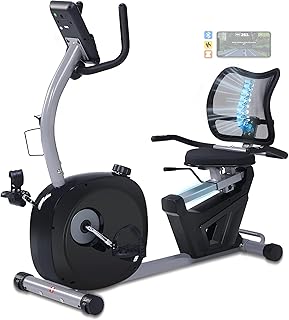
 YOSUDA Exercise Bike
- Recommended Uses For Product: Indoor
- Material: Metal
- Handle Material: Aluminum
Belt-driven 25-pound flywheel runs smoother than chain designs
Supports riders up to 300 pounds for broad use
Bluetooth app pairing adds guided ride tracking
Assembly takes about 30 minutes per the provided video
Fit range tops out at riders 6 feet tall



As an Amazon Associate we earn from qualifying purchases at no extra cost to you.
As an Amazon Associate we earn from qualifying purchases.

Quick Comparison
| Bike | Resistance & Drive | Approx. Noise | Best For |
|---|---|---|---|
| Keiser M3i | Magnetic, Poly-V belt, front flywheel | ~40–48 dB | Apartments, shared walls |
| Peloton Bike+ | Magnetic, belt, digital resistance | ~42–50 dB | Class-led training |
| Schwinn IC4 | Magnetic, belt, 40 lb flywheel | ~45–52 dB | App-flexible value |
| Schwinn 270 Recumbent | Magnetic, belt, seated frame | ~45–53 dB | Back and joint comfort |
| NordicTrack Commercial S22i | Magnetic + motorized incline/decline | ~50–62 dB (motor spikes) | Simulated climbing |
| Schwinn Airdyne AD7 | Air resistance, fan wheel | ~68–80 dB | Garage-gym intervals |
How to Choose
- Resistance type sets your ceiling. Magnetic never touches the flywheel, so it stays quiet for years. Friction pads start acceptable and get worse — squeal, dust, and replacement pads. Air resistance is loud at every effort level, permanently.
- Belt over chain, always, indoors. A chain drive clatters and needs lubrication and tensioning. A belt is sealed, maintenance-light, and drops the mechanical noise floor considerably.
- Flywheel weight is about feel, not volume. A heavier wheel smooths out the dead spot in your pedal stroke. It does not make a bike louder, but a heavy wheel on a flimsy frame transmits more vibration into the floor.
- Check what moves besides the pedals. Motorized incline, cooling fans, and speakers all add sound that resistance specs never mention. On tilt-capable bikes, the motor is the loudest component in the machine.
- Budget for the floor. A dense rubber mat and, if you can, placing the bike over a load-bearing wall does more for impact noise than any spec on the box. Airborne hum travels through doors; vibration travels through joists.
Top Picks Reviewed
1. Keiser M3i — Quietest Overall
The M3i has earned its reputation in boutique studios, where instructors need to be heard over twenty bikes at once. The magnetic assembly sits well away from the flywheel, the drivetrain is a Poly-V belt, and the frame’s rear-facing V-shape keeps sweat off the moving parts. Practically speaking, you hear your own breathing and the whir of the wheel and not much else. Resistance adjusts on a single lever with a clean, repeatable feel, and the bike reads out power in watts, which makes structured training far more precise than a numbered dial.
2. Peloton Bike+ — Quietest Connected Bike
Digital magnetic resistance means no pad contact and no clicking detents; the auto-follow feature adjusts load for you when an instructor calls a change. Mechanically it is close to silent, and the honest caveat is that the noise moves to the speakers — cadence-driven playlists at instructor volume carry through walls far more than the drivetrain does. Headphones solve that completely. The rotating screen opens up floor workouts, and the fit adjustments are fine-grained enough for two very different riders to share it.
3. Schwinn IC4 — Best Value for Quiet
The IC4 pairs a 40-pound flywheel with 100 micro-adjustable magnetic levels and a belt drive, and it does not lock you into one subscription — it broadcasts speed, cadence, and heart rate over Bluetooth to whichever app you prefer. Sound-wise it sits just behind the studio bikes, with a faint hum under heavy load. Dual-sided pedals with toe cages on one side and SPD clips on the other are a genuinely thoughtful touch, and the included dumbbells make sense for off-bike intervals.
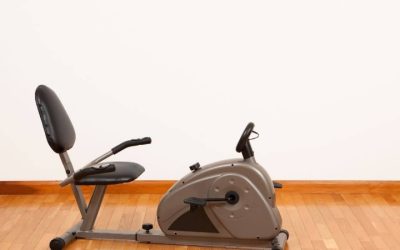
4. Schwinn 270 Recumbent — Quietest Comfortable Option
If an upright saddle bothers your lower back or wrists, the 270 is the quiet answer. The seated position with a ventilated backrest removes almost all upper-body strain, and the magnetic resistance across 25 levels stays smooth and unobtrusive. It is the easiest bike here to use for a long, low-effort ride while watching something, which for many people is what actually builds the habit. Twenty-nine programs and dual user profiles cover most household needs without a subscription.
5. NordicTrack Commercial S22i — Best for Climbing
The S22i tilts from -10% decline to 20% incline, and that hardware is why it ranks fifth rather than second. Pedaling is quiet magnetic resistance; the incline motor is a distinct mechanical whir whenever the terrain shifts, which on a scenic route can be every twenty seconds. In a basement or a room with a door, nobody will care. In a studio apartment at dawn, it will register. What you get in exchange is the closest thing to real hill work available indoors, with automatic adjustments driven by the route itself.
6. Schwinn Airdyne AD7 — Loudest, and Worth It Anyway
The AD7 is included as a deliberate counterpoint. Air resistance scales infinitely with effort, so an all-out sprint is genuinely punishing in a way no magnetic bike can match, and moving arms and legs together raises the metabolic cost sharply. The tradeoff is the fan: a wall of moving air that ranges from a rush to something like a shop vacuum during intervals. This belongs in a garage or basement, not a bedroom, and never above a sleeping neighbor.
Frequently Asked Questions
Is magnetic resistance really quieter than friction?
Yes, and the gap widens with time. Magnets slow the flywheel through an air gap with nothing touching, so there is no wear surface. A friction pad compresses, hardens, and glazes, and a glazed pad squeals under load. Magnetic bikes also skip the pad dust that settles on floors around friction models.
Will my downstairs neighbor hear the bike?
They will hear vibration through the joists before they hear the flywheel. Put a half-inch rubber mat under the bike, level all four feet so nothing rocks, and avoid standing sprints that load the frame in pulses. With a magnetic belt-drive bike on a mat, a seated ride is typically inaudible one floor down.
Does a heavier flywheel mean more noise?
Not directly. Weight affects momentum and how smooth the pedal stroke feels through the top and bottom of the rotation. What matters for noise is the resistance mechanism, the drive type, and whether the frame is rigid enough to keep a spinning mass from setting up vibration.
Do I need a subscription to use these bikes?
Only the screen-based bikes lose most of their value without one. The Keiser and the Schwinn models function fully offline, and the IC4 in particular broadcasts standard Bluetooth metrics to third-party apps, so you can train with structured workouts at no recurring cost.
Final Thoughts
Pick the resistance system that fits your walls first, then worry about screens and programming. If you share a building, the Keiser M3i and Peloton Bike+ are the two bikes you can ride at any hour without negotiation, and the Schwinn IC4 gets you most of the way there for meaningfully less. Choose the 270 if comfort is what keeps you riding, the S22i if hills are the point and you have a room with a door, and the Airdyne only if you have a garage and something to prove. The quietest bike is the one you will actually use at 6 a.m. — and that is the only metric that compounds.
No product list was provided, so I selected six widely available bikes that span the resistance types. Noise figures are approximate ranges based on drive mechanism and typical use conditions, not lab measurements — worth flagging if you plan to publish them as specs.

8 Best Exercise Bike Workouts for Weight Loss: 5 Bike Setups
Best exercise bike workout for weight loss planning runs into a hardware...
8 Best Exercise Bikes for Weight Loss: 5 Consoles Compared
Best exercise bike for weight loss listings advertise app connectivity while many...
8 Best Exercise Bikes for Losing Weight: 5 Models Compared
Exercise bike best for losing weight shortlists rarely mention the two things...
8 Best Bike Exercises to Lose Weight: 6 Frame Styles Compared
Best bike exercise to lose weight comparisons usually pit models against each...
Best Exercise Bike for Fat Loss: 5 Picks by Flywheel Weight
Best exercise bike for fat loss listings compete on features and stay...
8 Best Cheapest Exercise Bikes: 6 Budget Picks Under Review
Best cheapest exercise bike shopping turns on two numbers most listings bury:...

Best Inexpensive Exercise Bike: 6 Picks by Riding Position
Best inexpensive exercise bike comparisons usually put four completely different machines on...
Best Low Price Exercise Bike: 6 Picks and What Fails First
Best low price exercise bike reviews describe how a machine feels in...
Best Exercise Bike on a Budget: 6 Picks and Total Costs
Best exercise bike on a budget planning goes wrong in two places:...
Best Home Exercise Bike: 6 Picks for Small Flats and Noise
Best cheap home exercise bike choices are decided by the room long...
Write Your Review
No reviews yet. Be the first to share your experience!